
Pillars mark the entrance to Portland City Hall, reflected in the door, in Portland, Ore., on July 9, 2026.
Eli Imadali / OPB
Portland city government has spent the past year and a half changing the way it does just about everything.
Twelve new city councilors. New geographic districts. New rules about who gets to make decisions.
For Portlanders watching from the outside, the transformation has largely been a story about the politicians at the core of it.
But inside City Hall, there’s another group of people that has had to figure out how to keep the engine of government running amid all this change.
These are people who do the less flashy, behind-the-scenes work: The clerks tracking councilors’ votes, the technology staff keeping the Wi-Fi from faltering, the security staff waving people in the front door, the staffers scrambling to research new policy proposals.
They don’t have a vote on the City Council, but they are expected to keep the new government running smoothly from the sidelines.
The meetings got longer
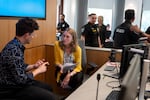
Portland City Council Clerk Keelan Whetstone, center, talks with Eben Joondeph Hoffer, left, as security staff and attendees begin entering before the City Council meeting at Portland City Hall in Portland, Ore., on July 8, 2026.
Eli Imadali / OPB
If Portland City Council is a bustling airport, Council Clerk Keelan Whetstone is its air traffic controller.
On meeting days, Whetstone arrives hours before councilors, printing out documents, checking the Zoom connection and making sure microphones are ready to go.
Then the planes start landing. A member of the public wants to speak far past their allotted three minutes. A councilor wants to introduce an unexpected amendment. A vote needs to be taken, and then taken again. And maybe taken a third time. The city attorney’s office needs to intervene. The agenda is cut short. The meeting runs hours over schedule.
Whetstone tracks it all from her seat on the far right side of the dais, gently steering the meeting from one item to the next.
Whetstone said she used to be able to multitask during long meetings, using slow moments to respond to emails. Now, she must stay focused on the meeting due to the sheer number of councilors and unique complexity of workflow.
“In the past it was pretty linear. It would start here and it would end up here,” said Whetstone, pointing left to right.
“Now, with this new form of government, it’s blown up. Things are going like this, they’re going like this,” said Whetstone, gesturing wildly in different directions. “And then they go in reverse, and then they come back.”

Whetstone reacts as she receives a notice that the Zoom application on her computer must update before the City Council meeting at Portland City Hall in Portland, Ore., on July 8, 2026.
Eli Imadali / OPB
That’s due to the varied ways council items are now introduced. Some come through committees, others land before the full council without committee vetting, some are introduced by the mayor or city administrator and many other ideas are tacked on as amendments on the fly.
Whetstone says a healthy pile of dark chocolate and a sense of humor help her stay on track. If — or, more often, when — the meeting goes off the rails, Whetstone is usually the first to laugh it off, softening any tension between councilors and tired city staff.
She’s used to things not going as planned.
Whetstone entered the clerk’s role at the start of the COVID pandemic, when all city meetings abruptly went virtual. Two years later, Portlanders voted to expand the size of City Council, and councilors met in a different city building while City Hall underwent renovations. And then, a year later, a brand-new slate of councilors held their first meeting in the brand-new City Council chambers, where they were establishing brand-new governing rules and expecting Whetstone to keep them on track. But the job was nearly unrecognizable.
“Every single one of our processes that we have used to support council has been changed in some way,” said Whetstone.
Perhaps most obvious is the number — and length — of meetings. In the past, Whetstone and her six-person staff ran about five meetings a month. Suddenly, they were handling roughly 18. Most of these meetings were the eight newly established committees, where a smaller number of councilors met to discuss specific policy topics, which often ran long. Whetstone’s team was stretched thin.



All images: Eli Imadali / OPB.
Earlier this year, Council President Jamie Dunphy slimmed the number of committees from eight to five, but tacked an extra hour onto each meeting. Whetstone added one staffer to her team, but the work hasn’t gotten simpler — or more straightforward.
She’s watched the changing landscape in City Hall burn out her colleagues. Still, the chaos hasn’t made her cynical.
“Because I’m a Portlander,” said Whetstone. “I feel very fortunate that I get to have this kind of front row seat to the decisions being made that are impacting this city.”
The hallways got quieter
The biggest change for council policy analyst Claire Adamsick isn’t the new council’s size, it’s the silence.
“It feels quieter,” said Adamsick, who helps research policy ideas proposed by the 12 councilors and present findings — ranging from potential associated costs or legal roadblocks — to the elected masses.
Adamsick previously spent six years as a policy advisor for former City Commissioner Amanda Fritz. In that role, she could walk down the hall, bump into another councilor’s staffer and hash out a policy idea. She could pick up the phone and ask a bureau employee a question. Those casual exchanges were often where policy took shape.
“I’m not seeing that in the same way,” Adamsick said.
There are two possible reasons for this shift in more spontaneous conversations around City Hall, she suspects.
The first is a perceived barrier between the city’s legislative and executive branches. Adamsick said she’s now discouraged from reaching out directly to bureau staff for a quick answer. Instead, the request has to go through the city administrator’s office, who will then sift through layers of bureaucracy to eventually get an answer.
“The push-pull that we feel between the city administrative side and the council legislative side, it feels very delicate,” Adamsick said.

Attendees speak during a city council meeting at Portland City Hall in Portland, Ore., on July 8, 2026.
Eli Imadali / OPB
The second is a 2024 change in state ethics rules, which bars a quorum of a governing body from talking about public business behind closed doors, or through emails or text messages. For city councilors, a quorum can be as small as three people, due to their committee sizes. Councilors’ staff are also subject to this rule.
Councilors and staff say this has had a chilling effect on even small talk among council offices.
Instead of workshopping messy ideas behind the scenes, councilors and their staff feel they can only discuss policies with each other at public meetings. Something is lost in that shift, Adamsick said.
“When the conversations are happening more often in more formal spaces, that also limits the rapport and the relationship building and the trust building,” she said. “That’s challenging for a new council.”
Democracy got a tech upgrade
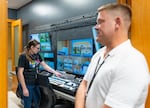
Davina Krug, left, and James Apple, city technology supervisor, show the technology control room in City Hall, Aug. 18, 2026.
Saj Sundaram / OPB
Behind a small closet door on City Hall’s third floor, Portland’s new government has entered a new era of technology.
The new technology control room has walls of video screens, rows of glowing buttons and a server that hums quietly in an adjacent room.
“It’s not a small change for us,” said city technology supervisor James Apple.
Prior to 2024, City Council’s audio and video needs were handled by Open Signal, a nonprofit contracted to stream city meetings online and on local TV. But that changed with the city’s new focus on hybrid meetings, allowing both councilors and members of the public to chime in to city meetings virtually. The city still partners with Open Signal to help with video streaming and captioning.
But making meetings more accessible has also made them more labor-intensive for Apple’s team. At each hourslong council meeting, one of his employees sits at a computer in the back of council chambers, making sure the technology is running smoothly.
If the Wi-Fi drops, a slideshow fails to load or someone’s Zoom mic is muted, “it’s all eyes on them,” Apple said.
“The meeting stops and it’s up to us to triage,” said Apple, who claims his team hasn’t had any major malfunctions since taking over City Hall’s tech needs. “We take pride in not having any interruptions.”
For Apple, the government overhaul offered a rare opportunity to update City Hall’s audio and video needs. The building is on the National Register of Historic Places, making it extremely difficult to get permission to carve into the building’s walls and update wiring.
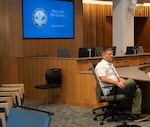
Apple explains the technology changes to support the city council, including stronger wifi signal and better angled cameras to capture meetings via Zoom.
Saj Sundaram / OPB
“So this was a perfect time to forego all of that because it was already approved in the remodel,” Apple said.
He has unique knowledge of the building’s inner workings. Apple’s first job at the city was equipping the building with internet cables in 1996.
“With the remodel, the contracts they didn’t know how to get through the interior walls, or what they’d find,” Apple said. “I knew what it looked like inside there, so I was able to relay that information.”
The council chamber now has a much stronger Wi-Fi signal and better angled cameras to capture meetings via Zoom, among other things.
“We try to keep up,” Apple said.
And security risks grew
City Security Manager Manny Guerra spends a surprising amount of time reading City Council agendas.
Not because he’s particularly transfixed by foie gras bans and urban renewal policy. He’s looking for drama: A contentious police policy, a controversial budget vote, a decision on homelessness. Anything that might draw heightened emotions — or protests.
“Let’s keep a closer eye on this and who may be coming in and, you know, voicing their opinions,” he said, referring to when he sees a more divisive agenda item. “We have to be ready for anything.”
He pointed to a recent example: Earlier this year, a group protesting the city-permitted U.S. Immigration and Customs Enforcement building was met by counterprotesters outside City Hall.
“All of a sudden, you see the tension start rising, people start sparring,” said Guerra, who oversees 115 contracted security guards across the city. “But you’re still trying to ensure that the members of the public are coming in safely. It’s really a tough balance.”
Like Whetstone, Guerra is used to the unexpected at City Hall. He joined the department weeks before the pandemic shuttered most in-person city operations. Not long after, City Hall became one of several focal points for frequent racial justice protests, which required heightened building security.
Throughout, Guerra tracked an increasing number of threats of political violence against elected officials, like a barrage of daily death threats sent to then-Commissioner Jo Ann Hardesty and a fire set in a residential building where then-Mayor Ted Wheeler lived.
“It was outrageous, the things that were happening,” Guerra said.
Focusing on threats to the city’s five council members became a central part of his job. And, when the city underwent its government transition, that work nearly tripled in size.
“Now we have 12, and 12 folks who like to do things differently,” he said. “We can just provide recommendations, but that doesn’t mean that I have the final say.”
More politicians means more people for everyone behind the scenes like Guerra to keep an eye on. Councilors also don’t spend as much time in City Hall as their predecessors, as some have offices located in the district they represent.
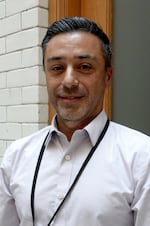
Portland Security Manager Manny Guerra stands for a portrait at Portland City Hall on August 18, 2026.
Alex Zielinski / OPB
While he’s focused on councilors’ safety, Guerra said he also gives equal consideration to the public’s safety. City Hall’s remodel brought a new security screening process, replacing handheld metal detector wands with a walk-through weapons detection system. Not only does this tighten the building’s security standards, but it also creates a more efficient screening process for visitors.
Guerra’s team is responsible for escorting people out of council chambers when the council president deems someone too disruptive. It’s a step he doesn’t take lightly.
“Someone has a right to be upset, and you have to give them that space to be upset,” Guerra said. “So, it’s that fine balance all the time of like, what’s really dangerous and what’s someone just saying, ‘Hey, I’m not really happy with this decision that the city made, and I want to voice that to somebody.’ That’s okay.”
Guerra said the expanded council body and lengthy city meetings don’t make his job harder, just more complicated.
“It has increased the workload,” he said. “But some things stay the same, like political violence — that’s always going to be here. Sometimes I have to remind our current council that this is something that also should be in the back of your mind.”