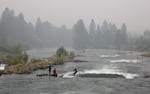
FILE - Surfers on a smoky day at the Bend Whitewater Park on Sept. 12, 2022 in Bend, Ore. A recent analysis from Oregon State University's Sustainable Tourism Lab looked at how prolonged wildfire smoke can impact tourism demand in Bend.
Joni Auden Land / OPB
How do climate-driven events like wildfires affect tourism in communities like Bend? That’s one of the questions the Oregon State University Sustainable Tourism Lab is trying to answer. A recent analysis examined how wildfire smoke impacted visitor demand. It found that while one or two smoky days may not affect travel plans, people are more likely to reschedule or cancel their trips during prolonged smoke events.
Todd Montgomery is a hospitality professor at OSU and director of the Sustainable Tourism Lab. Nate Wyeth is the chief of staff for Visit Bend. They both join us to talk more about how climate change is affecting communities that depend on tourism dollars.
Note: The following transcript was transcribed using AI and validated for accuracy, readability and formatting by an OPB volunteer.
Dave Miller: From the Gert Boyle Studio at OPB, this is Think Out Loud. I’m Dave Miller. How do climate-driven events like wildfires affect tourism in communities like Bend? That is one of the questions the Oregon State University Sustainable Tourism Lab has been trying to answer. A recent analysis found that while one or two smoky days may not affect travel plans, people are more likely to reschedule or cancel their trips during more prolonged smoke events, and this is having a measurable effect on city revenue. Todd Montgomery is a hospitality professor at OSU and the director of the Sustainable Tourism Lab. Nate Wyeth is the chief of staff for Visit Bend. They both join us now. Todd and Nate, welcome to the show.
Todd Montgomery: Thank you.
Nate Wyeth: Thank you.
Miller: Todd, I want to start with you. First of all, welcome back.
Montgomery: Thank you.
Miller: The broad category that we are talking about here has come to be known as “climate refuge travel.” What’s your definition of that?
Montgomery: Yeah, that’s a good question. So it’s just when travelers choose a destination more than just based on the attractions and the price of that destination, but also to avoid climate hazards such as extreme heat or wildfire smoke.
Miller: How did you settle on wildfire smoke as a way to measure these impacts in Bend?
Montgomery: Well, it’s become a part of daily life in a lot of mountain towns in the United States West. And, you know, historically, August has been that Christmas period for travel, a lot of make-or-break, but it just becomes such a prevalent part of conversation of living, of conversations in the industry. And then what makes wildfire smoke so interesting is that, unlike other climate events, there’s two very good data sets that help us measure that and actually assign an economic value that could potentially be transferable to other destinations as well.
Miller: Meaning this is a real issue and you have real data you can look at to study the issue, and so for a scientist or a researcher, it’s sort of irresistible.
Montgomery: Correct.
Miller: Nate, I wanna go back to something that Todd just mentioned, the importance of August for Bend. What does August mean, or maybe let me put it this way – what has it meant, traditionally, in Bend over the last few decades?
Nate Wyeth: It’s huge. You know, in the city of Bend, that lodging tax revenue where the majority of that goes to the city is really important for our city to be able to execute a lot of their long-term planning and a lot of their strategy. In the summer months, Bend tourism really increases significantly, and because of that the associated tax revenue that comes in becomes more and more important. And when we look back at our historic data and we see, looking at Todd’s data and overlaying that with what we’ve seen from smoke or other climate-driven events, it can have a significant impact.
One data point, if you look at this past August versus two years prior, we’ve seen tax collections increase about 22% year over year, and that’s only because we had blue skies, and we’re talking millions of dollars going back to our city’s general fund, which is really, really vital for our community to be able to have those services that every resident depends on.
Miller: And so you’re talking about August this year. So even though this has been a record breaking year for acreage, the winds and the place of the fires have meant that Bend hasn’t been hit especially hard?
Wyeth: Yeah, that’s exactly right. We’ve gotten incredibly lucky, and I think, while that’s great and while we got lucky last summer as well, what we know in this changing climate in this world that we’re in right now is we can’t depend on being lucky, so we have to really start thinking about how we operate and what the visitor economy means long term based on the changing climate.
Miller: Obviously we want to hear more about that, but Todd, just to dig into, as you said, this is a case where you actually have data that you can look at and map out. What did you learn about visitor behavior from the data that you have access to?
Montgomery: Yeah, sure. So intuitively, it makes sense, if you’re thinking about a destination that is smoky, you probably are gonna reconsider or maybe shorten your visit. But the data itself really provided an idea of that economic impact, because a lot of times people in these conversations and industry policy folks, it’s sort of, it’s bad, but we don’t really, I haven’t heard a lot about how bad it is, or what’s the economic impact?
And lodging revenue, because just like Nate said, it’s used for tax collection, is a great proxy for demand, and it really gives us an interesting idea or insight into what’s happening and then the prolonged, the sustained air quality and the impact that has on August and what that could mean. Just like Nate said, it could be much more than hundreds of thousands, millions of dollars, and that’s just directly to the lodging revenue. That doesn’t account for all the indirect costs of restaurants and recreation and the many other factors that tourism contributes.
Miller: Can you give us a sense for the timing? I mean, when do you find that people may choose a different destination or cancel an existing reservation?
Montgomery: Yeah, so first, as an industry, booking windows have become a lot shorter, particularly in August. Group business in mountain towns has shortened, so people are unwilling to book in advance, depending on cancellation policies. So that’s kind of that macro factor of repeated events of the last 10, 15 years of smoke events.
But the data showed that if it’s a smoky day, that relationship’s actually not very strong. But if it’s prolonged and sustained, as you start looking out from seven days of sustained bad air quality to 14 days, 21 days, 30 days, that relationship became much, much stronger, and once again, intuitive. It really helps us understand, big picture, what that impact can be on the economy, and then that leads to, I think where Nate’s talking a lot about is, how does that affect policy decision-making of destination management organizations across the Western United States and so forth?
Miller: Well, Nate, there are different ways to think about the timing here, and as Todd is saying, especially if you’re on your vacation already, and there’s one bad smoky day, it’s not likely that you’re gonna cancel your trip and go home. If it’s a week or a month right before your trip, that’s when maybe you’d make the change. But I’m curious in the bigger picture, if people are seeing that their favorite western destination is regularly smoky in August, do you think that’ll lead people just to say, you know what, I’m not gonna even think about it, there’s a chance I’ll be smoked out, and so I’m gonna either go there at a different time, or I’m not going to go there at all.
I mean, what are you seeing?
Wyeth: Yeah, that’s definitely happening the way that you just described it. I mean, folks have gotten really good at understanding what tools and resources are available for them to know what to expect on their vacation from a weather standpoint; and a lot of that comes down to checking all these smoke forecasts and these conditions, and we do see folks electing to cancel their vacation and go to the coast, as an example. And when those things happen, I think as an industry we have to start thinking about the impacts that visitation has on some of these smaller communities.
I don’t want to steal Todd’s thunder, but when he starts talking about the concept of climate refuge, this is what we’re seeing and what we’re talking about here. So we have to understand from a consumer standpoint where Bend can remain a viable destination and attractive to those visitors, and what work we need to do to invest in the future of our community from a livability standpoint so that folks can still see Bend as a place that they want to visit and live in. And that requires an update to the way that our organization and our industry really behaves.
Miller: You know, I have to say, we’re not just talking about more smoke and fire in the summer, we’re also likely talking about less snow in the winter and maybe more rain, maybe the precipitation will remain, but it just won’t be quite cold enough for it to be white. What does, Nate, that one-two punch mean from both seasons?
Wyeth: It’s scary. You know, we have just over a $400 million visitor economy in Bend, and so when, this past winter is a great example… Mount Bachelor, which historically has one of the longest ski seasons in the industry in North America, shuttered early, and that was a direct result of low snowpack. And because of that, things were more dried out going into a fire season and when we’re looking at what a super El Niño means for us this year, we’re already starting to think about, what does that mean if Bachelor does close again early? If we have a bad snow year, can we ensure that the economy remains strong enough in these slower periods so that businesses within our community can stay afloat? And that has all sorts of downstream impacts if this winter doesn’t produce the way that we hope it might.
Miller: Todd, you’ve said in the past that when it comes to vacations, people are naturally loss averse. What does that mean in this context?
Montgomery: Yeah, these repeated, smoky summers. When you’re making a calculation, you’re purchasing anything, what you’re factoring in is risk. Just normal, as the average human, we’re trying to avoid risk, even more so than we’re looking to satisfy and have a great vacation. So that natural inclination to prevent a bad situation, and then once again, I just go back to that repeated events of like the last 10, 15 years in August, that starts to have effect and not just change short-term behavior, but now that immediate long-term behavior and the way consumers purchase, in this case, purchase a vacation or leisure or travel.
Miller: Right. And as you mentioned earlier, one of the changes is that if people are going to be going to certain places, that they may make their decisions, if not at the last minute, then not as far in advance as in the past. You said the booking windows are getting shorter. What does that mean for a tourist-dependent economy if maybe people are coming, but there’s just less awareness of when they’re going to come?
Montgomery: Big picture, our industry is very dependent upon nature. Unlike a factory, which has a long supply chain, a long purchase plan, our industry, people can react quite quickly. And when we have these types of events re-occurring, just that risk of that booking window, that concern of whether that’s gonna continue or not, becomes really part of that behavior and thinking.
Group business is in the weeds, but that’s a big part of business, conventions, things like that, and it’s getting harder and harder to book those for places that have potential risk, either heat or smoke, and it’s not just in the U.S. and west coast or western United States, it’s also, we’re seeing a lot of this in Europe with Scandinavia and the Mediterranean area as we see a big push towards folks trying to escape the heat and move north.
Miller: Well, if tourist destinations that are prone to wildfire smoke here in the West might be the losers in terms of visitor dollars, who are the likely winners?
Montgomery: Well, Nate hit it right on the head, and that’s the next stage of this project is looking at that flow, but the coast, if we’re talking about Central Oregon, east of Central Oregon and on the coast certainly would be a winner. Now, how you define winner, you know, that means a lot. Like, if you already have a lot of people coming and you’re trying to cram more people on the coast, depending on who you talk to, that may not be considered a win. But locations in Southeast Alaska who we do a lot of work with are seeing their seasons expand. The cruise season used to be primarily summer. Now they’re getting a little bit more into the fall, a little bit earlier in the spring.
So there are absolute winners, but generally when it comes to the west, U.S. West, the Southwest, the water, the heat, we’re seeing a movement more towards the north. And it’s still pretty early, so we don’t exactly know who the winners are, but you’re already starting to see hints. And when it comes to wildfire smoke, obviously places located next to national forests and fire prone areas are going to be harder and harder to come by for tourists.
Miller: Nate, to what extent can places or times described historically as a shoulder season, before the, say, high summer, how much can that take up the slack that you might be losing from smoke fears?
Wyeth: I think there’s an opportunity for it to take up a significant amount of slack. In Bend, most of our summer visitors are families, and so we are dependent on things like the school calendar and sports schedules and things like that, especially as kids get back into school. But diversifying the audience that we speak to and that we market to is an opportunity that we have in order to offset those potential losses that we might see related to climate impacts in the summertime.
And above and beyond that, we invest a significant portion of the lodging tax revenue we receive back into grant programs, which our hope will drive that revenue to help enhance that quality of life for folks who live here. And when we do that, we know that visitors are going to want to come, too. So whether we’re investing in new theaters or public spaces or new hiking trails at Mount Bachelor, we’re trying to find ways that we can potentially expand the season that also have that meaningful impact here locally to folks as well.
Miller: Nate and Todd, thanks very much.
Wyeth: Thank you.
Miller: Nate Wyeth is chief of staff at Visit Bend. Todd Montgomery is a professor of hospitality management and the director of the Sustainable Tourism Lab at Oregon State University.
“Think Out Loud®” broadcasts live at noon every day and rebroadcasts at 8 p.m.
If you’d like to comment on any of the topics in this show or suggest a topic of your own, please get in touch with us on Facebook, send an email to thinkoutloud@opb.org, or you can leave a voicemail for us at 503-293-1983.