

Second year student Domenico Aditama coils ropes at one of Cascadia Tech Academy’s satellite locations in Vancouver, Wash., on Aug. 27, 2026. The Maritime Technology program is currently in its second year.
Saskia Hatvany / OPB
It’s the first week of school, and behind a small beige building at the Port of Vancouver, a group of high schoolers is about to be handed an oscillating saw.
“I’m a second year, so I’m just showing them how we use the tool,” says Elli Gorman, 18, a senior at Fort Vancouver High School.
It’s a helpful skill for a shipwright.
Gorman and about 30 other students from high schools across Clark County are here to learn the ropes of the maritime industry through Cascadia Tech Academy, part of Evergreen Public Schools.
This year-old program is gaining traction at a critical time for both the region’s students and the industry. Fewer than a third of last year’s college graduates secured full-time work related to their degrees, according to the research group Cengage.
Meanwhile, a 2026 Seafarer Workforce report from the Baltic and International Maritime Council and the International Chamber of Shipping predicts the global shipping industry will need an additional 113,735 officers by 2030 to operate the world merchant fleet. Many other maritime jobs are also in high demand.
A lot of these jobs are close to home. With 75 port districts, including three in Clark County, Washington state has the largest locally-controlled public port system in the country.
Cascadia hopes its maritime program can give high schoolers a clear path from graduation to well-paying trade jobs in commercial shipping, port logistics, offshore energy — most anything involving the ocean.
A workforce in demand



All images: Saskia Hatvany / OPB.
The maritime field is struggling to fill the growing gap in its workforce, according to Ann Avary, director of the Northwest Center of Excellence for Marine Manufacturing and Technology.
“If you make it, like, a scale of one to 10 — one meaning you feel no pain at all, and 10, it hurts like a big dog — I would say, for the state of the workforce, the industry is at an eight or nine,” she said.
A big reason for that is increased demand, Avary said. The 2026 Seafarer report noted that the expansion of the global merchant fleet and the recovery from the COVID-19 pandemic have driven the increase.
Even the federal government is taking note. In February, the White House released a Maritime Action Plan. It laid out a set of national policy initiatives aiming to rebuild the country’s ship-building capacity.
“The rebuild of the U.S. Navy, commercial shipping, commercial fishing, the recreational sector,” Avary said, “we know that those elements are growing and are going to expand.”
That means the trade needs to attract and train a new generation of skilled workers, which is exactly what Cascadia’s maritime program aims to do.
“They can go right from their high school program right into employment into the industry,” Avary said.

About 10 students from the program’s first graduating class have done just that, said Colton Edmiston, the instructor. Most of them are working for local launch services — companies that run supplies from shore to ships and tugboats.
“At the end of the school year, I had one student get hired by Shaver tug,” Edmiston said, referring to Portland-based tugboat company Shaver Transportation. “I mean, the student will be earning more than I do probably within a year.”
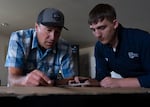
Maritime Technology instructor Colton Edmiston, left, helps first-year student Noah Williamson in Vancouver, Wash., on Aug. 27, 2026. The students are building to-scale models of an 800-foot tanker as part of the program.
Saskia Hatvany / OPB
In Washington, the annual mean wage in 2025 for sailors and welders was about $68,000, according to state employment data. For ship engineers, it was $113,450.
For program second-year Caleb Owens, 17, the money was a big draw. The high odds of securing a job right out of high school also made an impression.
“ That was a big lure for me because, I mean, this summer I applied for so many jobs, and I got one interview and that went nowhere,” he said. “ So, seeing firsthand, like, how hard it is to get a job right now, it’s definitely something that I keep in mind.”
Owens said he already has a job prospect lined up for when he turns 18 with a local boarding agent — someone who manages legal, logistical and administrative needs of vessels while they’re in port.
Edmiston hopes all of his seniors will be able to line up jobs before they graduate.
“There’s so many opportunities and you can try something out, learn so many skills,” Edmiston said. “Even if you don’t stick to, say, maritime, it applies to other areas easily. It’s unique.”
Students learn new skills, find passions
To model the industry’s formal chain of command and teach leadership skills, Edmiston chose a few students who went through the first year of the program to become his “mates,” or officers.
Henryk Kaiser, a senior from Battle Ground, is “first mate,” reporting directly to “Captain” Edmiston.
Kaiser learned about the maritime industry from his dad, who he says worked on a crab fishing vessel for years.

From left, Annabelle Corpuz and Henryk Kaiser paint a shed at the program.
Saskia Hatvany / OPB
“My dad’s always talked about the stories he’s had on sea, his camaraderie, some of the hazing that happened,” Kaiser said, “and I just figured, ‘Yeah, that life sounds good to me.’”
There’s one activity he loves more than almost anything else — welding.
“I fell in love with welding and soldering,” he said. “ I am so excited for when we get to start teaching the first years how to weld because I just loved it.”
After he graduates next year, Kaiser wants to be a nuclear physicist on submarines or aircraft carriers. For now, as he embarks on his final year of high school, he wants to help the next group of maritime students discover their passions.
“Whatever you’re passionate about, whether it be cooking, hauling, math, they need you out there,” he said. “So, yeah, if you have the opportunity, you should take it, because there’s plenty of jobs waiting for you.”

All images: Saskia Hatvany / OPB.