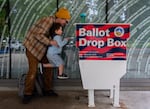
FILE - Matt lifts up his three-year-old son, Theo, to cast his ballot into the Hillsboro Public Library-Shute Park ballot drop box in May 2026. Election officials are increasingly recommending voters plan to use drop boxes rather than mailing their ballot.
Eli Imadali / OPB
Oregon election officials want voters to choose the drop box over the mailbox this Election Day.
And as a fight over the postal service’s role in the November election plays out in federal court, they’re asking state lawmakers for emergency funding to make sure Oregonians have plenty of places to deposit their ballots.
Secretary of State Tobias Read is requesting nearly $500,000 to purchase 20 new drop boxes for the Nov. 3 election, and to compensate elections officials for what he expects will be an increased use of ballot drop boxes this year.
“Due to uncertainty surrounding mail-in ballots and how they are processed by the U.S. Postal Service, [the Secretary of State’s Office] will be encouraging Oregonians to use ballot boxes to drop off their ballots instead of mailing them, especially closer to Election Day,” reads a funding request lawmakers will consider when they meet in Salem next week for periodic committee hearings.
The request is tied to years-old concerns that USPS changes have resulted in slower processing of mail – including ballots. That could mean a ballot mailed on or near Election Day doesn’t receive a postmark at the sole processing facility in Portland in time to be counted.
But the push for emergency funding also comes amid a fight over the very underpinnings of mail-in voting in Oregon and other states.
An executive order issued by President Donald Trump in March aims to give the postal service a stepped-up role in determining who is able to receive a ballot. A rule put forward by the USPS would require states to submit lists of voters who are eligible to vote by mail, which could then be compared to federal citizenship lists. States that decline to submit records may not receive ballots, the USPS has said.
The U.S. Supreme Court ruled last week that a lawsuit challenging the policy was filed prematurely, before the postal service had posted its final rule on the matter. States, including Oregon, immediately filed a new lawsuit, which resulted in a federal judge in Massachusetts blocking Trump’s order.
The Supreme Court could soon take up the matter once again, with fewer than two months to go before this year’s election.
Oregon officials have said repeatedly they are confident that the Nov. 3 election will play out as usual. But Read, a Democrat elected to office in 2024, now wants money to make sure things go smoothly.
The funding request includes $1,000 for each of the state’s more than 300 ballot drop boxes, which Read says will help local elections officials cover costs tied to higher drop box use.
The Secretary of State’s Office also says the state needs more drop boxes to ensure voters can turn in their ballots without relying on the postal service. The request includes $120,000 for 20 new 24-hour drop boxes that the office says will be installed “in areas of highest impact.” The office did not offer any sense of where those would be in a response to questions from OPB.
“These proposed investments from the Legislature will provide eligible Oregonians with more ways to return their ballots and make sure their votes get counted,” Read said in a statement to OPB.
The drop box funds are part of a larger request for emergency funding by Read that state legislators will consider next week.
As part of that $1.25 million request, the secretary’s office is asking for around $150,000 to allow voters in all 36 counties to receive updates about the status of their ballot. Five counties currently provide that service.
Read is also seeking nearly $500,000 to pay for notices that state elections officials are required to send to inactive voters, warning them they could be removed from voter rolls if they don’t respond or cast a ballot in two subsequent elections. The state ceased sending out those notices in 2017 despite being required to do so under federal law.
Oregon has instead kept inactive voters on its rolls, though they do not receive ballots. Read announced earlier this year the state would more proactively remove inactive voters – a step that helped him settle a years-long lawsuit from conservative groups.