
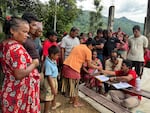
In this undated photo provided by Mercy Corps, aid workers in the Nuwakot district provide support to victims in the week following Nepal’s devastating flash floods.
Courtesy of Kreepa KC / Mercy Corps
Catastrophic flash flooding along the Tibet-Nepal border on Aug. 26 killed more than 1,300 people and thousands more are still missing, according to local authorities.
International aid groups are on the ground distributing food and shelter to people whose homes and entire communities were swept away or severely damaged.
“People who somehow saved their lives, they have nothing left,” said Suraj Sidel, Mercy Corps’ Nepal Country Director, who is based in Nepal’s capital Kathmandu. The Portland-based nonprofit is currently passing out basic necessities like hygiene kits, cookware and mosquito nets to over 700 affected families in Nepal’s Nuwakot district.

Sidel said the damage is bigger than the 2015 earthquake in Nepal that killed over 8,000 people. The death count from the flood is still rising as emergency rescue teams struggle to reach remote villages and people blocked by debris and water.

This photo provided by Mercy Corps shows a building submerged underwater on Sept. 2, 2026, in Bidur, Nepal, after a glacial collapse triggered flash floods on Aug. 26, 2026. The floods have wiped out entire villages and made it difficult for emergency response teams to perform rescue operations and recover dead people.
Courtesy of Kreepa KC / Mercy Corps
Right now, people are extremely traumatized, said Pratap Maharjan, Mercy Corps’ emergency response team leader on the ground in Nuwakot.
“The most heartbreaking thing [is] to see the pain in the eyes of people who have not slept for days with fear of another flood coming in,” he said.
A tight-knit Nepali community in Portland mobilizes to grieve and support one another
Seven thousand miles away at a Buddhist temple in Portland, a small but tight-knit community of Nepali Americans have been grappling with the loss.
As one of the only temples outside of Asia that practices the Newar Buddhism that originated in the Kathmandu Valley, the Nritya Mandala Mahavihara has been a special place of worship for Nepalis living abroad.
“This temple has been doing a lot of work to protect the Nepalese kind of Buddhism in America,” said Rabin Shakya, a Nepali journalist based in Portland. “All the life rituals are carried on at this temple.”
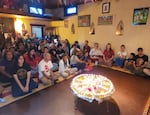
In this photo provided by Ganga Sharma, people gathered on Aug. 30, 2026, for a vigil at the Nirtya Mandala Mahavihara Buddhist temple in Portland, honoring flood victims in Nepal.
Courtesy of Ganga Sharma
Last Sunday, people gathered at the Nritya Mandala Mahavihara to grieve the loss of life in Nepal.
Ganga Sharma attended the somber, candlelit event with her sisters. As an executive member of the Nepali Association of Oregon, Sharma has been fundraising for disaster relief to help rebuild the flooded districts.
“This is massively huge, it’s global,” Sharma said of the flood’s impact. Because of the flood, the Nepali Association of Oregon and other organizations have canceled their annual Teej festivities that celebrate women and girls.
Right now, the focus is on recovery and survival. Several of Sharma’s friends have lost family members or know people who lost their homes. “It’s all washed out. They’ve got no place to go,” she said.
In 2015, Sharma and the Nepali Association of Oregon raised just over $60,000 to help rebuild Nepal in the aftermath of the 7.8 magnitude earthquake.
Related: Nepal warns of possible fresh flooding as communities grapple with devastation
This time they are collecting donations through Zelle and she hopes they can match their previous fundraising efforts through community support. The Nepali Association of Oregon will be hosting another vigil for flood victims on Sept. 20 at Pioneer Courthouse Square in downtown Portland.
“Every penny will be welcomed for donations towards the disaster relief fund,” said Sharma.
Even during this heavy moment for her community, Sharma doesn’t want this disaster to overshadow what her culture and country have to offer people.
“Please don’t be afraid to visit Nepal … It’s a beautiful country, Nepal, it survives on tourism,” she said. “The hospitality of Nepalese people is very kind and generous.”
Related: A melting glacier contributed to the deadly Nepal floods. We can expect more like this
Oregonians rally to support flood victims
Mingma Sherpa grew up in Nepal, spending summers as a mountain guide in his youth. He moved to Portland on the suggestion of his American clients who lived here. Now a chef, he sells Himalayan eats out of Sherpa Kitchen at the ZED in Southeast Portland.
Sherpa has collaborated with Zoiglhaus Brewing Company to make 80 gallons of their unique Himalayan pilsner. The pilsner will be sold at the Zoiglhaus brewery, and at the Norte Taproom in Wilsonville and the Hollywood Q in Northeast Portland throughout this weekend.
“We’ve been doing it as a seasonal beer for us, but since this tragic event has happened it just made sense to make it again to try to help people,” said Taylor Melvin, the operations manager for the brewery. Proceeds from the sales of the Himalayan pilsner will go towards Khangri Experience Foundation, a nonprofit based in Washington working to address the emergency needs of children who are flooding victims in Nepal.

Cook Marco Martinez prepares a dal bhat, a Nepali lentil curry, at Sherpa Kitchen in Portland, Ore., on Sept. 2, 2026. The restaurant is collaborating with a local brewery to raise disaster relief funds for victims of Nepal's massive floods.
Jireh Deng / OPB
Sherpa said he’s additionally donating 50% of his food sales this weekend to the Khangri Experience Foundation, which was founded by Sherpas living in the Pacific Northwest.
Support efforts are still gaining momentum, but Portland journalist Rabin Shakya said he’s already been overwhelmed by the kindness of his neighbors.
Steve March, a former Oregon state legislator, happens to buy a newspaper every day at the local 7-Eleven that Shakya and his wife work at. This past week he also dropped off a note with a check for the flood victims.
“It’s not money, it’s just his gesture that’s important,” Shakya said. “This is a time to be in solidarity, in unity with the flood affected people.”
Correction: An earlier version of this story misstated Mingma Sherpa’s name. OPB regrets the error.