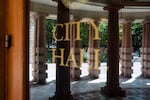
Pillars mark the entrance to Portland City Hall, reflected in the door, in Portland, Ore., on July 9, 2026.
Eli Imadali / OPB
Portlanders are feeling iffy about their new government.
In a survey released this week, only 22% of Portland voters polled believe the city’s government is effective, while nearly 40% do not.
“It feels like there’s no strategic plan in place,” wrote one of the 1,252 unnamed Portlanders surveyed by Oregon Values & Beliefs Center, a nonpartisan research group. “A lot of programs seem to be reactive rather than visionary in addressing what Portland residents want.”
The poll comes a year and a half after Portland overhauled its form of government. That voter-approved change tripled the size of city council and introduced geographic districts as a way for voters to feel better represented by their elected officials.
But that’s not being borne out, according to the data.
According to the 1,252 Portlanders polled, voters are feeling far less represented by their city councilors compared to last year. When asked if there is currently someone on council who represents them, 31% said yes – a nearly 10% drop from the same question OVBC posed to voters last year. And 36% of people said they didn’t feel represented by a Portland councilor – a nearly 10% increase from last year’s data. The total survey has a 2.7% margin of error.
Amaury Vogel is the executive director at Oregon Values & Beliefs Center. To Vogel, the data reflects a larger issue: Portlanders don’t understand what elected officials can accomplish under their new form of government. In the past, councilors oversaw city bureaus, giving them more influence over the city’s basic functions.
“Now, we have a council that is largely just legislative,” said Vogel.
She believes that has made it harder for politicians to follow through on their campaign promises, since they have less control over the city’s bureaucracy.
“Voters don’t feel like those things are coming to fruition because the reality is that council has limited power to actually implement some of those changes,” Vogel said. She said it’s on the city to better educate voters – and candidates – about what can be expected from elected officials under the new structure.
This flagging confidence in elected officials was reflected elsewhere in the survey. Asked to measure the trustworthiness of community leaders, those polled ranked small business leaders at the top of the list, with 73% of voters deeming them trustworthy. That was followed by 69% trust in voters’ neighbors.
In comparison, only 44% of those surveyed said they trusted Portland’s mayor, and 39% expressed trust in city council. They ranked Multnomah County board members even lower, with only 31% saying they trusted county commissioners.
The survey drops as Portlanders are ramping up for their second city election under the new form of government – and as voters prepare to elect a new county chair.
Vogel said candidates should be focused on ways to follow through on campaign promises to earn the public’s trust. But they should also trust that voters won’t give up on their community.
To Vogel, the survey demonstrated Portland’s deep love for the city. She pointed to voters’ high levels of satisfaction with natural areas, arts and culture, and neighborhoods. (Those surveyed said they were least satisfied with the cost of living and job opportunities).
In all, 63% of Portlanders said they were satisfied with Portland as a place to live – an ever-so-slight increase from last year’s rating.
“I just continue to be impressed with the way Portlanders just really hang in there for the city,” said Vogel. “Even when they’re dissatisfied with city services and accountability in government, overall, they say that they’re happy with Portland as a place to live. There’s sort of this underlying commitment to the city.”