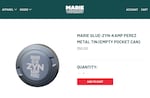
In this screenshot from the Marie for Congress campaign website, an empty metal tin with Zyn-inspired branding is listed for $50. The parent company of the nicotine pouch brand says the product violates the Zyn trademark.
Screenshot from campaign website
Southwest Washington Democrat Rep. Marie Gluesenkamp Perez briefly offered a punny piece of merch for sale on her campaign website: a metal tin for nicotine pouches called Zyns, emblazoned with “Marie Glue-ZYN-Kamp Perez” across the front.
The tins were only available for a day, after the Swedish company that owns Zyn asked the campaign to stop.
“While we appreciate enthusiasm for our brands from legal-age (21+) adults, the product violates our ZYN trademark and the campaign must cease and desist using it,” said a spokesperson for the U.S. branch of Philip Morris International, Zyn’s parent company, in a statement to OPB.
The response comes a day after Gluesenkamp Perez unveiled the metal tin alongside other products like coffee mugs, tote bags and T-shirts, with proceeds going toward her campaign, Marie for Congress.
A representative for the campaign did not respond to requests for comment Tuesday and Wednesday. The tin was removed from the campaign’s online shop Wednesday afternoon.
The expanded merch offerings could be one piece of Gluesenkamp Perez’s strategy to hold onto her Southwest Washington district seat. She’s in a tight race with Republican John Braun, the state Senate minority leader. Zyn nicotine pouches have become increasingly popular among young men, a demographic that swung rightward during the 2024 presidential election.
Zyn oral pouches contain nicotine powder and flavorings like mint, wintergreen, menthol and citrus. Nicotine pouch use among teenagers and young adults surged in recent years, according to a study from the Tobacco Epidemic Evaluation Network, nearly quadrupling between 2022 and 2025. Zyn is the most common brand, and 73% of young users are male, according to the study.
“Democrats have had a problem connecting with white men, particularly in rural areas,” said Dean Nielsen, a Democratic political consultant in Seattle with CN4 Partners, who is not involved in Gluesenkamp Perez’s campaign. “Who is the prime demographic for Zyn? White men in rural areas.”
Gluesenkamp Perez isn’t the only politician jumping on the Zyn trend. Members of the Trump administration, including Health and Human Services Secretary Robert F. Kennedy Jr., have also promoted nicotine pouches. Earlier this year, in a video showcasing the Zyn brand, Chairman of the Joint Chiefs of Staff Dan Caine joked that military service members consumed “a lot of nicotine” during the Iran War, according to CBS News.
When it comes to political merch strategy, Nielsen says Democrats have been playing catch-up to Republicans.
“It’s being creative with this type of product that helps get a [politician’s] brand out there,” Nielsen said. “I bet you by the end of the cycle you’ll see 10 other races doing the same thing.”
In June, the Food and Drug Administration relaxed marketing rules for 20 Zyn products, allowing the brand to claim that “using ZYN instead of cigarettes puts you at a lower risk of mouth cancer, heart disease, lung cancer, stroke, emphysema, and chronic bronchitis.”
Not everyone is thrilled that politicians are subtly promoting nicotine products.
Researchers still don’t know the long-term health effects of nicotine pouches like Zyn, and there are reasons to be concerned about the use of such a highly addictive substance, according to Renee Magnan, a Washington State University Vancouver health psychology professor who researches the effects of warning labels on nicotine and tobacco products.
She likens the current Zyn craze to the e-cigarette and vaping trend that took hold among young people about a decade ago.
“Part of the issue is that the tobacco companies were definitely marketing to youth. They’re relying on these appealing flavors, they’re using social media,” she said. “We’re seeing that same thing happening here. It’s definitely being marketed to young people.”
Editor’s note: This story has been updated to reflect that the Gluesenkamp Perez campaign removed the tin from its website after publication.
Correction: This story originally misstated the title of a representative with the Gluesenkamp Perez campaign. OPB regrets the error.