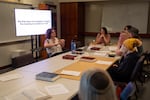
Avery Barron, left, leads a discussion on the Book of Deuteronomy, the fifth and final book of the Torah, at Congregation Shir Tikvah’s weekly queer Torah study group at Eastside Jewish Commons in Portland, Ore., on Aug. 18, 2026.
Eli Imadali / OPB
For many Jewish people, the Rosh Hashana holiday is a time for familiar rituals: hearing the Shofar, a traditional horn, eating apples and honey, and revisiting ancient passages of the Torah.
At congregation Shir Tikvah in Portland, a Torah study group has been returning to those same texts with a different set of questions for several years.
Angel Ya’el Murauskas, a lay leader of the congregation, said the group looks much like any other Torah study. Participants open with a Hebrew blessing while seated around a table with copies of the Torah in Hebrew with English translations.
But unlike most other Torah studies, this group is one of a handful in Oregon that approaches the text through a queer lens.
“If you look back at Jewish teachings about the Torah, it says that there are 70 different ways to understand any piece of Torah, any word, any command, any story,” said Rabbi Emerita Ariel Stone. She helped start the queer Torah study at Shir Tikvah.


All images: Eli Imadali / OPB.
Stone said constant reinterpretation is fundamental to Jewish tradition.
“It’s not complete unless you turn it over again and turn it over again and look at it in different ways,” she said. “You’re queering your perspective of it simply by studying it the way you’re meant to study it.”
Murauskas said queer interpretation of the text can start at the very beginning.
“Genesis 1 is incredibly queer,” Murauskas said. “God creates an ‘Adam’, which is a creature that is sort of a man and a woman. It’s not really clear, but they need to be cleaved apart from one another, which invites an interesting question about what exactly is going on here.”
The point, Murauskas said, isn’t necessarily to prove that biblical characters were queer. Instead, the group looks for what is already present in the text and questions the assumptions readers bring to it.
Murauskas said the approach can be especially meaningful for people who grew up hearing that their sexuality or gender identity was incompatible with Jewish teachings.
“We hear those kinds of stories all the time,” Murauskas said. “I’ve found this group to be incredibly healing because it’s the first time anyone has told them, ‘You actually aren’t an outsider to this. This book is full of people like you.’”
Being in a room where everyone is queer and Jewish gives participants permission to ask interesting questions.
“We can all be empowered to learn and say really profound things, also make mistakes, and just kind of play with what we have in front of us,” Murauskas said.
Murauskas said that creates an opportunity “to see that this is actually for you and this is your book. And these are your stories, if you want.”
The group isn’t afraid to get granular, including with the language itself. Hebrew is a gendered language, but Murauskas said the group sees the language’s references to masculine and feminine characteristics as something broader than a simple binary.



All images: Eli Imadali / OPB.
“So your cheeks can be masculine. Your lips are feminine. What does that mean?” Murauskas said. “That’s for everybody. That’s not just men and women. Everyone’s like that. That’s how your body is.”
For participants, that kind of historical and textual exploration is part of what makes Torah study valuable — including when the questions are irreverent, unexpected or distinctly queer.
Murauskas points to the story of Ruth and Naomi as one example.
“One of the most beautiful passages and expressions of love in the entire Bible is between two women,” Murauskas said. “Ruth says to Naomi, ‘I will literally go where you go. I will die where you die.’ I mean, what is that if not a marriage?”
Ruth 1:16-17 is commonly used in marriage ceremonies.
Murauskas sees universal love as foundational to Jewish traditions.
“It’s all over the place between everyone, between God and us, between us and the animals, between us and each other, between us and ourselves,” Murauskas said.

Reflected in a Jewish educational poster, Avery Barron gestures as she leads the conversation about Deuteronomy.
Eli Imadali / OPB