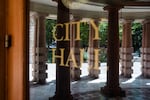
Pillars mark the entrance to Portland City Hall, reflected in the door, in Portland, Ore., on July 9, 2026.
Eli Imadali / OPB
In 2024, two civic organizations began partnering on a yearly survey to gauge how residents in Portland felt about some important elements that contribute to quality of life in a city.
North Star Civic Foundation and the Oregon Values and Beliefs Center asked more than 1,200 Portland adults how effective they feel local government is, whether they feel represented and what services they think should be prioritized.
North Star Civic Foundation Research Director Marina Kaminsky joins us to share results from the latest survey and how they compare to the last two years.
Note: The following transcript was transcribed digitally and validated for accuracy, readability and formatting by an OPB volunteer.
Dave Miller: This is Think Out Loud on OPB. I’m Dave Miller. In 2024, two Portland-based civic organizations began partnering on an annual survey. North Star Civic Foundation and the Oregon Values and Beliefs Center have been asking more than 1000 Portland adults how effective they feel local government is, whether they feel represented, and what services they think should be prioritized. The latest results are in, and they reflect some interesting trends. Marina Kaminsky joins us to talk about this. She is the research director at North Star Civic Foundation. It’s great to have you on the show.
Marina Kaminsky: Thank you so much for having me.
Miller: I want to start with one of the issues that’s gotten a lot of attention from this year’s numbers. There was a drop from last year in the percentage of Portlanders who say that they feel represented by the Portland City Council. How do you explain that?
Kaminsky: That’s a great question. And to be honest, I’m not sure. We’ve been doing this survey for three years. In 2024, folks who said they felt represented was about 20-something percent, and that increased in 2025 up to 40%, which was a huge jump, and then back down.
Miller: And that was before and after the major change in literal representation of how the Portland City Council is set up. How many people there are, and going from not that many councilors or commissioners who were elected, all at large, to 12 of them, representing four different actual districts.
Kaminsky: Yeah, part of the reason that we did the survey was that we were interested in tracking how folks felt about representation and governance over time, starting in May of 2024, prior to the reform, and then continuing each late spring, May-ish in ‘25 and ‘26. The interesting thing that we saw with representation was that the number of folks who said they felt represented increased dramatically between ‘24 and ‘25, and then we saw some backsliding in ‘26. It didn’t go back down to 2024 levels, which I think is significant. And while I can’t explain why this happened, I am very interested to see what happens next year. It could be something around elections.
Again, this is just a hypothesis. Folks might feel like, “Oh, I just voted for somebody and I’m excited to see that they got elected,” and so you might see a bump in representation because of that. It might be that folks were feeling excited about the reforms, and then they saw things play out that they weren’t anticipating or felt disappointed in. So we don’t really know, but I think getting another year of data in 2027 will be really interesting to see if this trend sort of continues.
Miller: I want to run something by you that Amaury Vogel, the executive director of the Oregon Values and Beliefs Center, said to our Portland politics reporter Alex Zielinski. She said that a lack of understanding of how the new city system works could be at play. That Portlanders may not understand that now council members are purely legislators, they write laws – or the city version of those – as opposed to what they were before. They were administrators of their respective bureaus. They don’t do that anymore, so they have less ability, technically, to manage a city and to make immediate change themselves.
Do you agree with that, that that is a possibility that Portlanders are disappointed because they want their city council members to do more than they actually are able to do?
Kaminsky: It’s certainly a possibility. Again, this is speculation, because we don’t know exactly all of the factors that go into what creates a perception in a community, but what we do see in the survey in many instances is a large fraction of folks saying, “I don’t know whether I feel represented. I don’t know if city government is effective. I don’t know if Portland is on the right or the wrong track.” So seeing that it’s about a third, in most cases, that sizable of a percentage answer “don’t know,” that does indicate that there is a level of awareness that is lacking about how city governance works and whether what’s happening and whether or not folks feel like it’s effective.
Miller: I wanna go back to what people did say they had thoughts about or where they had clear preferences that were expressed in the answers to the survey. More Portlanders said that the quality of city services was either good or excellent this year than in the last two years. What are people satisfied with?
Kaminsky: Yeah, that was actually really exciting to see because over the last several years of survey data, we’ve asked about 12 city services, ranging from fire and emergency medical services to parks and recreation, to streets, sidewalks, and transportation. These are just a few examples. And across the board in all of those, we saw a jump between 10 and 20 percentage points of folks responding that they felt services were either good or excellent. And that was a sizable and I think important finding of this year’s survey.
Miller: What services do Portlanders value most?
Kaminsky: That’s a good question, and it’s been really interesting to see, because we did some subgroup analysis, and pretty consistently across districts, across race, we see folks really valuing emergency fire and medical services, homelessness shelters, and… the third one is escaping me, but there’s this consistency across groups that has been really, really wonderful to see.
Miller: Well, let’s dig into this issue of consistency across groups, because folks can dig into the cross tabs and look with a lot of detail at how different Portlanders in different districts or different demographic ways of sorting humans, how all of those kinds of different responses played out. I’m curious, first of all, what stands out to you when you look at the districts themselves? Were there any meaningful differences?
Kaminsky: In some cases there were. We saw that District 1, for instance, wasn’t as satisfied. I’m going to give a very specific example, but I say…
Miller: District 1, that’s East Portland, right?
Kaminsky: Yeah, with their parks and their recreational opportunities, and that maps pretty well with understanding that they have fewer parks in East Portland than, for instance, West Portland does in District 4. So we saw a reflection of that when asked, which services or amenities would you like to see preserved? District 1 folks rated parks and recreation higher than District 4 folks, who have a lot of parks.
So that was one area where, I think, city leaders can sort of dig into their specific constituencies and understand, like, how are the folks that I’m elected to represent feeling? What do they need? How can I be responsive to them?
Miller: What about when you look at survey answers based on race or income? Are there other patterns that you think are meaningful?
Kaminsky: Yeah, definitely. One of the big ones that I want to highlight is looking at groups that earn less than $50,000 a year. Across the board, we see that they feel less represented, they feel less satisfied with city services, and generally, I think, lack access to our city leaders in the way other groups do. So that is one group that I think our community and our city leaders in particular can work to try to connect with more.
Miller: What do you want members of the Portland City Council to take away from this survey?
Kaminsky: Thank you, that’s a great question. And again, there is so much in the survey, so I encourage folks to go to OVBC’s website, look at the report, but there are specific policy questions that city leaders can look to. We asked a question about, what services would you like to see preserved and what services would you be OK with cutting in an environment of scarce resources? We asked folks how they feel about economic growth and which strategies make sense for this region. So again, I think that’s something that city leaders can really reflect on.
And then there are the questions about governance and representation, where we ask folks, is there anybody on City Council who you feel represents you and your interests? And understanding where the community sits with that I think is important, too. And city leaders can think about, how can we better access our community? How can we better listen to our community? Where should we be to be in community and share what we’re doing and hear from constituents?
Miller: We’ve been talking about the city side, but you did also ask about the County Commission. What did you find?
Kaminsky: Unlike some of the city trends, we’ve seen consistent trends in dissatisfaction with Multnomah County, and that serves as a baseline that we can compare to. We know that we didn’t see as many large changes at the county over the period of time that we’ve looked at the city, and there’s low trust in county leaders, unfortunately, and just a general sense that the county is less effective.
Miller: What are your hopes for what you can do in future years? Is the plan, first of all, to keep doing this?
Kaminsky: Yes, we want to do this to the extent that we can every year, moving into the next decade. We think that this can help with understanding opportunities for future charter reform efforts, both at the city and the county. It gives a point of reflection for, have we achieved the goals that the charter reform efforts in 2022 aimed to address? And it also just gives a sense of like, where is our community, in terms of what policy areas are really important? Where are our strengths, where are our weaknesses, and how can we improve in terms of delivering services to our constituents?
Miller: One of the benefits of this survey, which is super obvious already, is having, at this point, some longitudinal data.
Kaminisky: Yeah.
Miller: We can see that some of the same answers to some of the same questions year-over-year, as we were talking about at the beginning, about do people feel represented, we can see some of those shifts. But you can’t make a survey that’s 20,000 questions. So, I mean, are there things that you are hoping to ask in future years? I’m just wondering how you figure out which ones to ask, given that it has to be limited, otherwise people will just get fed up and not do it.
Kaminsky: Right, yeah, thank you. That’s a good question. We try to limit the survey to about 15 minutes. We have some questions that we anticipate being reoccurring questions every year, some that will be reoccurring every other year, so we can still track changes over time, but maybe save a bit of space for some unique questions. So, every year we hope to ask specific questions to that year around maybe current policy issues, current issues in governance or representation, and be able to have some flexibility to shift things over time in that way.
Miller: What are you excited to ask next year?
Kaminsky: Oh gosh, well, next year, I’ll say every other year we’re doing a policy survey. This year was more of a policy focus. Next year we’ll go back to asking questions more focused on governance and representation. And personally, I’m not sure where we’ll land. We developed the survey, as I mentioned, in partnership with OVBC but also with a group of civic leaders that North Star convenes. These are folks that represent cross-sectoral entities in the city business, community groups, philanthropy, other nonprofits, and they helped design the survey questions that are specific to that year as well, so I don’t know where we’ll land.
Miller: We’re almost out of time, but speaking of businesses, maybe I read this too quickly, but am I right that when asked who they trust, the highest level that Portlanders reported trusting are small businesses, and that was above their neighbors.
Kaminsky: Yeah, yeah, that was really interesting to see.
Miller: How do you explain that?
Kaminsky: My sense is that Portlanders probably feel that small businesses are invested in the community, and that they are also aware of what’s happening policy-wise, and that they want to do what’s right for the city. So that’s kind of how I read it. Again, that’s sort of speculation. I can’t really know why Portlanders responded that way. But that was a very significant and interesting thing.
Miller: That’s a positive read, and no shade on small business owners. I was just wondering if maybe the negative version is, what do people think about their neighbors?
Kaminsky: Oh, yeah, that’s interesting, I think that’s actually an interesting question to dig into in terms of districts, as well, because we see in District 4 folks…
Miller: That’s the West Side and a tiny bit of close in Southeast, like Sellwood or something.
Kaminsky: …trust their neighbors less than in District 1, and my interpretation of that is that District 4 has folks more spread out. They don’t live as directly in each other’s space or close to each other, so maybe they don’t know their neighbors as well, but, yeah.
Miller: Marina, we’ll talk again. Thanks very much.
Kaminsky: Thank you so much for having me.
Miller: Marina Kaminsky joined us. She is a research director at North Star Civic Foundation, which helped conduct this survey.
“Think Out Loud®” broadcasts live at noon every day and rebroadcasts at 8 p.m.
If you’d like to comment on any of the topics in this show or suggest a topic of your own, please get in touch with us on Facebook, send an email to thinkoutloud@opb.org, or you can leave a voicemail for us at 503-293-1983.