A federal judge in Oregon is considering whether U.S. Immigration and Customs Enforcement officers violated his preliminary order by arresting people without a warrant and failing to document it.
Innovation Law Lab originally filed a class action lawsuit against ICE last year, arguing that the agency could not arrest someone without a warrant.

FILE - The U.S. Immigration and Customs Enforcement office in Portland, June 11, 2025.
Kristyna Wentz-Graff / OPB
U.S. District Judge Mustafa Kasubhai issued a preliminary order in February that the federal government could only make a warrantless arrest if the person is likely to flee, and to send documentation of those arrests to Innovation Law Lab.
But lawyers for Innovation Law Lab say ICE has not been complying with that order and are asking Kasubhai to enforce it. They argue that ICE has continued to conduct hundreds of warrantless arrests since the judge’s order went into effect, and that government officials have only sent them documentation for just 24 of those in that time span.
Attorneys for the federal government deny those claims.
“There’s been a discrepancy from what we’re hearing from community members and what’s been produced to us,” said Jordan Cunnings, legal director for Innovation Law Lab. “We’re hoping that the court’s forthcoming order will enable us to remedy some of that.”
Much of the two-day hearing focused on the testimony of four different Oregon men arrested by immigration enforcement in 2026. Innovation Law Lab claims ICE arrested them without a warrant and before they had assessed that any of them were a flight risk.
Kasubhai is expected to issue an opinion sometime next week.
False information in report raises ‘significant concerns’
During the hearing, an ICE officer described in detail how his team identified someone living in the country illegally, quickly obtained a warrant and soon placed them under arrest.
The officer, identified only as J.G., said he and his partner sat in a Walmart parking lot in Southern Oregon in July, looking up nearby license plates for people in the country illegally. When one plate matched, the officers quickly obtained an administrative warrant to arrest the driver, followed the car to a nearby lake and arrested two people — the driver and his passenger, identified as H.D.G.H.
In court, J.G. testified that he wrote false information in H.D.G.H.’s arresting documents. He wrote that he had identified the passenger by name and learned that he was in the U.S. illegally before detaining the vehicle.
But J.G. admitted on the witness stand that what he wrote in the report was not true — he had not known H.D.G.H’s name nor his immigration status prior to making the stop, he said.
Innovation Law Lab argues that the warrant for H.D.G.H. was invalid because it was issued after the arrest occurred.
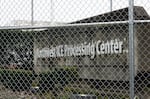
FILE - Undated photo of the Northwest ICE Processing Center in Tacoma, where many people arrested by ICE in Oregon are taken.
Stephani Gordon / OPB
Kasubhai told Assistant U.S. Attorney Ariana Garousi in court that J.G.’s incorrect report calls into question the truthfulness and accuracy of other ICE arrest reports. In particular, he was concerned that the incorrect information had been used to justify obtaining the warrant.
“[Officer J.G.] lied in a memorializing document about his conduct and his observations and knowledge of what, in fact, happened during an arrest,” Kasubhai said, later adding, “There are some discrepancies that exist in these documents that raise significant concerns.”
Garousi argued that the officer had made a simple mistake.
“I don’t think what he did was malicious,” Garousi said. “To me, the word ‘lie’ sounds like he did it on purpose, and I just don’t think he did.”
License plate queries on the rise in immigration enforcement operations
Some attorneys and academics say this practice, sometimes called “collateral arrests,” has become more common in recent months. They also argue it’s inherently risky and could lead to more instances of racial profiling and violent arrests.
According to the University of Washington’s Center for Human Rights, which has been tracking the practice of ICE relying on license plate scans to make arrests, there have been 276 arrests in Washington state since August 2025 using this method. Angelina Godoy, the director of the center, says that the number in Oregon is unclear because the state denied the center’s requests for records.
She says despite this increase, much of the general public doesn’t know that it’s happening.
“This is sort of an under-the-radar way that people are being brought in,” Godoy said. “If you’re not a member of a community that’s directly affected, or you’re not a member of one of the constitutional observer teams that are showing up to these scenes, it’s very easy to just neglect that it’s happening.”
Godoy, who is publishing a report on the subject in October, said big-box stores like Home Depot and Walmart are common targets for agents scanning license plates. She also said the number of license plates scanned that belong to work vehicles, either used for construction or landscaping, is “off the charts.”
“They’re traveling to areas that they deem are ‘target-rich areas,’” she said. “That enables a kind of racial and also occupational profiling.”
Those arrest methods are not foolproof. J.G. testified that they once arrested a McDonald’s employee after scanning the car he was driving, only to learn it was a case of mistaken identity — the man was driving his relative’s car.
That same man, identified as C.J.V.M., told the court through a translator that the experience terrified him.
“I’m still afraid and I’ve kept the trauma of that day,” he said.
Aliza Kaplan, a professor at Lewis & Clark Law School, said the implications of federal agents surveying license plates go far beyond immigration.
“These are significant privacy issues, and everyone should be paying attention, no matter what their background is,” Kaplan said.
Correction: An earlier version of this story misstated Ariana Garousi’s job title. OPB regrets the error.