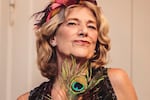
Charla Hathaway is an author, a PhD in human sexuality and a sexologist who's performing a one-woman show she wrote called "More Naked Than Ever." Her first show was titled "Naked At My Age." Undated production photo provided by Charla Hathaway.
Courtesy Charla Hathaway
When you hear the term sex education, you might think of classes for kids in public schools. But what Charla Hathaway means by that is far broader. She’s an author with a PhD in human sexuality, and she also became a sex worker for a short time at age 55.
She’s now 78, and over the last two decades, Hathaway has given a wide variety of classes and workshops about intimacy, touch, sensuality and sexuality. She says she wants to remove shame around bodies and sexuality in the culture and make those topics normal — not taboo — to talk about.
Hathaway joins us to share more about her life and work and the one-woman show based on her work, titled “Naked at My Age.” She’s now performing a follow-up called “More Naked than Ever.”
Note: The following transcript was transcribed digitally and validated for accuracy, readability and formatting by an OPB volunteer.
Dave Miller: This is Think Out Loud on OPB. I’m Dave Miller. Before we start this conversation, I should note that we’re gonna be talking about relationships and sexuality, and it might not be appropriate for younger listeners. So here is your chance to turn off your radio or your podcast segment.
OK, on with the show. When people embark on midlife career shifts, when they pursue new work in their 50s, they very rarely become sex workers. But that is exactly what my next guest did. Charla Hathaway then went from sex work to sexology at 78. She’s now an author, a performer, an intimacy coach. Her latest one-woman show is called “More Naked Than Ever.” Charla Hathaway, welcome to Think Out Loud.
Charla Hathaway: Thank you very much for having this conversation.
Miller: What led you to begin doing sex work in your 50s?
Hathaway: Well, you’re probably too young for this, but when you turn 50, things really open up.
Miller: I have turned 50. I haven’t yet pursued that career shift. But we’ll see what happens.
Hathaway: I know. I wasn’t prepared for it either. My guidance counselor never told me that this would happen. I was a violin teacher and wrote for the newspaper in Steamboat Springs. But at about 50, my son goes off to school. And I looked at my husband of 22 years and said, “You know what? Let’s take a year off, a marriage sabbatical, and discover life on our own, contacting each other if we want.”
Miller: What did he say to that?
Hathaway: He wasn’t real sure about that. But he knew he had a tiger by the tail. We were always independent in our life, and really shared our parenting and childcare responsibilities.
Miller: Am I right that this wasn’t a, “how do you feel about this?” This was, “I’m going to do this?”
Hathaway: Yes, this is what I want to do.
Miller: OK, so he didn’t have too much of a choice?
Hathaway: Correct, he did not.
Miller: What was that year like for you?
Hathaway: It was an amazing discovery year not only for me and our marriage, and I found another lover at that time. I found the Body Electric School. I mean, Body Electric. I went to the seminar. It was for women only, celebrating the body erotic. But there, Dave, I discovered we use about as much of our body potential as we use in our mental potential. We have so much more ability to feel, relax, say what we want, get it. And in that workshop, I just started reading about sexuality and found a new career.
Miller: You said that your guidance counselor never suggested that for you. Obviously a joke, but I’m wondering what your 20- or 30-year-old self would have thought about the new path that you took?
Hathaway: When I was 20, I had an abortion my senior year at the University of Illinois, and that was really before Roe v. Wade. I thank goodness my mother came with me to the hotel room in Detroit for that to happen. But basically, I say my 20s were pretty clueless, sexually. I think they are for a lot of people. I was kind of a hippie and lived in a cabin in Colorado in the mountains. In my 30s, I got married and it got a little bit better. But even in marriage sometimes things weren’t … I mean, I wanted things to be slower or different or more vulnerable, and I didn’t know how to ask for it.
Miller: I want to turn then … Because we got as far as, you turned 50, and you wanted to sort of open up your life and open up your experiences. Not uncommon, but as I mentioned in my intro, I think it’s much more uncommon for people at that age to pursue sex work. How did that happen?
Hathaway: Absolutely. I looked down at my end table one afternoon and I discovered all five books were about working women, the age of the new enlightenment, working girls. It was about sexuality. I was fascinated to learn not only myself, but maybe help other people too. At that point, I was thinking of divorce and I wanted to be able to make good money easy, still be an artist, still play the piano, be a good neighbor. And I met a mentor in the field. She helped me build a website and the rest is history. I just found the most empowering work, in turn, of my life.
Miller: Were you an independent contractor, or did you have someone who connected you with clients?
Hathaway: I wrote every word, basically, of my website and had some good help on how to make it safe and how to mentor, because you have to work kind of under the radar. But soon, I got more training, like sexological bodywork with Joseph Kramer, the founder of Body Electric. I took his Sacred Intimacy training and wrote. I got contacted to write books early on in my career, and then pursued a PhD at the Institute for Advanced Study of Human Sexuality. So I just made a study of it and I’ve grown with the field.
Miller: How long did you do the, having people pay you for sex, part of your career?
Hathaway: The whole career. And quite well and quite deservingly, because the “ahas” that men, women and couples would have. I mean, there was one couple that came to my Erotic Massage class. There’s maybe six couples. Each has a massage table. And at the sheer back at the end, the husband said, “I brought my wife here today for our 42nd anniversary. She’s a massage therapist. And I thought I knew what slow was, but I discovered today that it wasn’t slow enough, and I’m so glad I can still learn.”
Miller: Did you ever feel unsafe with clients?
Hathaway: Not really. The clients who’d come to see me are so ready to learn, and the women too. The women would come mainly because they weren’t able to ask for what they wanted. “My boyfriend kisses me too hard, too fast, too wet, and I can’t say anything.” So I would say, you know what? I think you need to get a bossy massage where you have to say what you want and tell me many things in your own words.
Men, I think, would come more from wondering if their wives or their girlfriends were really satisfied or not or they really didn’t have some confidence. I found I turned the tables on them because they had come in to try to get another golden bullet at how to give more, but I was teaching them how to receive.
Miller: What do you want your clients to get after they spend time with you? I imagine, as you were going through some of those different examples, they came in with different questions, different needs. But broadly, what do you hope they leave you with?
Hathaway: That’s a great question. I hope that by spending time with me, they’d have more confidence in the ability of their body to feel pleasure. And the simple tools to get there, of attention and breath, and putting the mind to the sensate focus techniques. And feel more ready to like their own body, accept it however it is and to share it with others.
Miller: Not long ago you wrote a book called “How to Be a Prostitute and Not Get (Blanked).” That last one is a word I cannot say on the air because we have the FCC. Do you think of that as an advice book?
Hathaway: That’s the FCC, huh? OK, got it. [Laughter] The first is the stories of me, “Naked At My Age” is the name of my first play, in which how I find sex work. What did that mean to me? What did it teach me about learning, in my own life, to receive? I forgot the question. What was it?
Miller: Well, your book, “How to Be a Prostitute and Not Get (Blanked).” If you think of it as an advice book?
Hathaway: You know, it’s really fun. I had a great time reading it. It’s a quick read – one or two hours, 100 pages.
Miller: A fun time reading your own book?
Hathaway: Yeah. [Laughs]
Miller: Not everyone says that.
Hathaway: It’s entertaining to find out what her path was, and then how she met the bluebonnet madam. And then a good eight or 10 stories of her clients, or what the 68-year-old virgin from Kansas that drives all the way to take her Erotic Massage class in Austin, Texas, which is where my BodyJoy School was at that time. And at the end are some of my own stories, foibles or whatever, triumphs and challenges of my own stories.
Miller: Last year, Eugene Weekly wrote that your first show, your earlier show, “Naked At My Age,” was an irreverently reverent and salacious sexual exploration that, in your words, “you could take your mother to.” What does it mean? I’m curious how you think about appropriateness, and how you talk to different populations?
Hathaway: I think going on 80, I just really have kind of a corner on the market of talking about sex in a comfortable, mature and wise way. Dave, it’s amazing. After the play, which I have really taken around the world, mothers will come up to me and say, “I wish I would have brought my daughter.” And daughters will come up to me and say, “I wish I had brought my mother.” Some of the most comments I get are, gosh, it was not only entertaining, but I really took away a lot. Sometimes my audiences don’t even get up from their chairs, and I just look at them and say, “what’s on your mind?” And we stay another half an hour and talk.
Miller: What do you talk about?
Hathaway: A lot of them have stories, especially from New Zealand and Australia, where sex work is decriminalized. So they could talk. There’d be sex workers that would come to the play. And they would talk about how great it is to have the police have their back, and they never have to see anybody that they don’t want to or do anything they don’t want. So people would just have some of their own stories or wonder more things about what I brought up in the play.
Miller: I asked you earlier about what you hope your clients will get after spending time with you. But that’s, obviously, on the individual level, the one-to-one level, or maybe if it’s a couple, one-to-two. What broader impact would you like to make, or what kind of cultural changes would you like to see, in terms of sexuality in this country?
Hathaway: Oh boy. My one-on-one clients paid the bill, but where I gave to my community was my classes. They could get everything I taught individually for $40 in a two hour class or whatever. So I felt that that was my real gift. The reason I would have a newsletter about sexuality and events is because I think this dialogue that you and I are getting to have today is about a subject that’s so important to most people and so little talked about. Now, in my older times, because I’m not seeing clients anymore really, I’m educating you might say from the stage, is I would like to see sex work destigmatized.
Oregon is actually at the forefront of a movement for decriminalization. There is an impact project right now that is actually surveying 400 Oregon sex workers [on] how being criminalized in your work affects your ability to get housing, to get another job, to find childcare, health care. This is really a one-of-a-kind study. And I think the whole dialogue in our country is beginning to understand that adult consensual sex work makes a community stronger and safer.
Miller: But I’m sure you know the counterargument, that for many people who are involved in sex work, it is not consensual, and it can be very hard for people who are paying for services to know. And that many people, especially many young people, are being victimized. How do you deal with that?
Hathaway: That’s a difficult question. We have to deal with it. I think the criminalization of sex work causes it to go underground and undercover, and then a lot of abuse can happen that way. Actually, not criminalizing your own self, to be able to use your body as an adult with consent, could free up a lot of resources to get the bad apples out of there. I really think that this is a chance to do that.
Miller: You embrace conversations about age. You don’t shy away from them. Your first show was called “Naked at My Age.” How do you want to change the way we talk about aging and sexuality?
Hathaway: I’m doing a talk at the women’s gym next week called “Intimacy Changes Clothes.” I think as we age, sexuality changes. Hopefully, like regular life, it becomes deeper, more reverent and more precious in so many ways. Touch is the only one of our five senses that actually grows more acute as we age. That’s wonderful news. So if women can step up to the plate of being more truthful and authentic, even in a patriarchy, of who they are. And men naturally want usually more intimacy as they age, and the attention changes from one focus – on orgasm or whatever – into partnership. There’s rich terrain in aging.
Miller: A lot of your work is aimed at helping other people, but how do you think doing this work over 20-plus years now has changed you?
Hathaway: It’s made me so much more confident and fun in my dating life, in my partner life. It’s made me not be afraid. I think so many women shy away from even relationships because they haven’t ever been empowered enough to make it their way. Really, women are the key. They need to lead a lot. So I feel like I’ve been able to just enjoy all kinds of relationships in a very authentic and honest way. And I’m thankful for this work because of that.
Miller: You think you’re a different dater now than you were 20 years ago?
Hathaway: Oh, absolutely.
Miller: In what ways?
Hathaway: In the ways that I’m not afraid to do it. And in the ways when I do show up, I know that if something isn’t happening quite right, I don’t blame the other person. I go, hmm, how can I tweak this? How can I make this … Because I do believe when we are honest to ourselves, we bring that into the bedroom besides the boardroom or wherever – that’s our biggest gift. I’ve learned to really have confidence in that through my studies, through my books, through my work.
Miller: What are you excited to work on next?
Hathaway: I wanna continue with the people locally who are doing wonderful work in decriminalization. There’s a real national look on that. I wanna continue with my plays and show up in places with them because it’s such a wonderful way, in this later part of my life, to interact with people. So I’m excited to be at a women’s theater, 100 Lives Repertory, on October 10. I’m being sponsored by She Bop, the sex store people, and there’s a winery, Clos Griotte, who’s helping me, and those wonderful women at the theater. We’re gonna have a great night actually with Project Impact people there, the people surveying the sex workers. And we’re gonna have a great night. That’s October 10, and then I play the next Saturday night at SomaSpace in Portland.
Miller: Charla Hathaway, it was a pleasure talking to you. Thanks very much.
Hathaway: Thank you, Dave.
Miller: Charla Hathaway is a sexologist, author, performer and intimacy coach.
Listener Mailbag:
At the end of our show, we take a few minutes to read some of your recent feedback and note that the AI scam email that uses Dave’s name, did not in fact come from him.
Dave Miller: Finally today, our senior producer Allison Frost joins me in the studio to read some of your recent feedback. Hey, Allison.
Allison Frost: Hey Dave. Recently we talked with an expert on ADUs and MDUs, mobile dwelling units. We asked on Facebook if people would live in an MDU, like a tiny home on wheels or an RV, or rent space to one on their property.
Miller: Brennan Swan said, “Yes. It’s better than sleeping in a car.”
Frost: Greg Hallock wrote, “Assuming the mobile tenant is respectful to property and rules, sure. Long-term ‘visitors’ can be fun.”
Miller: Yvette Clark wrote, “No to the trailer. It feels temporary to me. Yes to the tiny home. That feels cozy.”
Frost: Jill Eckenrode wrote, “I am doing that as I type! I live in the Mount Hood Tiny Home Park. I pay $850 a month to park my cabin, and my space rent covers water, sewer, cable, trash and landscaping, plus an additional shed that’s actually a fully furnished studio that I’ve converted into my sewing space.”
Miller: Not only that, Jill told us, but her tiny home park also includes a fully-equipped fitness center, pool, jacuzzi, community center, snow plowing, and a large group of people who care about their neighbors. She wrote, “It takes some time getting used to not owning the land, but I think it adds some freedom and time saved by paying others to do all that stuff.” “Tiny living” she writes, “for the win!”
Frost: Last month we interviewed master gardeners, and we asked people on Facebook if there are times when they turn to other gardeners rather than the internet for information. For many folks, the answer was yes and no.
Miller: Lisa [Morrison] said, “I reach out all the time to other gardeners in real life and through the social media groups I trust. I also use trusted online sites. I’ve learned the hard way not to trust AI for answers.”
Frost: Greg Hallock said, “I am dubious about anything on the internet these days, so I only talk to gardeners, but often that is over the internet.”
Miller: Keren Chapelle said, “I’ve met some really fabulous friends, as well as a network of people I trust for information and that I can geek out with about native plants through the Friends of Backyard Habitat’s Facebook page. I always call it the nicest place on the internet. I do my own share of research offline as well, but I’ve also received great information by asking questions there and by reading answers to other people’s questions.”
Frost: We talked with tourism experts who told us how people were canceling or rescheduling their visits based on weather conditions. We asked folks on Facebook how much wildfire, smoke and other climate-driven events factor into their travel planning.
Miller: April Johnson wrote, “When I plan driving trips to visit family in Northern California and Reno, Nevada, wildfires and smoke are at the front of my mind. Will we be breathing smoke? Will roads be closed? Will we have to evacuate? My mother-in-law lives in Tuolumne County, and I resist going there at all during fire season, which gets longer every year.”
Frost: Athena Contreras wrote, “Considering that a fire evacuation happened at our rental on the day before we were supposed to be there, we will definitely be more careful next year.”
Miller: Leif Eccles wrote, “I didn’t think enough about it when I planned a camping trip to Timothy Lake this summer. Then, checking the Watch Duty App, I saw that part of the lake was at Level 3-‘Go Now!’ So I chose a different location. Then checked again the day before I left. That’s gonna be my new normal, which makes it hard to book camping sites months in advance.”
Frost: And Mike Meyer wrote, “It’s a key reason the coast is our top choice now.”
Miller: Finally, while we’re on the subject of feedback that’s come in, I thought I’d share a kind of public service announcement. Over the last week, I heard from four authors from all around the country. They’d all received emails purportedly from me asking if they would be guests on our show.
The thing is, I had never emailed them. It was a scam, one that sadly has become really common. Scammers have impersonated interviewers, radio hosts, podcasters, book festival organizers all around the world. The scammers send out tons of these emails, and if folks respond, they ask for money for the interview to proceed. That is something we would never and will never do.
So sorry to the folks who got AIified emails from someone impersonating me. I guess it’s just one more reminder to everyone out there, be careful about every message you get.
Frost: Having said that, we always appreciate your 100% human comments and suggestions. You can leave them on our Facebook page. We’re at OPBTOL. You can also send us an email at thinkoutloud@opb.org or leave us a voicemail at 503-293-1983.
Miller: Allison, thanks very much.
Frost: Thanks, Dave.
“Think Out Loud®” broadcasts live at noon every day and rebroadcasts at 8 p.m.
If you’d like to comment on any of the topics in this show or suggest a topic of your own, please get in touch with us on Facebook, send an email to thinkoutloud@opb.org, or you can leave a voicemail for us at 503-293-1983.