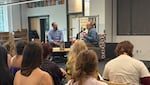
Author George Saunders (right) speaks with "Think Out Loud" host Dave Miller in front of an audience of students at Portland's McDaniel High School on Thursday, Sept. 24, 2026.
Gemma / OPB
George Saunders’ biting, imaginative short stories and novels have made him one of America’s most celebrated authors. His 2017 novel “Lincoln in the Bardo,” which won the Man Booker Prize, follows Abraham Lincoln as he grapples with a host of spirits following his son’s death.
In his most recent novel, “Vigil,” Saunders returns to the afterlife to explore corporate greed, climate change and the nature of salvation.
Saunders joins us to talk about life, death and everything in between in front of a live audience of students at Portland’s McDaniel High School.
Note: The following transcript was transcribed digitally and validated for accuracy, readability and formatting by an OPB volunteer.
Dave Miller: This is Think Out Loud on OPB. I’m Dave Miller coming to you today from Portland’s McDaniel High School. It is an hour with the writer George Saunders. George Saunders’s short stories and novels have made him one of the most celebrated English language authors in the world.
His 2017 novel “Lincoln in the Bardo” won the Man Booker Prize. He’s also won MacArthur and Guggenheim Fellowships and has been a finalist for the National Book Award. In recent years, as his accolades have piled up, he has been hailed as a kind of secular saint, but that’s not fair to him or to his work, which is weirder and more slippery and funnier than sainthood would imply. Take just one scene from his latest novel “Vigil.”
Two dead scientists appear at the deathbed of an oil company CEO. The scientists are very proud of the ways that they sowed public distrust in climate change research. While they talked to the dying man who paid them handsomely for that work, tiny replicas of themselves drop out of their butts and grow into full-size versions who drop out even more replicas and on and on, defecating Russian dolls of disinformation.
If that is sainthood, I say bring it on. George Saunders, welcome back to Think Out Loud.
George Saunders: It’s great to be here, man. That’s a nice description. I like that.
Miller: Admittedly, it’s a weird scene to start with and to focus on, but I wanted to do it because to me it encapsulates a lot of things that I love about your prose. The gonzo creativity, the politics, presented in interesting ways; the specificity, the humor. Can you explain for folks who haven’t read the novel, what’s happening in that scene?
Saunders: No, I can’t. Basically this guy is dying, so he’s very weak and some images and visions are coming up from inside his own mind. But the ones you describe are actual former colleagues of his, and they were sort of in cahoots in the denial movement and they’re kind of in hell because they still haven’t repented. And so their kind of eternal damnation is to roam around the world coming to the deathbeds of other people like him and telling him, “Come on over to the dark side, it’s fine over here.”
So, I came into writing from, as a working class kid in Chicago, kind of more into music and movies, and then when I started writing, I’m like, the one thing I don’t want to do is be dull. That’s one thing. But the second thing is I kind of wanted to acknowledge the fact that this life that we live every day, the way it feels normally, like right now we’re just, we’re fine. It’s only the tip of the iceberg, and you know there’s always things, disasters waiting to happen and miracles waiting to happen.
So I always wanted my writing to kind of suggest that mundane experience isn’t everything and that we ought to be alert to the fact that life can lurch into new registers at any moment, and not just become sort of sleepy about normalcy. So when I get to a scene like that, I’m always looking to push it out into something that’ll kind of startle the reader and maybe even offend. That’s OK with me too.
Miller: At this point in your career, do you have a sense for where an individual moment like that comes from? Where does it feel like it comes from?
Saunders: It’s, well, this is something, we’re here in front of this wonderful group of students. Thank you for being here, although you had to, so whatever. But, there is something about when I was taught writing, I always had the idea that it was more intentional on the part of the writer than it actually is. In other words, the idea was, the writer had some big idea that you, reader, don’t have. He comes in, he takes this big manure truck with his ideas and dumps it on you, and you kind of sit there and take it.
So it’s kind of like, the idea is that the writer has some stable static knowledge to deliver, but in my practice of it, it doesn’t seem like that at all. If I have a solid idea about a book, it always stinks. So the trick is to kind of wade into it with a really open mind and your intuition turned on and also your faith in your intuition and then you try to receive.
So coming to a scene like that, it’s just, he’s there in bed. His mind is weak and therefore receptive. And then there’s maybe a second slight tone of saying, what does he need to hear right now? Or more exactly, what does the book need introduced into it right now that will make it have broader shoulders? So at that point, it was kind of like, who has he interacted with that led him to this spot? Is there a way we can get that person in? But the main thing is I really try to keep my mind very open for what’s fun.
Like when I was in high school, one of the things we loved to do was imitate our teachers, for example, or our parents. If you could do a good imitation of your mom…
Miller: A vocal imitation?
Saunders: Yeah, just goofing around and all of a sudden you’re doing somebody’s mom or dad or whatever. That morphed into sort of a George Carlin-esque thing of just doing a voice that wasn’t a living person, but you weren’t creating it. You were just riffing on it. I draw on that all the time. Just that little sense of impending fun, like, oh, I can do that voice.
Then as you’re doing the voice, the person, if anybody can do an accent or a dialect, if you start doing it, a person arrives behind the voice, you see it all the time in improv. So I really trust that mode because what’s happening there is you’re not overcontrolling the material. You’re not using it to teach a lesson. You’re not honoring your existing idea about the book. You’re finding out instead of, you know.
Miller: All that, if I hear you correctly, it sounds a little bit like the moment of creation, and then later comes all kinds of rereading and refining and deciding, yeah, I like this. No, I don’t. This works for me, this doesn’t.
Saunders: 100%.
Miller: Just to focus on this because it seems like a helpfully specific example, what do you like about these self-pooping-out scientists?
Saunders: Because everybody who hears that, even these two in the front here, when they said pooping out, they went, “What?” That’s the best reaction – somebody’s pooping an imitation of themselves out their butt, there’s something about that kind of, it could be shock, it could be interest, it could be just jaw-dropping. I think that’s kind of what art is for one way or the other. However, if that’s all you’re trying to do, it’s not quite right either. It’s something about doing it in a way that honors that moment in the story.
But yeah, so for me, the revision part is really important and in a certain way, but every moment that the inception moment, every one of the thousands of moments of revision that follow are all in that sort of intuitive thing. The minute that my rational mind starts saying something analytical, I kind of try to shut that off, because even as you’re reading that scene for the nine millionth time, a choice will present to you and your gut will say, oh yeah, that’s better. That I trust because it’s infused with the book actually.
You’ve been reading the book for many months at that point or years, so I have a lot of faith in that there’s something in your subconscious that is actually wiser than the person you manifest as in any moment. And one of the great blessings of a long career in writing is I’ve really learned to trust that truth, that there’s something that is in me that is not me that’s smarter than me and can be summoned.
Miller: Let’s take a question from our audience. What is your name and what’s your question?
Emmy: Hi, I’m Emmy, and my question is, your writing utilizes clever humor and satire to approach serious topics and issues. How do you decide when humor is the right device to use alongside your writing?
Saunders: Wow, thank you, Emmy. Great question. Again, the deciding happens just in the moment. I make a joke in the prose and the next day I read it and I go, ah, too much, or not funny, or, oh yeah, so I mean, it’s a little bit simple, but that’s really it. You just come at it after you’ve made the joke and of course you’re reading that text hundreds of times and if each time you go, yeah, leave it, then you leave it.
The bigger answer is I grew up in Chicago on the South Side and in the late 60s and 70s and looking back in that community, one of the ways you expressed love was by sarcasm. No one ever said, “George, you’re a wonderfully thoughtful young man,” they say, like, “Hey, idiot!” And you’re like, oh, he loves me. Yeah, no, really. And also, of course, as you know, being funny is kind of like getting to the truth, but a little quicker than is polite.
I think that’s a real sign of respect. So for me, and then the third answer, which is maybe the most truthful of all, is for many years I kept humor out, because I was working class and I thought literature has got to be very high and very serious and none of these fart jokes are allowed.
Miller: When you say that you kept it out, did you have to actively keep it out?
Saunders: Yes.
Miller: Your fingers would put it on the page and then your brain would say, no, that’s not respectable.
Saunders: I think it had more to do with the pre-writing positioning like, OK, we’re going into writing now. No jokes. And then also having a certain, like for me it’s Hemingway was a big one. So you’d have that Hemingway as a voice in your head and everything was very serious, which of course meant leaving a lot of your real life behind. Like my dad owned a place called Chicken Unlimited. It was a chicken franchise in Chicago, and the motto was, “Chicken Unlimited doesn’t stop at chicken.” Kind of like a Zen thing.
So if I start to write about that, I just wouldn’t, because I didn’t see any way to write about that in the Hemingway-esque mode. So it’s kind of a pre-censoring, but that work never really had any energy in it. So you’d give it to somebody and they go, “Yeah, yeah, I read it,” very hurtful to a young writer. I basically got exhausted by that and had a kind of a breakthrough and started being funny and all of a sudden people were responding. So this, I mean, I’m sure there are young writers in the audience, one thing that you can kind of trust is your audience.
If you write something and everybody’s just like, “Eh, all right,” but if you write something and, I always use this example, like if you wanted to be a string quartet composer like Shostakovich, and you wrote them and everybody fell asleep during performance, OK, you want to note that. But then if you start playing like polka on an accordion and everybody’s dancing, OK maybe you’re a polka composer. So that idea that an artist really does have to be sensitive to the energy in her work, is there energy or not? That’s a really big lesson and to be open to that is kind of the key to finding out what you’re supposed to be doing.
Miller: And hopefully, I suppose as an artist, to pick up on that example, you’ll be happy with a life making polkas even if what you set out to do is to write something different. Hopefully you can find joy in it.
Saunders: 100%. And the other thing that happens that kind of closes the loop is if you started your career wanting to express something, or maybe you don’t even know what it was, but you have a feeling of wanting to be a presence in the world, right, and speak to people. If you start playing the polkas, whatever you set out to say will be said, because you’re in your mode.
Like for me, I think when I was really young, I wanted to write stories that were moving to people, emotionally moving, that talked about big things, which I wouldn’t have known to list these, but say capitalism and deprivation and emotional things. Those Hemingway stories I was writing, they didn’t do any of that. They were just too boring. When I started being funny, first of all, I had an audience and I loved doing it, but then all those things started coming into the work all on their own.
So I think it’s a little bit like if you go out to lunch with a friend and for some reason you can’t talk about the real thing in your natural mode, then that’s a stiff lunch. Nothing happens. But if suddenly you start speaking sincerely in your own voice with some urgency, one, your friend sits up and starts listening, and two, some real substance starts getting in. I’m not quite sure why, but there’s something about speaking in your honest voice that just raises the bar in all kinds of ways.
Miller: Let’s take another question from our audience. What’s your name and what’s your question?
Juniper: Hi, my name is Juniper. My question is, you approach your writing in a very satirical, rhetorical way. Does this affect your viewpoint on everyday life?
Miller: Oh, it’s almost like the opposite of how does it affect your writing.
Saunders: Right. Yes, and first of all, it’s like I said, that’s the way I approach life, is in a kind of a satirical way. Although I like to think I am gently satirical. I don’t like hurting people’s feelings and I don’t like being kind of deliberately confrontational, but I always have a kind of a, like if I go to a party, I’m always like, what’s weird about this? How would I write this to explain this strange moment? I’ll say one thing that happened, though in Chicago when I was growing up, I probably had a default setting of being too satirical.
Like my first girlfriend, I was a junior and she came up to me and said, “I’m breaking up with you because you always make jokes.” And then I made a joke right away, and then that was the end of it. But so I think, and for many years, I thought after I figured it out, that humor and satire was my go to.
But the one thing art doesn’t like is autopilot. So, around 2015, this idea for this “Lincoln and the Bardo” book came, and I could see that it wasn’t gonna be that funny, it wasn’t gonna be in the same mode. That was an interesting moment to say, OK, you, so far you’ve been allowed to be at the party because you’re satirical and funny and you have this approach. This book is going to take a different part of your personality. Is it there? And it was kind of a big thing. I was afraid that if I tried it, I might lose my following or lose my mojo.
So that’s another thing is that it’s beautiful to be reminded, especially as an older person, that you’re not just one thing, each of you in the audience has has some image in your mind of who you are, why people like you. When you are at your best, how should you behave, how should you speak? And that’s all very good, but the kind of thrilling thing as you get older is to go, that’s just one manifestation of who you are. As Whitman said, you are large, you contain multitudes. So art for me has been a great way to say, yes, I’m a sarcastic person. But also I have another mode I can go into, which is a nice life practice, actually.
Miller: You’ve said in other conversations about the new book that you thought about death from an early age. How though has your thinking about death evolved over the years?
Saunders: Yeah, well, I’m against it. That’s one thing. No, I think, well, on the one hand, as you get older, it’s kind of like we’re all on a cliff. And everybody’s walking and every so often somebody goes over the edge. And mostly there’s a chronology to it, but sometimes there isn’t, sometimes a young person goes over. So I think no matter what, at 67 now, I know there’s the edge of a cliff, and I know I’m moving towards it, and I hope it won’t be soon, but you just don’t know.
So this idea that life is kind of this beautiful party, beautiful, and sometimes horrible, it’s so mixed and it’s always coming at you from different directions and they won’t tell you what time it’s over, nobody can tell you. That gets kind of more exciting to me as you get older because you can’t deny it anymore. You can’t. So that’s interesting. But I also love what it does to your perception of every moment, like if in fact we could be convinced right now that there’s absolutely no guarantee we’re going to be here tomorrow. Isn’t this beautiful, that we actually are here now. That has been one of the kind of nice side effects of writing about death and the afterlife and so on.
Miller: Is that a feeling you can regularly tap into, or do you have to work at that? That feeling of gratitude, I guess is what I’m wondering about.
Saunders: Yes, for me it takes work to tap into it because I can say it, but I’m like, yeah, yeah, what time is it? I got it, but every so often in writing, in meditation, sometimes just for no reason at all, it’ll show up and what that does to me is remind me that most of the time I’m not feeling it, most of the time we think, well death is a drag for those idiots because it’s not happening to me. So I think that is somewhat in writing, but maybe more in meditation, the idea to kind of move that idea a little closer to you and then get into a little bit better relation to it, not for any morbid reasons, because it actually, it makes life more rich if you, makes the party is better if you know it’s not infinitely long.
Miller: Let’s take another question from our audience. What’s your name and what’s your question?
Hazel: Hello, I’m Hazel. So when I was reading the short story “Puppy,” I noticed the juxtaposition between the parenting styles and philosophies of the two main characters. I was curious how your own upbringing and parenting experience affected this.
Saunders: It’s a great question. Thank you. Yeah, that was one where that was a true story. We have two daughters, they were little. And we just had a great day at this lake in upstate New York and we had a new car, which we had never had before and we’re driving home with our beautiful kids in a new car and we go by this house and there’s a kid, as in the story, with a dog collar and a leash or maybe it was a harness. So somehow he was attached to a tree.
And as we flew by, like, what the heck? And he comes running, running, running, and he got to the end of the chain and went down. And the thing I remember was he didn’t seem to mind. He got up and did it again, and then we were gone out of his life. So I thought, well, that’s weird, and, and then I just went home, and I thought about it for three or four years. And the question was, how did that happen? What does his mom think about that? Did he put himself on that? So that was the seed of that story. Just how can I get inside there and try to figure out a world in which a kid is chained to a tree that also made some sense with the world of me and our kids happily driving by in a car. That was really it.
And then, of course, what I do is I just start trying to, I had the idea of telling it from his mom’s point of view, since she was the one I wanted a few words with, like what are you thinking? And what I tend to do is then I do a thing that I think of as third-person ventriloquist where I just say, OK, I’m that mom. And kind of to what we talked about earlier, how does she speak? And I just let her start talking and she came to me in a kind of a very working class way but in her own way kind of articulate and so I let her talk.
And then I said, OK, give me somebody driving by. Not you, George, somebody like you. So I made another mother and when she came to me her diction was slightly higher. But she told me that it hadn’t always been that way. She had come also from… So then I just let those two talk. On different days I do different sections, and then at some point you start cutting those up and juxtaposing them, and then it goes like that.
Miller: I’m interested in that. You said just there at the beginning that that moment stayed with you for three or four years. You’d think about it every now and then, eventually it turned into the story after you worked at it. Since we’re in a high school now, are there moments from your high school years that are the same thing that keep coming back to you, that your brain just plays for you every now and then?
Saunders: Yeah, yeah. When I went to school in Chicago in the 70s, it was kind of really uncool to try anything. So I didn’t do much studying in school. I just was gonna be in a band and I knew a guy who knew a guy who knew a guy who knew a guy in the Eagles, like that was my career planning, but I had a teacher. I had a teacher named Joe Lindblom, who was my geology teacher, and he did, I’ll just say one thing he did that was huge for me. He saw that I had some abilities and he also saw that I wasn’t trying.
So he, my senior year, he took me to a big science fair they had in Chicago, a citywide science fair, and it was mind blowing. It was so good. There was a kid did a nuclear reactor. I don’t know what, just amazing talent and work ethic. And I can see now that his intention was simply to say, “George, you’re wasting your time. You’re not doing anything. And meanwhile, there’s kids in your peer group who are really doing good work.” So when I first got there and we were walking around, I felt so ashamed, like, oh God, I love this. He was my mentor. I admired him so much and I kept thinking, he must think I’m terrible, he sees how good these other kids are.
But in fact, of course, he knew, he knew what he was doing. And the thing I took from that was we walked around for a couple of hours, had a great time. He was just praising all the projects and telling me why this was especially good, but there was never a touch of shame in that. Not a little bit of I told you so, or you should be working harder. It was just celebrating and allowing me to celebrate it with him. And so in what I took from that was he had faith in me, he had faith that I’d see what he was demonstrating and faith that I would sort of change my approach.
So with my students at Syracuse, I always remember that, how loving that was. He could have been more pointed about it, but he just had total faith that I’d get it. So that was a big moment for me and I went home and went, OK, I don’t ever want to feel that way again and I wanna honor his faith in me. And then I end up going to the college that he got me into by making a phone call. And Joe actually passed away this year, so I’m kind of honoring his memory, but that’s a big one. There’s a lot less, I mean, more see-me things, but that was the most high-minded thing.
Miller: At this point, when it comes to writing, what do you think you can teach and what do students, writers, just need to learn or do on their own.?
Saunders: Yeah, well, at Syracuse we get about 700 applications for six spots, so they’re already incredible. So I think, what I always say I’m trying to do with them is just somehow gently coach them to do the thing that only they can do. Because they can imitate other writers endlessly and beautifully, but the idea is to guide them up to the thing that their psychology and their life experience and their voices position them uniquely to do.
Miller: That sounds more like therapy on some level than craft.
Saunders: It’s therapy by craft because, I don’t know. I mean, I don’t know them that well, and I kind of keep a little bit of distance. We don’t hang out, but you read their work. And then what I do is a real, real close line edit and then also kind of a structural analysis basically. Then I bring it to them, but mostly I try to get them to talk to me a little first, like if you go to the doctor with some symptoms it’s more useful. So I just want them to tell me what’s bothering them about their work. Then you bring in your technical analysis and then it gets to be therapeutic.
Because the thing is, I think, my own experience tells me that when people love writing, it brings a lot of fear. You don’t want to screw it up. You also don’t think you’re good enough, there’s a lot of imposter syndrome. So one of the biggest things that young writers do is they block out parts of their experience, as I did with humor, for example. Consciously or unconsciously, they’re not bringing their whole selves to the table. So there’s an interesting thing where by looking at the edits, the places where my reading energy dropped, there’s a mapping of that onto their suppression patterns, if you want to say it that way.
So the fun part is I’m never going to say that, I’m just suggesting it. So I kind of, I wonder if you, the first half feels a little slow. And they go, “Yeah.” Often they go, “Oh, thank God someone said it,” but it takes a lot of listening at this point. And also a lot of faith that, as you suggested, they’ve already been working and they’ll probably get it on their own anyway. So you’re just doing a little bit of light judo to kind of speed them along their way.
Miller: Let’s take another question from our audience. What’s your name? What’s your question?
Jane: Hi, my name is Jane, and in your interview with Dua Lipa, you mentioned that each character you make is some manifestation of yourself in some way. What characters do you see yourself most in or what are some traits and characters that you find you have too?
Saunders: Oh, that’s a great question. Thanks for listening to that. Isn’t she a good interviewer, Dua Lipa? Amazing. Really, there’s some of me in every single character and probably the closest relation, there’s some that are really OCD, and especially in “Tenth of December,” there’s a lot of characters who have these wild internal monologues in which they’re always re-examining their own motives. That’s definitely me, and I have a lot of fun doing that.
It’s very easy for me to kind of track my own crazy mental phenomenon, put it on the page, and then edit it, of course. But I think that’s kind of one of the exciting things about writing is you’re a young person who grew up in Portland, someone says, write a story from the point of view of a 90-year-old woman, can you do it? You can actually.
There’s a great Israeli writer named Etgar Keret, and both of his parents were Holocaust survivors, and he tells a story about being with his dad one time and saying, “You know, Dad, I know I could never understand your experience in the camps.” And his dad said, “Son, nonsense.” He said, “Have you ever been tired?” “Yeah.” “Ever been afraid? Ever felt powerless?” “Yeah.” He said, “It’s just that, but more.” So that’s a beautiful idea that we, any one of us can understand any other one of us just by looking inside and saying, I have this feeling, if I exaggerate it by 40%, I might be feeling what someone else would be feeling. So language in a story is kind of a mechanical way of forcing that a little bit.
Miller: One of the central and recurring acts in the new novel “Vigil” is that ghosts, especially your main one, because she’s maybe the most powerful of all of them in the book, she can enter into the consciousness of living people and also other dead people and not just have some guess as to what they’re experiencing, but she can truly feel it. It’s a literal version of what we have, a kind of metaphorical version of, as readers or writers…
Saunders: Yes.
Miller: …something you’ve talked about a lot, this kind of the imaginative power, the empathetic imagination. But the fact that it was literal in the story, for me called attention to the fact that it’s actually, it’s not literal for the rest of us. When you write your characters, you may be imagining what the mother of the kid with the harness was feeling, but it’s still just your brain.
Saunders: Yes.
Miller: And when we read that story, we can put ourselves into that through your words, but it’s us. It’s always us.
Saunders: Yes.
Miller: I’m curious still how you think about that imaginative leap. What’s possible as we imagine other people’s lives and when are we just still ourselves?
Saunders: Yes, I think we’re always still ourselves. And I think the power of that is not that I correctly entered the mind of that woman with the kid on the leash. I didn’t even see her, but the move, I think that’s so beautiful, is I say to you, I am now a 90 year-old-woman, and here’s how I’m thinking, blah blah blah blah. There’s no 90-year-old woman. I’m making her up. You go, “I know. Let me hear it.” Your mind then starts working on that text and you become some version of my 90-year-old woman.
So it’s the moving together, I think, that makes it beautiful. We should never think that a writer can represent another person’s thoughts. You can’t even represent your own thoughts. Thought is too crazy. So I think there used to be a commercial on TV where a guy said, dressed up like a doctor, “I’m not a doctor, but I play one on TV.” So I think a lot of fiction is that I’m not that 90-year-old woman, but I’m pretending to be. You’re granting me that and then you’re pretending to be her.
What does that teach us? I think it teaches us that – this might be a leap – but it teaches us how trapped we are in self. In other words, I’ve been me my whole life and you’ve all been yourselves your whole life. How does that get made? Thoughts. You get up in the morning, your mind tells you a story about who you are and you start living into it. That can be pretty rigid and it can be a trap.
So when through fiction you pretend for a few minutes to be this 90-year-old woman we’re talking about, and if a writer somehow busts you out of that prison cell for just a couple of seconds just to show you that the bars are rubber, that kind of thing, that seems to me kind of important. And just as a way of saying, our mind every moment is making that kind of trap.
Miller: Let’s take another question from a student here in the audience. What’s your name? What’s your question?
Hope Hitchcock: Hi, I’m Hope Hitchcock, and I was wondering about your trip about 20 years ago along the Mexican-American border, and what was one person or experience from that trip you remember particularly well?
Saunders: Hm…
Miller: I should say this is for an essay that you wrote for a trip you wrote about for GQ.
Saunders: Yeah, yeah, the thing I remember most from that trip, which I can’t believe was 20 years ago, but at the end… OK, so as writers, and especially if you have a commission from GQ and they paid you already and you need the money for your kids’ school, at the end of that trip you are having a bunch of ideas because you gotta go home and write that thing up, and it’s gotta be 12,000 words and all that, it’s a lot of pressure. So I finished the trip, and the last thing I did was I parked my car down in San Diego. You park your car and then you walk about four miles and you get to the border, and Tijuana’s on the other side and the border fence literally comes down a hill and goes into the water, and it’s not very far so you can easily walk around it and go into Mexico, which I did just to be funny, and I had at that point a whole idea of what the story was. I had my whole kind of progressive idea, and I was ready to go and type it up.
I come back from Mexico and I’m walking back to my car and suddenly on the hillside these two border patrol guys on horses come galloping, also both of them completely hot, like these beautiful young guys on horseback. It’s like wow, and the one guy goes, “Sir, you just entered Mexico.” I said, “Yeah, I kind of did.” He goes, “Well, you know, legally we can take you back across the border and leave you at the next legal border crossing, which is 50 miles away.” And he goes, “I’m just messing with you.”
So we have a big talk and I said I’m a writer. They say, “What are your conclusions?” So one by one I told them what I thought the story was supposed to be about, and one by one with that great power of actually knowing something, they destroyed my argument. Everything I had to write about, they went, well, think about this, so I walked back to my car like, oh my God, I don’t have a story, I’ve been on the road here on the border for 10 days. I don’t know anything.
The reason I’m telling you is that was one of the best moments of my life. To have all of your ideas disallowed, and I had the rich experience, but I didn’t know what it meant. That is a holy state, and we’re not in it very often. Our egos and our insecurity makes us always want to have an idea. But I kind of love literature for those few moments when the ideas just go away and there you are swimming in that sea of contradiction, and of course on the way back the ideas started coming again, but it was great to be in that state for a couple of minutes.
Miller: Let’s take some more questions. What is your name? What’s your question?
Adele: My name is Adele and my question was, while writing “The Great Divider,” was it difficult for you to maintain your own perspective throughout your writing after spending time with two different groups of people with opposing beliefs?
Saunders: Yeah, thank you, Adele. Yes, exactly. It was really hard because you’d have a certain set of inputs and you go, OK, now I know the truth, and then somebody else, you meet somebody else. There was a guy I met who had been what they call a coyote. He had been somebody smuggling, a human smuggler for many years. Then he kind of saw the light and became a pastor, and now he’s working with people who are trying to come into the country to sort of protect them.
And he told a story. It’s in the piece, but it involves the fact that when the border is uncontrolled, it’s dangerous for everybody. And I won’t go into it, but there was a couple that was coming across that were brutalized by bandits and it was a moment that kind of blew my mind, because I didn’t really understand the complexity of things and he was a guy who’d actually been there and was in a deep state of shame, I think about his part in it, and he told me this really complicated truth. Didn’t know what to think, still don’t.
Miller: Let’s take another question from our audience. What is your name and what’s your question?
Berlin: My name’s Berlin, and my question is, would you be able to write neutrally like how you did in “The Great Divider” if you wrote it now in 2026 with the news on immigration today?
Saunders: Yeah, that’s a great question. At that point, it was a little bit just starting. I would love to try it actually. Yeah, I mean, the answer should be yeah, you can write anything. There’s a famous story about this Russian poet, Anna Akhmatova, and I think it was her husband and her son had both been taken by the Stalinists, and they were in this camp. She didn’t know what was going to happen with them. It didn’t look good. And so every morning in that freezing cold weather, her and a bunch of other women would gather outside the prison. All they were looking for was some word. Your husband is dead, your husband is alive, and mostly they didn’t get anything.
So a very despairing situation. And at one point a woman recognized Akhmatova as this famous poet, and she kind of said, a little bit sarcastically, “Poet, can you write this?” And Anna Akhmatova took a beat and she went, “Yeah.” And then she did, she wrote some magnificent poems about it. So I think the assumption is you can write anything if you have enough faith and if you have enough humility actually to keep letting the truth wash over you. So I would love to try that now. Yeah, it’d be intense. So yeah, yeah.
Miller: Earlier we were talking about your example of the person who wants to write string quartets and then it turns out people love their polka so they become polkas. I said hopefully they would find joy in this other mode that they had not intended to do. Do you still find joy in writing?
Saunders: Oh yeah, more than ever.
Miller: More than ever?
Saunders: More than ever.
Miller: Has the joy changed as it’s gotten bigger?
Saunders: A little bit. I think when I was younger, I just wanted to be somebody, I just wanted to get noticed for it. And then, with that motivation, you find out, OK, but you have to do the work and you have to learn the craft. Now, I feel like, well, I did OK. I had books out and all that, but the thing that’s still out there is writing the book, or maybe better than that, being in the mindset that you would be in when you wrote your best work. I think about like Dickens, when he wrote “A Christmas Carol.” I would love to be that guy for five minutes.
Miller: Do you think about writing your best book? I guess that really surprises me. I would have thought that you were going to say that the moment to moment surprises, that that’s what’s sustaining, but you still think about writing your best book?
Saunders: Yes, but what you said is also true, in day to day, that’s gotten sweeter because I have a more intelligent outlook. Like if I have a bad day, I’m like, all right, that’s part of it. Or if I hit a roadblock in a book, I go, oh, the book’s trying to talk to me, so that’s good. But yes, I still think I want to write a book that gets it, that represents the way I really feel about life right this minute. There’s a joy, there’s a deep neurosis, there’s appreciation, there’s fear, there’s resentment, all that stuff, and I want to write a book that gets all of that in there as truthfully as can be done, and I know I haven’t done it yet, and probably never will, but that aspiration is alive.
Miller: If you have an aspiration for writing your best book, does it also mean that you have your own ranking of the books you’ve already written?
Saunders: Yes, but I would never say it.
Miller: No, I’m not asking you to. No and also if it exists.
Saunders: Yes, but that also changes minute to minute. I had to do something for a movie and I read some of the stories in “Tenth of December” last night, and I’m kind of high on those right now. They’re better than I thought, yeah, but that changes. So yeah, you, I think you do, and that’s part of your, like when I go to start a new book, I am kind of going, OK, what have you done? Any of those speaking to you right now? Have you disavowed any of it? Is there something that I did writing this book that I want to veer away from? That’s very alive. So there is that ranking, yeah, yeah.
Miller: How much is there a connection for you between understanding how you feel about something, what you feel about something, and writing itself?
Saunders: I try to forget what I know or what I think I know. That to me is too tidy. If I gave a talk right now about my politics, you guys would all be asleep because it’s just like your old liberal uncle, same old junk. And I know it, but I can’t come up with anything better on the spur of the moment. But give me six weeks to write you a story. Or two years or whatever. That’s interesting.
So I know what I think about things, but I don’t care. That to me isn’t so good. But what you might think of as the secret knowledge, that stuff. So there’s a moment in the story where you’ve worked through it and worked through it, and your ideas kind of get left behind and suddenly the story is talking and there’s a moment where it drops in and you go, oh wow, that’s what you were trying to say. And what can be beautiful is you do recognize that from inside yourself, but you never thought it was wisdom before, so that’s pretty fun.
Miller: George Saunders, it was a pleasure as always talking to you. Thanks very much.
Saunders: Thank you. Go mountain lions, right?
Miller: Thanks as well to librarian Nancy Sullivan and AP English teachers, Mike Irikawa and Gene Brunak here at McDaniel and to Olivia Jones Hall Literary Arts. Most of all, thanks to all of our students here at McDaniel.
“Think Out Loud®” broadcasts live at noon every day and rebroadcasts at 8 p.m.
If you’d like to comment on any of the topics in this show or suggest a topic of your own, please get in touch with us on Facebook, send an email to thinkoutloud@opb.org, or you can leave a voicemail for us at 503-293-1983.