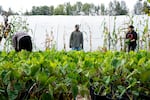
Volunteers with the Ka ʻAha Lāhui O ʻOlekona Hawaiian Civic Club harvest kalo leaves at Unity Farms at the Oregon Food Bank in Portland, Ore., on Saturday, Sept. 26, 2026. The kalo leaves are given to community members for free.
Jireh Deng / OPB
The plot of land is no bigger than 400 square feet, tucked behind the Oregon Food Bank on an acre of land known as Unity Farms. Despite its modest size, this garden has yielded over 300 pounds of leaves from its crop of kalo — the Hawaiian name for the taro plant — this year.
On a cold morning in late September, dozens of volunteers with the Ka ʻAha Lāhui O ʻOlekona Hawaiian Civic Club sliced the stems of the tropical root vegetables, harvesting their arrow-shaped leaves to be consumed. This was a special barbecue and potluck celebration before the kalo would enter hibernation for the winter.
Growing kalo in this garden — or māla as it’s called in Hawaiian — began as an experiment five years ago. People weren’t sure if kalo could grow in the Pacific Northwest.
“Because it’s Oregon weather, we’re still learning,” said Anita Keā’lani Yap, who is training at Oregon State University’s master gardener program. “[Kalo] grows over in Hawaii really well and it lies in the water.”
They found that kalo is hardy enough to survive outdoors in Pacific Northwest winters. This year’s harvest has now fed dozens of families, grounding the rapidly increasing diaspora of native Hawaiians living in Oregon thousands of miles away from their homeland.
How the māla fosters cultural belonging and learning
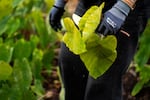
A volunteer harvests kalo leaves at Unity Farms at the Oregon Food Bank in Portland, Ore., on Saturday, Sept. 26, 2026. Kalo, a tropical root vegetable native to Hawaii, will go dormant in the winter, dropping its leaves.
Jireh Deng / OPB
Kalo is a staple of traditional dishes like lau lau, a Hawaiian-style tamale where kalo leaves are wrapped around pork and fish, then steamed.
David Frye said he’s learned more about how to make cultural foods by volunteering at the māla.
“It’s my favorite thing,” said Frye, who grew up in Hawaii and sometimes feels homesick. “When we come out here, it’s almost like we’re back home for a minute. We’re around people that understand us.”
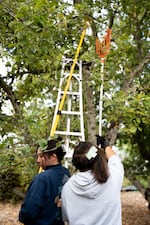
Community members harvest apples for cider at Unity Farms at the Oregon Food Bank in Portland, Ore., on Saturday, Sept. 26, 2026.
Jireh Deng / OPB
Leialoha Kaʻula, the executive director of the Ka ʻAha Lāhui O ʻOlekona Hawaiian Civic Club, also known as KALO, like the plant, says the vegetable is more than just subsistence. In the Hawaiian creation story, kalo is sprouted from the stillborn son of the goddess Ho‘ohōkūkalani and nourishes her second-born, the first native Hawaiian.
“For me as a kanaka, that’s my identity,” she said of the sacred plant. “We see that plant as our ancestor, our grandfather, our kupuna.”
Hanging from a table next to the potluck at the māla, an illustration of kalo breaks down the anatomy of the plant by its indigenous names.
Nohea‘ililani Waiwai‘ole, a third generation native Hawaiian raised in Oregon, brought her daughter, Kaualanipili, with her to the festivities. She said it’s important that she raises her three-year-old with an understanding of her family’s lineage. New census data from 2020 revealed that over half of native Hawaiians now live out of state.
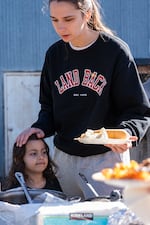
Nohea‘ililani Waiwai‘ole and her daughter Kaualanipili load their plates at the potluck hosted at the māla on Unity Farms in Portland, Ore., on Saturday, Sept. 27, 2026.
Jireh Deng / OPB
“It’s hard to form your identity in isolation,” she said of trying to define her own Hawaiian identity living away from the islands. “All of that stuff is cultivated through relationships and through community, having things mirrored back to you.”
Growing kalo strengthens food sovereignty for native Hawaiians
Growing kalo is also addressing health equity within the Hawaiian community in the Pacific Northwest. A study from 2016 to 2021 by the Department of Health and Human Services found that Native Hawaiians and Pacific Islanders were 41% more likely to experience food insecurity than households nationwide.
Yap, who formerly sat on the Multnomah Food Policy Council, said she’s concerned about how her community will be hit by potential cuts to SNAP benefits next month. Hawaiians at the māla talked about leaving the island and coming to the Pacific Northwest for the lower cost of living.
But prices are still hefty at grocery stores off the island. For example, kalo leaves can cost anywhere from $4 to $12 per pound in the Portland metro area.
“People are going to be hungry; things are really expensive,” Yap said.
Ka’ula said there’s still more to be done to understand the food insecurity of native Hawaiians living in Oregon, especially since census data does not always disaggregate Asian American communities from Pacific Islander populations.
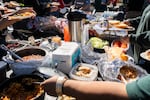
The Ka ʻAha Lāhui O ʻOlekona Hawaiian Civic Club hosted a special māla day to celebrate the end of summer at Unity Farms at the Oregon Food Bank in Portland, Ore., on Saturday, Sept. 26, 2026.
Jireh Deng / OPB
“There’s already a mistrust with the government and the people,” Ka’ula said, referring to the history of US imperialism and illegal overthrowing of the Hawaiian kingdom. KALO is now working with the Oregon Health Authority to get a better sense of the needs in their communities.
“We want to be a resource, to be able to be a voice at the table,” she said of bridging the gap between government resources and the native Hawaiian population.
KALO also operates the AloHā Resource and Community Center, one of the only native Hawaiian cultural hubs in the entire state of Oregon.
“Our main goal truly is just to be able to create a puʻuhonua or a safe place or a home where our people can gather,” Ka’ula said.
In the meantime, Amelia Styan, the ʻāina coordinator at KALO who oversees the māla, said KALO has given away 1200 plants for free in an effort to help community members have access to affordable, culturally relevant food.
“Once you have one plant… it will make new keiki and babies,” Styan said. “Then you have given them out to your friends, so I think it’s like the best plan for food security.”
Correction: An earlier version of this story misstated how long ago the garden was started. OPB regrets the error.