
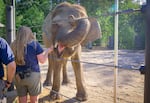
Chendra, a female Bornean elephant at the Oregon Zoo, gets a sweet potato from elephant keeper Aimee Bischoff on August 18, 2023.
Sheraz Sadiq / OPB
More than 2,800 zoo and aquarium professionals will gather in Portland this week for the annual Association of Zoos and Aquariums conference.
The nonprofit organization advocates for the advancement of zoos and aquariums and is the accrediting body for high standards of care for animals.
Dan Ashe is the president and CEO of the AZA. He joins us to discuss the role of zoos today and their future.
Note: The following transcript was transcribed digitally and validated for accuracy, readability and formatting by an OPB volunteer.
Dave Miller: From the Gert Boyle studio at OPB this is Think Out Loud. I’m Dave Miller. About 2,800 zoo and aquarium professionals are gathering in Portland this week. They are here for the annual Association of Zoos and Aquariums conference. The nonprofit is dedicated to advocating for the advancement of zoos and aquariums and is the accrediting body for higher standards of animal care. Dan Ashe is the president and CEO of the AZA. He joins us to talk about where zoos are today and where they might be headed. It’s great to have you on the show.
Dan Ashe: Great to be here, Dave. Thank you.
Miller: How do you define the Association of Zoos and Aquariums? What is it?
Ashe: You mentioned it’s an accrediting body, so the foundation of our business is accreditation. Our standards are viewed as the gold standard globally for a modern aquarium or zoo. We have 254 accredited members, most here in North America, but as far away as Hong Kong and Singapore, 13 other countries.
Miller: Membership is voluntary. So why would an individual member of, say, the zoo here in Portland, just in the hills not far from us, seek it out?
Ashe: Because they want to be the best that they can be, and at the core of our membership is a desire to be the very best in their profession; and so, certainly, Oregon Zoo here in Portland, Oregon Coast Aquarium, the High Desert Museum in Bend are members that are looking to be the very best they can be in their field, and have the opportunity to share and learn from their colleagues in their profession, and that’s what we’re doing here this week.
Miller: What might the differences be between an AZA-accredited compliant zoo and some roadside one, or smaller one that’s not a member? I mean, are they differences that I would notice as a zoogoer?
Ashe: I think so. I mean, what you’ll notice is the quality of the habitats that the animals are living in. You’re going to see a naturalistic habitat with a variety of structure, three-dimensional features, and vegetation that allow the animals to express their natural behavior. They’re not just an exhibit. They’re living in that space, and we want them to exhibit their natural behaviors.
If you got a little bit deeper, you would see somebody with a title like veterinarian. Oregon Zoo would have a full-time vet and a veterinary staff, so you would see animal care professionals, and if you went a little deeper, you would see a nutrition center, people that are dedicating their career and their time to making sure that the animals are properly fed, and you would see a very deep field of animal care.
Miller: What kind of disciplinary power do you have? In other words, how do you make sure that this accreditation is meaningful?
Ashe: I spent a good part of my career in government, working for the U.S. Fish and Wildlife Service, which is in part, a law enforcement agency…
Miller: In part? You were the director of it, you didn’t just work there.
Ashe: I was the director in the Obama administration, correct, and a law enforcement official in the organization one time told me, “Law without enforcement is just guidance.” The important thing about AZA standards is we enforce them. So, we are having accreditation hearings here in Portland, 34 facilities going through accreditation. The Oregon Zoo was accredited on Monday, so they went through their normal five-year process.
But in between those five years, any unusual incident, if there was an animal escape or an unusual animal death or injury, or a guest injury, then they’re required to make a report to our commission, and they have a variety of options available to them. If it’s severe enough, they can require a mid-cycle inspection. They can remove accreditation. So the important thing about AZA standards is they’re enforced, and we regularly have long-term members that lose their accreditation because they’re not fully adhering to our standards, and that’s the most important distinguishing factor is our standards have meaning and have impact and if members aren’t adhering to them, we catch it.
Miller: How have zoos changed in your own lifetime?
Ashe: There’s been a total transformation, I grew up in Atlanta, Georgia. I, as a child, with my four brothers, we spent many days at what was then called the Grant Park Zoo in Atlanta, and by today’s standards, abysmal, really.
Miller: What did you think of it, as a kid?
Ashe: I thought it was wonderful, and you know, you’re oblivious to a gorilla named Willie B., a lowland gorilla who spent 25 years of his life in solitary confinement, on concrete floors, behind bars. And if you go to that same physical space today, it’s called Zoo Atlanta, completely transformed.
They have a Ford [African] Rain Forest exhibit, where a troop of gorillas, they’re living as gorillas in a natural habitat. They have 24-hour care. They exhibit all the social behaviors of gorillas. The Dian Fossey institute is co-located at Zoo Atlanta, and they’re doing groundbreaking research on heart disease and other things that afflict both gorillas that are in human care and gorillas in the wild. They’re doing incredible conservation work in Uganda and Rwanda to help save gorillas from extinction.
So that one example, Zoo Atlanta, completely transformed, and that’s all across our accredited zoo community. They’re dedicated to conservation of animals in nature, doing cutting-edge scientific research, running directed, mission-driven education programs, and so completely transformed.
Miller: What happens at the annual AZA Conference? As I said, 2,800 people are coming. What kinds of meetings do they take part in?
Ashe: It’s a variety of meetings. You think about the zoo, of course, animal care. We have meetings of our Animal Welfare Committee, our Research and Technology Committee, our Wildlife Conservation Committee. We have specific panel sessions on the business part of running a zoo and aquariums, so fundraising, guest service, cashless transactions, all of the things that require a modern business to run and be financially successful.
Miller: Well, on that note, broadly, I mean, we’re talking about more than 200 places in the U.S. alone that are accredited by your organization. So I imagine there’s a lot of diversity within it, both zoos and aquariums. And even when you mentioned Oregon, keep in mind that the High Desert Museum in Bend is a part that gives us a sense that it’s very different from the Oregon Zoo. But how would you say the business is right now? I mean, how much are Americans excited to spend their money to go visit these institutions?
Ashe: It’s a thriving community. We just did an economic impact analysis in 2024. $35 billion in annual economic impact, 254,000 jobs, over 210 million guests, and the Oregon Zoo is a great example. The people of Portland just two years ago passed a $380 million bond initiative because they see the value of the Oregon Zoo, not just as a great place to go and spend time with your friends and families, but as an economic anchor in the community.
Our members are doing well. They’re like all businesses right now. I think there’s underlying stress in the economy right now and they’re certainly feeling that, but overall the proposition is thriving. And I personally think that as human beings, we’re increasingly urban. Nature, at the large scale, is a diminishing resource, and people are looking for places to make those connections, and our members are the places they’re going to.
Miller: If you’re just tuning in, I’m talking right now with Dan Ashe. He is the president and CEO of the Association of Zoos and Aquariums. That association is having its annual meeting this week here in Portland. You’ve been criticized by zoo proponents in the past for letting PETA and the Humane Society have a presence at AZA meetings, despite the fact that those organizations or other groups like them have, in a sense, called for the end of zoos. Will those organizations have an official role in Portland this week?
Ashe: They don’t have an official role, but we have friends from PETA that are attending, and since I came to AZA, one of my goals has been to not divide people but to unite people. And while we may disagree with PETA on some things, we agree with them on most things. Our members spend 24 hours, 7 days a week, 365 days a year working to take care of animals and so...
Miller: But obviously they disagree with the fact that… They don’t think that those people you’re talking about should be taking care of animals that are, even if the habitats are much better than when you were a kid, still, those gorillas, those giraffes, those elephants, they are behind a version of bars still, and they don’t want those animals to be there.
Ashe: They don’t, but they also recognize that they are there, they want them to be well cared for, and they recognize that AZA stands for that. And so we can agree on that. That the animals that are there should be in exceptional care and animals that are in places like the roadside zoos you mentioned should not be there. So we have common cause there, as we do with Humane World, which is formerly the Humane Society of the United States, and the International Fund for Animal Welfare. We have a collaborative, joint project called “Not a Pet,” to try to educate people that exotic animals are not appropriate pets, and work fighting against illegal trade in animals. So we have much common cause.
Miller: How do you think about the correct balance, the appropriate balance between internal activities like visitor entertainment or education, the things that happen within the walls of a zoo, and truly external conservation efforts done by zoos, funded by zoos across the country, that could happen anywhere in the world? What’s the balance that you think is the right balance?
Ashe: I think the appropriate presentation of animals that creates this thing we call experience is a vital part of conservation, because after more than 40 years in the conservation profession, more than ever, realized that if we’re going to be successful in conserving nature, we need to win people’s minds and their hearts.
Miller: It’s a kind of Teddy Roosevelt idea.
Ashe: Exactly. We have to make that connection with people, and Oregon Zoo and Oregon Coastal Aquarium are the places that that’s going to happen.
Miller: Is there research that says that this works? I guess, in other words, what you’re saying is, if people in Louisville or Portland or wherever, they go, they take their kids, or they just go themselves; they go to an aquarium or a zoo and they see a manatee or an elephant or whatever, you’re saying you think they’re going to care more about wild animals in Rwanda, or habitat that’s not going to turn into a palm plantation. Is that true?
Ashe: I know it to be true. The late great ecologist, E.O. Wilson,
Miller: The “Ant Man.”
Ashe: E.O. Wilson had a zoo story… When I said that that gorilla in solitary confinement in Atlanta is a vital part of my constitution and why I became so entranced with animals and helping animals in nature, I know it to be true.
I think that the connection to conservation in the wild is also very obvious. In May, a free-flying condor that was released in the Yurok Reservation in California, flew across the border into Oregon, the first time a free-flying condor has been in Oregon since 1904.Those are zoos that made that happen. Los Angeles Zoo, San Diego Zoo, Oregon Zoo, Santa Barbara Zoo, that created that population that could be released and restored and wild.
Miller: I’m gonna go back to the question I asked you earlier about the balance, because I had set this up in a kind of binary way. I’d said there’s what happens inside the walls of the zoo, and then there’s the conservation efforts outside them. The reason I ask it that way is that from the numbers I’ve seen, something like one, two, three, maybe four percent or so of what zoos, broadly in the U.S., of their operating budgets goes to conservation. And the vast majority goes to taking care of the animals inside the zoos.
Clearly your answer, you were saying that it’s a little bit of an artificial binary, because you see the work inside the zoo as leading to all kinds of conservation mindset. But to go back to that percentage, I’ve seen different studies that have different numbers, but it’s relatively small. In other words, most of the money zoos spend is not on conservation in Rwanda. It’s not habitat preservation somewhere else. It’s to make sure that they’re taking care of the animals in their keep. How do you feel about that?
Ashe: I feel very good about that. I think, again, as a lifelong conservationist, if we think about it in the context of the U.S. government, how much of the U.S. government’s budget gets spent on environmental protection? Less than one percent.
Miller: Sure, but the U.S. government is not, I mean, we have, what was the famous line? “We are an army with health insurance.” The government is not saying, “We are in the business of conservation,” as one of the main ways that it sells itself. And zoos do that. Zoos, if you look at the advertising, you might get the wrong impression of the allocation of their budget. You might think that they spend more in habitat preservation elsewhere than they actually do.
Ashe: But the absolute fact is that our members last year spent $374 million in direct support of field conservation. Collectively that makes them one of the world’s largest supporters of field conservation. That’s sharks, that’s killer whales, that’s manta rays, that’s manatees, that’s sea otters, that’s black-footed ferrets, that’s Mexican wolf...
Miller: And your argument is that that money wouldn’t be spent if it weren’t for the zoos.
Ashe: It wouldn’t be, yeah, for sure. And going back to the zoo itself, you know, creating that spark in someone, that ignites a curiosity in them about a river otter or a polar bear or a jellyfish. I watch people stand in front of jellyfish exhibits at an aquarium and just are mesmerized by it.
Miller: I have been one of those people who is mesmerized. The colors and shapes are extraordinary and undulating.
Ashe: And I think that’s maybe not capable of being measured, but I know that it happens.
Miller: On Wednesday, there is a session called “Conversation on Conservation: Is nonpartisanship a strategy or a dream?” The moderator is the director of the zoo. How would you answer that question? As somebody who spent a lot of time in D.C., worked on the House Committee, and then ran the U.S. Fish and Wildlife Service under Obama, a very different time. But is nonpartisanship for you a strategy or a dream when it comes to conservation?
Ashe: You know, for me, at this point in time, it’s both. I think if we are going to be successful in saving animals from extinction, we have to bridge the divide between Republicans and Democrats, and that’s very difficult today because things are so partisan. Everything becomes partisan.
You and I were talking about AZA has established a new 501c4 organization which will allow us to do more lobbying than we can do as a c3, and we intend to build a middle, to try to restore that middle habitat in politics, because animals bring people together. So our goal is, and it’s a dream, is to help rebuild that middle.
Miller: At a time when the Trump administration is gutting the EPA, gutting basically every federal effort to combat climate change. Just last week, one of your successors at Fish and Wildlife put out a letter basically saying it’s fine to kill endangered species, fill in a wetland or chop down a forest, as long as your goal is not to kill those animals. If you kill them all, it’s fine, because that wasn’t your goal. So when all this is current policy, where do you see room for compromise or hope?
Ashe: I see it because I joined seven former colleagues who were directors of the U.S. Fish and Wildlife Service and directors of NOAA Fisheries, who worked across both Republicans and Democratic administrations in opposition to that policy.
Miller: To what end?
Ashe: Well, hopefully, again, to begin to bridge a divide ultimately, hopefully to support the legal challenges that are being made against those changes.
Miller: OK, you’re talking about the change in definition of “harm,” something we talked about in the past. Folks can find that conversation on our website.
Ashe: A critical issue in endangered species conservation, but again, people that served under both Republican and Democratic administrations coming together on that issue. And so, with AZA action and our members – and also very important to note that we recently did public perception polling – 77% of people trust AZA accredited aquariums and zoos to provide them with information about wildlife. Better than National Geographic, better than universities, better than government institutions. So we think we’re particularly well poised to help play this role.
Miller: Just briefly, I want to hear some recent news. China’s President Xi has sent two pandas to Atlanta, part of this longstanding panda diplomacy. What role do animals play in politics?
Ashe: I’m joyful about pandas coming to Zoo Atlanta, as I was about pandas coming back to National Zoo and to San Diego Zoo, because there’s no moment in time where it’s more important for the United States and China to get along. And here’s an example of a place where our two countries can agree, and people can learn about pandas and what’s happening to them in nature and how we’re all working to conserve them and just be joyful about the animals, so I think it’s a great step forward.
Miller: Dan, thanks very much.
Ashe: Thank you, David.
Miller: Dan Ashe, President and CEO of the Association of Zoos and Aquariums.
“Think Out Loud®” broadcasts live at noon every day and rebroadcasts at 8 p.m.
If you’d like to comment on any of the topics in this show or suggest a topic of your own, please get in touch with us on Facebook, send an email to thinkoutloud@opb.org, or you can leave a voicemail for us at 503-293-1983.
