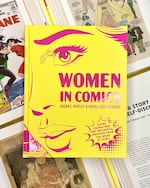
"Women in Comics" using 6 archetypes to trace the impact and influence women have had in comics.
Courtesy of Black Dog & Leventhal
From Wonder Woman and Lois Lane to Cathy and Veronica Lodge, there have been no shortage of women represented in comics. In the new book, “Women in Comics,” authors Nhora Lucia Serrano and Portland State University’s Susan E. Kirtley explore the history of not only the women on the page, but the authors behind them. Using archetypes commonly found in comic books, Kirtley and Serrano look at some of the most influential women that have changed the medium. Kirtley joins us to share more on the book and the impact women have had on the industry.
Note: The following transcript was transcribed digitally and validated for accuracy, readability and formatting by an OPB volunteer.
Dave Miller: From the Gert Boyle Studio at OPB, this is Think Out Loud. I’m Dave Miller. From Wonder Woman and Lois Lane to Cathy and Veronica Lodge, there have been no shortage of women in comics. In the new book, “Women in Comics,” authors Nhora Serrano and Portland State University’s Susan Kirtley explore the history of not only the women on the page, but the authors behind them. They focus on six female comic book archetypes stretching back 130 years, and they explore the ways that comic books have both reinforced and exploded societal stereotypes. Susan Kirtley, welcome to Think Out Loud.
Susan E. Kirtley: Thank you so much for having me.
Miller: You’ve written a lot about comics in books that you’ve written and co-edited. What first got you interested in comics? I mean, were you a reader before you were an academic who studied them?
Kirtley: Well, I started reading comics because I’m a contrary person. And when I was in elementary school, I was teased by some of the boys on the playground who said that girls don’t read comics. I’m contrary and decided, well then, I will read all of the comics. I will read everything I can. So, I don’t know if you remember the spinner racks at the grocery store, but I would go to the spinner racks and I fell in love with the comics. And I fell in love with the “X-Men,” and I thought, why aren’t we all reading these? They’re amazing. They’re like soap operas with more punching and just so much fun.
Miller: That was your first one, “X-Men?”
Kirtley: That was my first love, I think the one that really stood out to me and sort of started my obsession. And then as I got older, I read and I fell in love with independent comics. I started reading “Grendel,” “Concrete” and these other comics. Then I found other comics like Lynda Barry and all these other comics. I read all of the comics. So, I’ve been a reader of comics my entire life. I think they entered into my academic life later, but it was a great joy to bring in my own academic training with this passion for comics.
Miller: It’s fascinating that, as you said, you were a contrarian and you started this partly because you were told that this wasn’t for you. As a reader though, as a young reader, as a girl, did you feel like you were represented or you could see yourself in what you were reading? I mean, pre-Lynda Barry and pre the comics you turned to later?
Kirtley: Yes, I think I connected, I think many people connect with the “X-Men.” And I loved the characters. They were sort of these outcasts, misunderstood characters. And I have this abiding affection for this character named Rogue. And Rogue was this villain who’s trying to be good, and her power was that she sucked the life out of everyone. And as a sort of nerdy kid, I was like, oh, I relate. I, too, suck the life out of everything. But I really connected with those characters. And as I grew up and read more and more, I found these points of connection, and felt excited and represented in these comics.
Miller: The very first full page illustration in your book is a cover of a comic called “Marge’s Little Lulu Clubhouse Special” from the 1970s. Can you describe it?
Kirtley: Well, there’s this “Little Lulu” comics, many folks will know them, and there was sort of a challenge where the boys in this particular comic were saying, “No girls allowed.” And little Lulu is having none of it. So she eventually paints over the clubhouse that says, “No girls allowed,” and it says, “Now girls allowed.” And that was a theme for Nhora Serrano – my co-author – and I, this idea that girls are part of this clubhouse of comics, characters and creators, and they’ve really been there all along.
Miller: Right. In that sense, the “now,” if I read you correctly, it’s almost misleading. You argue there was never a time when girls and women were not a part of comics.
Kirtley: I think so. I think we were not making the case like, oh, this is a new thing, women in comics, but rather, looking at comics history with the idea of putting women at the center of that historical perspective. And, I agree. “Little Lulu” is sort of making a declaration, but really, women have been part of that history all along.
Miller: As I mentioned in my intro, the way you chose to explore this prism is by looking for more than 130 years of comic history – comic strip, comic books, various kinds of graphic storytelling – and then breaking up the female characters into six different archetypes. The first one that you go into is known as the patriot. Who is a patriot?
Kirtley: You know, it’s really interesting, and we use these sorts of archetypes, not arguing that these were the only ones…
Miller: Or that these are discrete. There’s overlap, too, right?
Kirtley: Exactly, exactly. So we have these archetypes, and the idea was these are sort of a lens through which to reveal these interesting stories in a compelling way, as opposed to just a list. So we start with the patriot, and it’s really fascinating in ways that this figure has changed. In these early examples of these patriots we see in these sort of early political cartoons, we see countries embodied by these women, these female figures like Britannia and Columbia, but they’re really more ideals than agents. They’re just these ideas. But at the time, women were really prevented from participating. So it’s interesting that there are these representations of countries, but really, they weren’t able to participate in the politics of the time, say, in the 1890s and such.
Miller: They were symbols, not humans.
Kirtley: Exactly, yeah, they’re just not active agents. They’re ideals. And then over time we start seeing these amazing patriotic characters like Wonder Woman, who is this interesting figure because she’s not originally from the United States, but a very patriotic character. We have Wanda the War Girl, who’s this amazing Australian.
Miller: Can you describe it? We’ll talk about Wonder Woman in a second because she’s so seminal and well known, but there’s still stuff to dig into. But I had never heard of Wanda the War Girl from Australia. Who is she?
Kirtley: Well, this was one of the joys of doing the book is that Nhora and I discovered a lot of characters and creators that we weren’t familiar with. And I think it’s interesting to think about the patriot through this international global lens. Patriotism is not unique to the United States.
So we have this character, Wanda the War Girl, which was created by this woman, Kathleen O’Brien, during World War II. And it was really her tribute to the servicewomen in Australia during World War II. [She was] just a wildly popular character, had amazing adventures, and again, she was also very fashionable, very daring, did covert espionage missions. It’s so much fun.
Again, this was just a joy doing the research. Nhora and I would say, “you have to read this, we have to look at this,” and we would go down this rabbit hole. And it’s just so much fun. So we have this sort of evolution of the sort of ideal, and then we have these active patriots. Then in more recent comics, we’ve seen an interesting turn in which some of these patriots are moving away from individual countries and more about “justice for all,” which is a very interesting evolution.
Miller: Let’s turn to Wonder Woman. You note that one of her creators, a psychologist named William Moulton Marston, wrote, “Wonder Woman is psychological propaganda for the new type of woman who I believe should rule the world.” What did he mean?
Kirtley: Well, I think the legacy and the origins of Wonder Woman are fascinating. William Moulton Marston was the psychologist who created the character, but did so very much in collaboration with many strong women around him. And I think he had this ideal as well of this powerful woman who was guiding the way.
Miller: How explicit, how much did the public know about the women who were with Marston? You talk about one ghostwriter. I’m curious how public it was that women were a part of the creation of these stories, for Wonder Woman in particular.
Kirtley: I don’t know that it was hugely nor widely known in that some of the women working on it used different names, and he had a wife, and he also had his mistress, and today that would be very public knowledge. You have all these outlets. But at the time, I don’t think it was well known.
Miller: You include the cover of the very first standalone issue of Ms. Magazine, in the book, which Gloria Steinem published in July of 1972. It says, “Wonder Woman for President” with a big picture of her. What was happening to Wonder Woman in the years leading up to that? What was this a reaction against?
Kirtley: Well, I think that’s one interesting trend as we’re reading across these comics, you also see the history of the time. You see the history of the women’s rights movement, as reflected in these different comics. And we see Gloria Steinem, and we see this moment in women’s rights, what they would call the women’s lib moment. And you see, Gloria Steinem kind of reclaiming the character. Wonder Woman has gone through many, obviously different writers and creative teams, and she’s had runs where she’s very powerful and exciting, and there are also times when she kind of gets sidelined and becomes sort of a minor character or, oh, “I’m the secretary for the Justice League.” But I think that was a moment where I think the women’s liberation movement and the comics came together and there was this, let’s reclaim this powerful symbol for women.
Miller: Can you tell us about a contemporary hero who you put in the patriots section named America Chavez, created by the artist Gabby Rivera?
Kirtley: Well, I think one trend that we’ve also noticed, a really exciting one, is the more diverse characters that we’re seeing, and she’s a great character. I think that again speaks to a lot of folks, and is more diverse, and represents that sort of intersectional identity, which I think is a really exciting trend that we’re seeing in contemporary comics.
Miller: Let’s turn to another archetype that you have. It’s called the working woman. How do you describe the working woman? Who fits into this?
Kirtley: Well, in comics history, we have this tradition of representing women in the workplace, and this was a really interesting one. And in the patriot chapter, I talked about, oh, some things have changed in our representations. In the working women chapter, it was interesting to me how much has stayed the same.
So, for example, I talk about a character named Fluffy Ruffles. “Fluffy” was a proto-comic from 1907 to 1909, written by Carolyn Wells, who was a mystery writer, and illustrated by Wallace Morgan. But Fluffy is this sort of socialite debutante. There’s that crossover, but she loses all her money and she tries to get a job. And this is in 1907. And poor Fluffy cannot keep a job, not because she’s not competent. She’s competent at everything she tries every week. She’s a beekeeper. She’s a golf teacher, a dance instructor and a governess. But what happens is all of these men sort of invade her space and cause a ruckus.
Miller: She’s too pretty. She’s too distracting.
Kirtley: Exactly. So she just can’t find a job, and I think it’s a fascinating tale of the time. But then you’d mentioned “Cathy.” You think about Cathy, and “Cathy” by Cathy Guisewite – the comic strip was 1976. She also struggled to be accepted in the workplace and represented that in the comic strip. She goes to a convention and everyone asks her for coffee. They think that she’s their date.
And even as recently as 2017-2018, you have this French cartoonist Emma, and she talks about, writes about and shows her struggle to be accepted in this workplace. And it’s interesting that over time, it’s the same sort of frustrations and themes represented across time and space in the globe.
Miller: When you look at “Cathy” now, where do you see the line between shining a light on stereotypes or skewering them, or reinforcing them?
Kirtley: I think “Cathy” is a fascinating example, because people make fun of Cathy because she talks about dieting, fashion and…
Miller: And chocolate.
Kirtley: … chocolate and things like that. One interesting thing to me as a researcher is that’s a lot of what gets remembered. But if you actually go back and they look at the daily strips, what’s not anthologized is fascinating. So there’s a whole story arc where Cathy is sexually assaulted and harassed by her boss, and has to fight back and it’s this whole theme. But that doesn’t get into the anthologies.
Miller: Well, as you’re saying, maybe it doesn’t get into the anthologies. It is also … what you led with is as interesting, that it doesn’t get remembered by the rest of us.
Kirtley: Right.
Miller: And instead, the kind of act, pulling your hair out, that’s what gets remembered. How do you explain that?
Kirtley: Well, I imagine that they obviously did lots of product … There were cards, t-shirts and things like that. And the comic strips that people cut out and put on their refrigerator are the ones where she’s talking about chocolate or …
Miller: As opposed to talking about sexual assault.
Kirtley: Exactly. But I don’t think those are remembered and talked about. And she was doing really interesting things, talking about family medical leave and all of these things. So I think there’s a lot more there that deserves to be talked about, looked at and contemplated.
Miller: Another archetype that you dig into is the socialite. Who’s a socialite?
Kirtley: Well, there’s a lot of socialites in comics because it’s this idea of wealth and prestige. And for us, this was interesting to think about because it’s a form of power that isn’t always recognized. Not physical force. It’s this power of connection and influence. So, we talk about characters, you think of Veronica from “Betty and Veronica,” but also socialites, there’s Lady Penelope. But there are these interesting figures that wield power and influence through this network of prestige, influence and polite society, which I think is really interesting.
Miller: There’s something obviously gendered about the term “socialite,” but is Bruce Wayne a socialite? Is Iron Man, a very rich industrial magnate, a version of a socialite? Or when they’re men who are rich, is it different?
Kirtley: I think it’s really interesting to think about whether the term would apply, and I’m not entirely sure. I think for those characters, they’re presented as having perhaps options or influence in other ways that isn’t always accessible to these characters who are women. So, for example, you mentioned Bruce Wayne. Bruce Wayne, vigilante and so forth, and this very wealthy person with a lot of prestige, but then you have Catwoman. And Catwoman sort of started out as this socialite, this kind of glamorous figure, but then she gets sort of shut down by the Comics Code Authority.
Miller: Can you tell that story? This is a fascinating one – when Congress gets involved and there are hearings. So what was the Comics Code Authority?
Kirtley: There was a sort of a movement inspired by Fredric Wertham [who] wrote a book, “Seduction of the Innocent.” And his argument is … and this is very simplified, and there’s other research about it. But he’s arguing that comics are bad, would ruin our children, and they’re morally depraved. So they had these hearings in Congress and the comics companies came up with the Comics Code Authority. And it was created by the comics companies as sort of a self-policing, self-censorship idea.
They had these tons of rules, and one of them is that crime cannot be glamorous. And that was basically the end of Catwoman, and she disappeared for quite a while because crime cannot be glamorous. She didn’t come back until years later after the TV show and the character became popular, and then she came back. But the Comics Code had a very stifling influence on comics.
Miller: Catwoman is also interesting in the book because, if I read it correctly, she was one of few villains in the book. There’s a lot of heroes. And she’s a weird kind of villain, too, because she’s never gonna put Batman in mortal danger. So she is sort of portrayed as a relatively safe villain and also a sexy villain, too, which is different from some evil guy who might kill the male superhero.
But how do you think about women villains in comics over the years?
Kirtley: As a reader, they’re a lot of fun to read. But, it’s interesting. One reason we didn’t want to just focus on the villain archetype is because I think that one is talked about a lot, like, oh, placing women in categories, the hero and the villain. So we sort of wanted to expand and think broader than that, but I think there are a lot of characters that are women and they’re put in this villain category. And they’re really fascinating, and they’re usually complicated and complex, like Catwoman, this really sort of morally ambiguous … sometimes they’re good, sometimes they’re not good. And that, I think as a reader, is really compelling.
Miller: So in addition to the socialite, you have a focus on the fashionista, which is very much about not just looks, but style. How does that character function today?
Kirtley: I think for us, thinking about that, with comics, the image is so important. And I don’t want to forget, Nhora and I can and do talk and talk and talk in the book, but we want to also show the images. We have some great images of fashion and fashionistas, both from older comics and more contemporary ones. And I think this is a way that comics are unique in that they can show us. They show us these fashions.
Going back in time, it’s great to look at the ways that creators would tell stories without a word through these fashions. In terms of today, there’s a lot of fun comics throughout the world. For example, Annie Goetzinger has a comic called “Girl in Diore” about fashion, really engaging with that’s high fashion. But then there’s “The Prince and the Dressmaker,” which is a great graphic novel, by Jen Wang talking about the ways in which we can find connection and authentic identity through what you wear. So as someone interested obviously in the visuals, it’s really fun to get to look at the ways in which fashion and style, as you say, is used as this image to tell the story.
Miller: You made the bold choice in that section to include a couple of pages about Barbara Brandon-Croft, an artist who made the decision to not include the bodies of her characters in one of her famous series. Instead, you get heads and arms to illustrate emotion, action, everything.
It’s worth talking for a second, in that context, about sort of the diametrically opposed version of cartoon depictions of women, which are scantily-clad, busty characters who were pretty clearly drawn either for the male gaze or for the 14-year-old boy gaze. How do you reckon with that as an academic who’s focused, in this case, on women in comics?
Kirtley: It’s funny because people will sometimes ask me, “Oh, you study comics, aren’t comics kind of sexist?” And they’ll ask me that and I’ll say, “Well, isn’t society? Aren’t many films, aren’t many books, but not all?” So, yes, there is that element, but it’s not the only element. It’s important for us to talk about it, and recognize it, and think about what it means, but it’s not the only thing that’s happening.
I’m glad you mentioned Barbara Brandon-Croft because she made this amazing comic, “Where I’m Coming From,” and very intentionally chose – it’s focused on this cast of Black women – I’m going to just show their heads and their arms, and they’re having this discussion. And she’s like, I’m so tired of having it be this focused on the body. We’re just going to have a conversation. I think it’s a really fascinating approach.
Miller: Maybe it’s just because I’m a journalist myself, but I was thrilled to see that reporter is one of the archetypes. How did it come to be?
Kirtley: I think when you think about reporters and you think about their presence in comics, you think about Brenda Starr, and of course, the origin, Lois Lane. And Lois Lane is this key figure, another one who I think was sidelined and then grew into more of a character, more of a backstory, more prominence. And then there was sort of a reimagining of Lois Lane recently by another cartoonist, Kate Beaton, in which she depicts Lois trying to get the story, and Superman’s just always getting in the way. She’s like, oh please, Clark, just get Superman, just get out of my way. I want to do my job.
Miller: Clark, who is a reporter himself, but it would make no sense to put Superman in the category of reporter. It’s not consequential for his character in a way that it defines Lois.
Kirtley: Yes, absolutely. She was always a dogged reporter from the very beginning, but I think over time, she, again, has gained more agency and more autonomy, which I think was an interesting trend. But that’s it. I mean, we see a lot of reporter characters in the comics, and it seems like that reportage is an important function for comics because there are nonfiction comics. There is journalism in the form of comics as well.
Miller: Right, you include reported graphic novels and other nonfiction in this section. In your mind, they’re connected?
Kirtley: Well, for me, I think there is often this idea … or I experience a lot of folks saying or thinking that comics are just superheroes. I love superheroes, but comics are a way of telling a story.
Miller: Do you hear that in 2026? It seems like “graphic novels,” that phrase that has come to mean so many things. It seems like there’s been much more of a cultural understanding in the U.S.. And maybe we’re behind some other countries in Europe in this, but it seems like things have changed in the last 15 years. Maybe I’m wrong though.
Kirtley: I think it has, and the fact that I’m able to teach comics courses at a university is a testament to that, that there is a growing awareness, respect and understanding of comics. But it still happens from time to time. I was at Powell’s and I was near the children’s section, and this child picked up a comic and their parents said, “Oh, get a real book,” and it just broke my heart because they’re such amazing stories.
Miller: As I mentioned, you’re the author of two earlier books, one about Lynda Barry, one about women-created comic strips in the last 50 years or so. This new book has a much broader focus. We have about a minute left, but what was it like to dig into this larger history for you personally?
Kirtley: For me, it was a thrilling journey and a celebration because I got to see so much more of the landscape, because I’ve been focused primarily on comics from the United States. It was just a joy to discover all of these comics from across the world. So it is absolutely a celebration that I hope people will enjoy.
Miller: Susan Kirtley, thanks so much.
Kirtley: Thank you.
Miller: Susan Kirtley is a professor in English at PSU, co-author of the new book “Women in Comics.” It comes out on October 6.
“Think Out Loud®” broadcasts live at noon every day and rebroadcasts at 8 p.m.
If you’d like to comment on any of the topics in this show or suggest a topic of your own, please get in touch with us on Facebook, send an email to thinkoutloud@opb.org, or you can leave a voicemail for us at 503-293-1983.