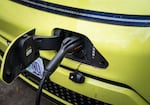
The charging cable is plugged into Kip Silverman's Hyundai Kona at his home in Portland, Ore., on Sept. 29, 2026.
Saskia Hatvany / OPB
When Kip Silverman bought his first electric car in early 2024 — a brand new Hyundai Kona EV — he was hoping to reduce his carbon footprint and save money on gas.
But Silverman, a resident of Portland’s St. Johns neighborhood, soon learned that filling up his battery was a much bigger challenge than filling up a gas tank. Fast chargers, which can get a battery up to 80% full in about 20 minutes as opposed to hours, can be hard to find.
Silverman recalls driving from charging station to charging station to find a spot, but they were all taken. Finally, he found an open charger in a New Seasons supermarket parking lot and was able to plug in.
“We drove around for about half an hour and my capacity went from 20% to 10% to 8%,” he said. “That was really hairy.”
Over the past decade, electric cars have gained popularity. Today, there are more than 5.3 million electric cars and trucks registered across the nation and about 140,000 of those are registered in Oregon. But as drivers have switched to this new technology, critical charging infrastructure has not kept up despite millions in federal funding — including $52 million awarded to Oregon.

Kip Silverman poses for a portrait in his car. Silverman, who purchased an electric car in 2024, said he has since had trouble finding ways to quickly and reliably charge his car outside of home.
Saskia Hatvany / OPB
Now, more than a year after the Trump administration’s reversal of Biden-era climate policies and a freeze of federal funding dedicated to improving access to fast chargers, Oregon is finally preparing to welcome its first federally funded fast chargers next month. It’s a problem that has affected much of the country. Not a single federally funded fast-charging station is in operation on the West Coast.
The Oregon Department of Transportation, which has struggled with a $200 million budget hole, hopes to have more than a dozen more such stations running or underway by next year.
The slow rollout of fast-charging EV stations has forced drivers like Silverman to get creative when they hit the road. He now has five different applications on his phone that tell him where he can find a charger, the charging speed and if it’s available to use.
On road trips north to Seattle or down to Ashland, he said he routinely finds lines of EV drivers waiting for an open spot to charge.

Kip Silverman shows the apps that he uses to find charging stations on his phone. Silverman relies on several different charging station companies to find places to charge his car.
Saskia Hatvany / OPB
At a large charging station in Tacoma, he recalled, only three chargers were actually working.
“There were a whole bunch of us that were just sitting around waiting for one to open up,” he said. “So that was brutal. Portland, it’s even harder to find one.”
Silverman’s experiences illustrate the broader challenge faced by drivers of electric cars.
While gas stations can be found in nearly every small town and even in remote and rural areas, there are few EV charging options. Drivers like Silverman have had to meticulously plan out stops to recharge, even on Oregon’s busiest roads.
In some of the state’s rural areas, drivers face even more challenges, with fewer charging options and long waits at outdated charging stations that can take hours to top up a battery.
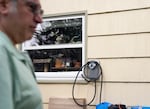
Kip Silverman stands in the driveway of his home, where he has a charging station installed.
Saskia Hatvany / OPB
A slow start to the fast charging push
In 2021, well before Kip Silverman bought his electric car, the Biden administration announced a plan to make EVs more attractive. The goal of the $5 billion National Electric Vehicle Infrastructure program, or NEVI, was to create a robust network of fast-charging stations along some of the nation’s busiest highways.
The program sent a signal to the industry that electric cars were here to stay, according to Ingrid Malmgren, a senior policy director with Plug In America, a national nonprofit focused on accelerating EV adoption.
“It’s not all about gas anymore and there are other options, and that you can drive all the way across the country on electrons now,” she said.
Five years ago, there were a little more than 17,000 public DC fast chargers in the nation. Fast forward to July 2026, there are nearly 74,000 public DC fast chargers, according to federal data. That equates to about 71 electric cars per fast charger.
But that rapid deployment still leaves drivers of electric cars with far fewer options than gas car drivers when it’s time to fuel up. According to the publication E&E, EV chargers are harder to find, farther apart and accept different forms of payment through multiple applications.
The NEVI program was a way to provide states with the tools needed to build more fast-charging infrastructure to help fuel these vehicles.
But despite what the program signified, it had challenges from the start, Malmgren said.
The program needed to establish minimum standards, like defining what “DC fast charging” was and how many chargers there would be per station. Each U.S. state and territory had to develop its own plan. Only then could the federal government send NEVI funds to the states.
When Oregon finally learned it would receive $52 million through the program, the Oregon Department of Transportation estimated the funding would add about 64 DC fast-charging stations, with at least four fast chargers at each. Each station would be located near food and public restrooms. The state set out to add these stations in locations that desperately needed them, especially on the state’s most-driven highways.
In October 2024, ODOT announced it would use NEVI funds to pay three private companies to build, operate and maintain 13 fast-charging stations along Interstate 205 and Interstate 5 south of Eugene.
Then Donald Trump was elected president.
Delay, delay, delay
In his first month in office, the Trump administration halted all federal funding that was being dispersed through the Biden-backed infrastructure law — even when the funds had been promised. At the time, Oregon had already allocated $26 million.
The freeze, which lasted about six months, affected multiple renewable energy and climate action investments through the federal government. More than a dozen states, including Oregon, sued the federal government, saying it unlawfully withheld funds from the program.
Those delays impacted many projects across the nation, including all of Oregon’s planned stations.
Electrify America had been chosen to build two stations along Interstate 205, one in Gladstone and the other in Happy Valley.
The Trump administration freeze slowed that work, Andrew Dick, the company’s business development manager for incentives, said.
Electrify America had expected to take 12 to 18 months to build each station.
NEVI states had to restart their programs “after this unexpected interruption at the federal level,” Dick said. “So the timeline that we’re seeing in Oregon actually parallels what we’re seeing in some other NEVI states.”
Electrify America’s Oregon EV charging stations are back on track despite that six-month delay, Dick says.
But others say the administration’s program freeze and proposed rule changes have weakened the sector, slowing the deployment of fast-charging stations across the U.S. and in Oregon.
When the NEVI program was introduced, it required a little more than half of every dollar spent on components to go to U.S.-made parts. The Trump administration is proposing to change that to 100% American made moving forward, and charging station developers are watching for a possible rule change.
“We should not underestimate the chaos that the Trump administration has caused in this space,” Jeff Allen, executive director of Forth, a national organization that focuses on accelerating EV education and adoption, said. “The damage is done.”
Allen said the proposed American-made rule is an impossible “standard that almost nothing any of us ever buys could possibly meet.” If that rule moves forward, Allen said he expects it to be challenged in court.
“All of that has made it really difficult for the states and for the charging companies and for the people who want to site these, and ultimately for the people who are trying to choose an affordable, clean electric vehicle and use it to get where they need to go,” Allen said.
When a court order reopened the program, NEVI took another big hit. The Trump Administration stripped hundreds of millions of unallocated funding.
Of 1,014 NEVI-funded charging sites announced across the country, only 132 are up and running as of Aug. 12, according to Plug In America. Most of these are in the Midwest and on the East Coast.
ODOT’s budget hole
The Oregon Department of Transportation’s $200 million budget gap also contributed to a delay in the deployment of fast EV charging stations across the state.
Brett Howell, ODOT’s transportation electrification coordinator, said the agency’s funding challenges played a “small role” because it was forced to slow down hiring and leave vacant positions open amid the financial uncertainty.
But navigating the federal and legal issues added extra time, Howell said.
“As a result, the state devoted more time to reassuring partners that we were doing everything possible, including pursuing litigation, to protect these funds and maintain program continuity,” he said in an emailed statement.
What’s next
That could change later this year, Howell said.
Almost two years after it was told it would receive NEVI funds, Electrify America has completed all pre-construction requirements for its planned charging station in Gladstone along Interstate 205. The company expects to break ground this month.
EV Gateway, the second company ODOT picked to get NEVI funding, was set to build four stations south of Eugene on Interstate 5 between Cottage Grove and Medford.
But the company has not responded to OPB’s requests for comment on the status of its planned stations and has yet to announce when the company plans to begin construction.
Howell said EV Gateway had until the end of September to show “meaningful progress,” after which ODOT would give the company a 15-day deadline to comply with its contract. After that, ODOT would cancel the EV Gateway contract and seek a different developer to build fast-charging stations along Interstate 5.
In April, ODOT announced a second round of NEVI-funded projects. It chose seven private companies to build 24 stations along Interstate 84 and U.S. Highways 20, 26, 97 and 101. Howell expects most of these stations to be up and running sometime next year.
For electric car drivers like Silverman, that change can’t come soon enough.
“When I’m driving around, I see other people in EVs and I feel like I want to wave at them because I’m like, ‘good for you.’ It feels like a big family,” he said. “Unless we have to fight over a charger that only has one open spot, then it’s every person for themselves.”