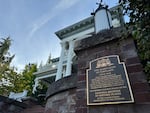
The Alano Club of Portland, as seen Oct. 1, 2026. The nonprofit is the largest and oldest recovery organization of its kind in the U.S., serving 10,000 people a month with a variety of meetings, classes, workshops and other offerings. Project Red, the Club's naloxone distribution program, has partnerships with organizations in all 36 Oregon counties.
Allison Frost / OPB
Portland’s Alano Club is dedicated to helping people recover from alcoholism, addiction and mental health disorders. It serves 10,000 people a month with meetings, classes, workshops and other activities and programs. Founded in 1947, it’s the oldest and largest Recovery Community Organization in the country.
Several years ago, a participant in its programs decided to start bringing naloxone from the Alano Club and distribute it to bars and restaurants whenever she could. When the executive director got wind of this effort, he immediately began writing grants and invited her to run a formal program to provide naloxone to communities all over the state. Those initial efforts became Project Red, which now works with organizations in all 36 Oregon counties to get the life-saving medicine to as many people as possible. Like many 501-C3s, it lost a significant portion of federal funding, which nearly ended the program. But recent grants from Boulder Care and Pearl Jam’s Vitalogy Foundation have enabled the expansion of the program and guaranteed its operations through 2027.
Kasey Anderson is the executive director of the Alano Club of Portland. He joins us to tell us more about the nonprofit’s work and how Project Red became integral to distributing naloxone throughout Oregon.
Editor’s Note: This description has been updated to specify Alano Club of Portland’s designation as a Recovery Community Organization service provider.
Note: The following transcript was transcribed digitally and validated for accuracy, readability and formatting by an OPB volunteer.
Dave Miller: This is Think Out Loud on OPB. I’m Dave Miller. Portland’s Alano Club is dedicated to helping people recover from substance use and other addictive disorders. It serves 10,000 people a month with meetings, classes, workshops and other programs. Several years ago, a participant there decided to start bringing the overdose reversal drug naloxone from the club to local bars and restaurants. Pretty quickly, this turned into a statewide effort called Project Red. The loss of federal funding nearly meant the end of this program, but new grants have enabled its expansion and will let it operate through next year.
Kasey Anderson is the executive director of the Alano Club of Portland. He joins us now. It’s great to have you on Think Out Loud.
Kasey Anderson: Thank you, Dave. It’s great to be here. Thanks for having me.
Miller: I gave a one-sentence version, an incomplete version of your organization. How do you describe the Alano Club of Portland?
Anderson: Well, first, I usually tell people it’s the oldest and largest organization of its kind in the country. There are other Alano clubs throughout the country. Some were founded before ours, but they’re very different. So, we are a place where a lot of mutual aid meetings happen, a lot of group support meetings happen. But mostly I think of our organization as a hub that provides as many points of possible connection to recovery as we can in order for individuals to access services.
Miller: If people think of meetings in the basement of a church that are anonymous as a classic version of help, what else might happen at your club that people might not think of?
Anderson: Sure, our club does have a basement, and there are meetings that happen there. So rest assured, if that’s what folks are looking for, we have it. The other services that we provide are anything from yoga and meditation classes. We have two separate locations that provide fitness and wellness programming, which is anything from a CrossFit class to a sound bath. We have arts programming, so we recently finished a five-year writing group led by the writer Kaveh Akbar. Melissa Febos has also led a writing group for us.
We have cooking classes. We have one-on-one peer mentorship services, which is providing individualized recovery plans for anyone who wants to change their relationship to substances. We have a million things that I am probably not thinking of, but those kinds of meetings that you’re describing worked for me, they don’t work for everybody. So our mission as an organization is to try and provide as many resources as we can that might appeal to someone, who then might find their way to another kind of meeting.
Miller: I don’t know if all this is happening, but the headquarters is in a converted colonial home that’s on the National Historic Registry, a grand building. How does that play into what you’re talking about?
Anderson: That home was donated to the organization by Cora Klein in 1967. And the way that I think about it is that so many people who come to recovery do come to those basements or to sort of nondescript spaces. And there’s a real benefit to that, too. There’s a real rightsizing that happens in those spaces. But there are also so many of us who, when searching for recovery, have been institutionalized, have been recently released from incarceration, have been kind of led to believe that we don’t or shouldn’t have access to nice things and nice spaces.
So for the first step someone takes in recovery to be in an old beautiful colonial home, I have seen and heard people say, I can’t believe this is where I get to go to a meeting. I can’t believe this is where I get to meet my peer mentor. It just sort of reaffirms that everyone deserves access to, for lack of a better word, nice things, nice beautiful spaces.
Miller: So let’s turn to Project Red, another of the big reasons we want to talk with you today. How did it start up?
Anderson: It started up with a woman named Ellen who would stop by the club and ask if we could provide her with naloxone. Often she would ask for as much as we had. And after a few times that happened, I asked Ellen, just for my own edification, “What are you doing with this? This is a fair quantity that you’re taking from the organization.” And she said, “Oh, I’m distributing it to bars and restaurants.” She had lost a dear friend to overdose. She worked in the service industry. So she was taking it on foot in her time off around the city to different bars and restaurants, handing it to them, explaining to them that it was legally safe, it was medically safe to use, showing them how to use it, and then saying you should have this on hand. It’s not unlikely that an overdose could occur on the premises of a bar or restaurant.
Miller: She was a one person harm reduction helper?
Anderson: Essentially, yeah. And I thought that was so inspiring and such a great example of community care. She and I knew each other socially, and I said, “If I were to write a grant request to make this a program, I know you’re happy where you work, but is this something that you would want to do as a job?” And she said, “Well, let’s see.” And so I did, and we launched the program on August 31, 2022, which is International Overdose Awareness Day. Five, six days later, I think, we were on the road with Pearl Jam distributing naloxone on their U.S. tour. Over the years it has grown into the largest non-governmental naloxone distribution program in the state. It’s really just about allowing people access to naloxone.
Miller: Maybe this is an obvious question, but how does naloxone distribution fit into your overall mission?
Anderson: It keeps people alive. That is the point of the Alano Club’s existence. Whether that’s keeping people alive through mutual aid support meetings or one-on-one peer mentorship, or this. It also serves to de-stigmatize drug use and addiction, and to destigmatize the treatment of drug use and addiction.
Along with Project Red, Alano Club is also the fulfillment partner for a program called Just In Case Oregon, which was recently launched by the Oregon Health Authority under the Rural Health Transformation Program. That’s a mail order naloxone we launched September 1 and have fulfilled 1,600 orders over the last month. So there is a need for this. I think, apart from keeping people alive, it really just meets community needs. It creates another point of connection for people.
Miller: You mentioned stigma there. How much of a stigma is there right now in 2026, four or so years after you started the statewide version of this? How much stigma do you see about naloxone itself, an opioid overdose reversal drug?
Anderson: We have seen it change over the last four or five years that we’ve been operating the program. I think it still exists. What we know is that 75% of fatal overdoses occur when a person is using alone. We know that 30% of people with substance use disorders report a fear of seeking resources out of fear of ostracization. So the stigma does exist.
What has been really gratifying and heartening to see is, going from even just 2022, people not understanding what naloxone is, people believing that it enables drug use in a way, to now seeing a statewide mail order naloxone distribution program. Hearing people at every level of government understand that this is a necessary medication that saves lives, and that’s all it does. It doesn’t enable drug use the same way that having a fire extinguisher on hand doesn’t enable someone to commit arson.
Miller: What happened to your funding in the last couple of years?
Anderson: It was reduced pretty significantly. Our public funding was reduced by 15% in 2025. It was reduced by another 15% in 2026. And that’s at all levels: federal funding, state funding. There was some county funding that was reduced. And it disproportionately impacts a program like Project Red because Project Red is really a one-person program. There are others of us who do the work with Ellen, but it’s really Ellen’s program. She continues to oversee the distribution and she continues to be the person who administers overdose reversal trainings.
So, organizationally, we’ve seen a 30% reduction in funding over the last two years. That particular program saw a 75% reduction in its funding, which really jeopardized services. There was a point early last year where I thought there’s just no way I’m gonna be able to operate this program. I can’t pay the person who staffs it.
Miller: So what changed? It was possible, you’re saying, that this was simply going to go away or maybe even likely. What changed?
Anderson: What changed was the Vitalogy Foundation stepped in, which is Pearl Jam’s charitable foundation. We had a relationship with them from doing the tours. We’ve been their partner on every U.S. tour since fall of 2022. And what changed in that regard was I just let them know in December of 2025, “Hey, if there’s a tour coming, I don’t think we’ll be able to do it. I don’t know if this program is going to exist.” And their response was, “What keeps the doors open? Give us a number.”
I did, and a week later, they came through with a donation to fund one program position. That was then matched very recently by a company called Boulder Care, which is a medication-assisted treatment company that also had worked with Ellen and Project Red, and was very aligned with the work. So what happened is the community stepped up, and I know you all at OPB are very familiar with that situation. What has to happen, for better or worse, when public funding is gone is that the community steps up, and people demonstrate their care and their need financially.
Miller: In this case, do you see the drop in funding as being ideological, as harm reduction being targeted specifically, or are you just the recipient of an overall bad economy and a drop in interest in funding nonprofits and giving out grants?
Anderson: I would say that there are two things that happen concurrently. One, there is an administration who has demonstrated a clear disapproval of the term “harm reduction” and what they believe it means. At the same time, they funded the Rural Health Transformation program, which funds naloxone distribution. So clearly, there is still a desire to get naloxone into the hands of people at the federal and state level.
Miller: And it probably goes without saying, but I’ll say it anyway, that the opioid epidemic has hit red states and blue states, urban areas and rural areas terribly…
Anderson: Yeah.
Miller: ..and in some ways rural areas even worse than urban areas over the last 15 years. So this is not a partisan place. It’s not a geographic issue.
Anderson: Exactly. Yeah, we always say addiction and recovery are a bipartisan issue.
Miller: But for this administration, the phrase “harm reduction” is not allowed right now?
Anderson: It’s not a phrase that they seem to favor. I think you’ll hear a lot of organizations using the term “risk reduction” or “tertiary prevention.” So it’s a sort of reframing. I think there is an understanding at every level of government that something like the distribution of naloxone is necessary and saves lives. So again, I think there are ideological differences, but it’s an issue where it seems like red states and blue states can come together.
Then I think, as you said, the economy changes. There’s not one person that I’m aware of at any level of government who said, shut off the funding to recovery services. There is a real shortage of resources, and I would love to see that addressed at every level of government. But there’s no one who doesn’t care or who thinks that the work is not as valuable as it was three years ago. Everyone I work with at the state level, at the county level, at the city level understands the importance and the necessity of these resources. It’s a matter of that sort of systemic labyrinth of freeing up the resources.
Miller: We’ve been talking about overdose reversal drugs. It’s one big element of harm reduction when it comes to opioid use. What else do you think is missing statewide, though, if we’re talking broadly about harm reduction or whatever the new term of art is?
Anderson: Yeah, so one thing that I know … Senator Wyden has talked about pretty openly that there was some funding taken away at the federal level from the distribution of testing strips, which are just strips that people can use to test their substances to see if they’re using the drug that they intend to use. I know…
Miller: Is this Valium or is this fentanyl, for example.
Anderson: Right. Yeah. Does this substance that I have in front of me have fentanyl in it? I don’t want it to. I want to find out if it does. Those are really important resources. I think, also, as pat as this sounds, really connecting people to care and working to de-stigmatize substance use. The more that people feel safe sharing in their communities, the more that people feel secure in being open about what they choose to do, the better the access is to care if and when they decide they need care.
Miller: Kasey, thanks very much.
Anderson: Thank you, Dave.
Miller: Kasey Anderson is the executive director of the Alano Club of Portland, which operates Project Red.
“Think Out Loud®” broadcasts live at noon every day and rebroadcasts at 8 p.m.
If you’d like to comment on any of the topics in this show or suggest a topic of your own, please get in touch with us on Facebook, send an email to thinkoutloud@opb.org, or you can leave a voicemail for us at 503-293-1983.