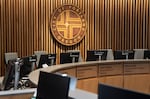
The Portland City Council chambers on Oct. 5, 2026 in Portland, Ore.
Saskia Hatvany / OPB
Half of Portland voters will cast their ballots for their district city councilors this November, including those living in Portland’s District 3.
That district includes most Portland neighborhoods west of Interstate 205 and south of Sandy Boulevard.
This will be the first city election following Portland’s highly unusual first election under its new form of government, where all 12 council seats were up for grabs — and nearly 100 people were in the running. That was also the city’s first election with ranked choice voting, in which the three top-ranked candidates in each district win.
This time, there are only six seats available: three council seats each in District 3 and District 4.
District 3 is the second most affluent district in Portland and arguably the city’s most left-leaning district. Two of its three representatives — Councilors Tiffany Koyama Lane and Angelita Morillo — are members of the Democratic Socialists of America. The third, Councilor Steve Novick, describes himself as a progressive Democrat, and in City Hall fluctuates between supporting his more leftist colleagues and those described as more moderate. All three council incumbents are hoping to keep their seats.
Political analysts suspect incumbents are in the driver’s seat, unless the political makeup of District 3 voters has drastically changed in the past two years. While council seats are nonpartisan, most of the lead candidates are registered Democrats.
Portlanders are feeling unsure about their new government. According to recent polling by the nonpartisan Oregon Values and Beliefs Center, 36% of people don’t feel represented by their city councilor, while 31% do. And 39% say Portland’s government is ineffective compared to the 22% who say it’s working. According to the poll, District 3 voters care specifically about councilors improving emergency medical and fire services, homeless shelters, affordable housing and roads. They are least interested in spending public dollars on cultural events, construction permitting and emergency preparedness.
In the 2024 election, District 3 saw the highest districtwide voter turnout in the city, at 76%. Citywide, only 71% of voters participated.
Twenty-one people are running for a council seat in District 3. OPB sifted through each candidate’s campaign website, voter pamphlet statement, and for some, record on City Council, to help understand each contender’s history, support and goals.
The candidates
Koyama Lane has spent her two years in City Hall pushing for traffic safety, equity programs (like civil rights protections for polyamorous families) and transparency in big city spending, like the Moda Center renovations – among other things. As council vice president in 2025, Koyama Lane also focused on creating some early ground rules for the brand new government body. Koyama Lane, a former public school teacher, has collected endorsements from a number of major city labor unions, local progressive organizations and the Portland branch of the Democratic Socialists of America.

(Left to right) Tiffany Koyama Lane, Angelita Morillo and Steve Novick, incumbent candidates in Portland’s District 3 council race in November 2026.
Left image: Jenny Kane for OPB; Center and right images: Eli Imadali/OPB / OPB
Morillo introduced more policies than most (if not all) of her council peers in her first two years. That included a policy banning landlords from using artificial intelligence to set rental rates, establishing penalties for landlords of detention facilities and helping enshrine the city’s sanctuary policy into city law. If re-elected, she hopes to increase accountability in city police programs, shelter providers and the annual budget process. She’s also been endorsed by city unions, progressive advocacy groups and the Portland DSA.
Novick has a history inside City Hall. As a city commissioner from 2013 to 2017, he has experience with both the previous and current forms of government. He spent his first two years back in the building focused largely on public safety issues, like making it easier for the police to crack down on properties used for criminal activity and pushing the Portland Police Bureau to expand training on gun laws. He’s also advocated for tweaks to city spending, whether through new tax hikes on companies with well-paid CEOs or cutting costly top management positions. Novick’s the only incumbent in District 3 to earn Mayor Keith Wilson’s endorsement. He’s also notched the support of local labor groups and more moderate, business-focused political advocacy organizations.
There are 18 other people running for the District 3 seat. Six have qualified for the city’s Small Donor Elections program. Under that program, any candidates who commit to only accepting individual donations under $350 can have their donations matched by the city, up to a certain amount. To qualify, a candidate must raise donations from at least 250 people.
Along with the incumbents, three newcomer candidates are qualified for the program.
They include Kellie Torres, who currently manages how Portland Parks and Recreation partners with private organizations. Torres has worked for the city on and off since 2022, including a stint as Councilor Dan Ryan’s chief of staff. She’s focused on strengthening city parks, fully funding public safety programs, and streamlining the new government structure. Wilson has endorsed Torres. She’s also endorsed by former Gov. Barbara Roberts, local trade unions and moderate political advocacy groups.

In this provided photo from Sept. 12, 2026, City Council District 3 candidate Kellie Torres speaks to a group of volunteers at a canvass kick off and campaign rally.
Courtesy of the campaign
Tom Sollitt, another small donor program user, is a communications consultant who’s spent much of the past year deeply engaged in local politics. Sollitt is a regular at council meetings and community civic events. He wants to see the city invest more in neighborhoods, improve relationships with other local governments and create more spaces for public engagement. He’s intentionally avoided receiving endorsements from any leading political groups.
Esther León is a physical therapist who works in Oregon prisons and is also qualified for the donation-matching program. She’s running to improve the city’s affordable housing options, support small businesses and strengthen police accountability. She’s notched an endorsement from the Sierra Club.
Other District 3 candidates include Joel Corcoran, an attorney who previously worked in Councilor Loretta Smith’s office. Corcoran also worked as a legal counsel for U.S. Senator Jeff Merkley. He wants to improve the city’s new form of government in its nascent years.
Matthias Hallett, an estate planning attorney, wants to improve the city’s economy by tweaking the business tax and boosting manufacturing.
John Sweeney is a mechanical designer who wants the city to deliver better on its taxes and let the county oversee the region’s homelessness response.
Larry Kelly is a chef who wants to see the city improve its relationship with small businesses.
Martin Ward, unemployed, wants to cut city construction projects and install more surveillance cameras to address crime.
Keir Legree manages a glass manufacturing company and wants to see more police officers and lower utility bills.
There are a few candidates who also ran for this position in 2024. That includes homeless services specialist Cristal Otero, architect Patrick Hilton, electronics manufacturer Kenneth R. Landgraver III, retiree Terry Parker, and Heart Free Pham (who did not share information in the county’s voters’ pamphlet).
Four additional candidates did not submit a voters’ pamphlet statement.
Election Day is Nov. 3.