
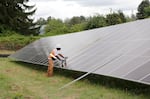
PDX Community Solar is a more than 2,200-panel project in Northeast Portland, aimed at helping lower energy bills for qualified low-income Cully neighborhood residents. The PDX project is funded through a grant of more than $4 million awarded to Verde from the Portland Clean Energy Fund. Once completed, the solar project could power up to 150 homes. Photo taken on August 22, 2024.
Monica Samayoa / OPB
The voter-passed Portland Clean Energy Fund, or PCEF, has been awarding grants for about five years. The tax on large retailers who do business in the city has raised far more money than expected. Now Eugene voters will decide whether to pass their own clean energy fund, called ECEF. It’s modeled after PCEF, but it differs.
We’re joined by representatives from both sides of the campaign: Co-Chief Petitioner Aya Cockram and Laura Sedwick, with the no campaign.
Note: The following transcript was transcribed digitally and validated for accuracy, readability and formatting by an OPB volunteer.
Dave Miller: This is Think Out Loud on OPB. I’m Dave Miller. The voter-passed Portland Clean Energy Fund, or PCEF, has been awarding grants for about five years now. The tax on large retailers who do business in the city has raised far more money than expected. Next month, Eugene residents will vote on a measure to create their own clean energy fund called ECEF. I’m joined now by representatives from both sides. Aya Cockram is a Co-Chief Petitioner. She works for the Breach Collective. It’s a climate justice nonprofit. Laura Sedwick represents the no campaign. She works in technology project management. Welcome to you both.
Aya Cockram: Thanks so much for having us.
Laura Sedwick: Thank you.
Miller: Aya Cockram, first. What is the local problem that you are trying to solve with this ballot measure?
Cockram: Yeah, I’ll just say that as soon as the Portland Clean Energy Fund passed and started doing all of the amazing work that it does, we have been looking to it and wanting to replicate it for a long time. But simultaneously in Eugene we have these really ambitious climate goals, and we have just been running into the same problem over and over again, which is that any attempt to kind of meet those climate goals hits a funding problem.
So it’s become increasingly clear that we need to have dedicated funding to make sure that we can prioritize meeting our climate goals while simultaneously dealing with the climate crisis, which is here as we can feel in October as it’s 70 degrees outside, and as we see with low snowpack and heat domes and the like. And this fund has so many other co-benefits, our community is feeling the strain of inflation. Affordability is on top of mind for folks, and this fund would really address climate head on while also creating green jobs in our community and making our community a more resilient and livable place.
Miller: Laura, there’s a lot to get into there and I do want to focus more squarely on affordability and price in a little bit, but if you want to first start by responding to Aya about the main point that she started with that the important thing here is to get dedicated funding for climate change response and resiliency in the city. What’s your response?
Sedwick: I think that the challenge here is that there are so many critical issues in the city that are underfunded. When we take a lot of revenue and put it into one bucket, we’re keeping that revenue out of other buckets that are equally hurting and need revenue. So we take a mechanism that can bring in a lot of money, and then we lock all of that money in this one pot when there are other vital funding needs around education, homelessness, public safety, infrastructure, etc.
Miller: Aya, your response?
Cockram: Well climate is, obviously, I think the most pressing challenge of our time. It is an existential crisis, but at the same time, funding climate is not distinct from funding other areas, right? Climate touches so many different issues. So this fund would not just only reduce greenhouse gas emissions. It would also create jobs, as I mentioned earlier. There would be dedicated funding for apprenticeships and job training programs. This would also increase affordability.
We would expect increased subsidies for weatherization, for clean energy technologies to increase efficiency in home, reduce people’s bills, solar on roofs, more availability of electric vehicles. These things are going to help reduce costs every day for families as well as addressing the climate crisis. So we just see so many co-benefits that come with this fund that we don’t see it as distinct as taking away from anything else. We see it as creating benefits across our community.
Miller: Laura, your response?
Sedwick: A lot of the problems with funding – I’ll take education, for an example. Yes, I understand that this fund could create money that could go into, let’s say, making a school more energy efficient or more climate safe, but that doesn’t pay teachers. When you look at the most essential problems with some of our other areas, this fund doesn’t necessarily reach those problems. It’s taking the money and it’s putting guardrails on it. That doesn’t let those issues compete in a central budget.
So instead of taking money, putting it into a city budget where it can be allocated across the city based on the most critical needs, it really is all going into this area. And I understand that there are some elements of the funding that could hit other things, but it can’t pay teachers’ salaries. It can’t build a homeless shelter. It can’t pay police officers. It can’t build a road. There are actual limitations here.
Miller: So let’s dig into some of the details here. Aya, can you explain the actual revenue raising mechanism that is in this measure?
Cockram: Yeah, absolutely. The Eugene Clean Energy Fund, if passed, would place a 2% business license fee on retailers operating in Eugene that earn over $1 billion in gross profits nationally, as well as half a million dollars in gross profits locally. So these companies that meet the threshold, which does not capture our local businesses, would have to pay the fee to get a business license, starting in 2029.
Miller: 2% of what?
Cockram: 2% of the gross profits that they make in Eugene.
Miller: OK. Laura, how do you feel about the mechanism itself of the revenue raising? We can talk about what you see as the effects of it in just a second, but what do you make of the system that is embedded in this measure?
Sedwick: Well, I do think that it is essentially a tax. I think that calling it, yes, it’s technically a business license, I think that that can be a little bit misleading for voters. When you tax the gross profits, that’s a figure that’s before things like rent and payroll. There are retail margins that are going to be impacted, and I think we know that it’s going to raise costs. It’s being presented as a fee that doesn’t raise costs, but I think that’s a misleading claim. The state has found in multiple nonpartisan commissions that taxes like this do increase consumer prices. So, I think that that is something that needs to be part of the conversation.
And I think that it’s unclear how much money it will raise. The city has not been able to do a cost analysis on that. The Portland one has raised a lot more money than anticipated, and then what we’ve seen is that money being reappropriated or reallocated back to other things. I think that there are just some questions about the structure that need to be part of the conversation.
Miller: Aya, your response?
Cockram: Yeah, there’s a lot to unpack there. First of all, it is the Eugene city attorney that has characterized this as a fee. So do with that what you will, but it was the city attorney that has characterized this as a fee. I don’t think that it’s misleading. This is a fee that is exchanged for a privilege which is operating within the city. So this is a fee. We also know that these retailers set their prices at a national level, and this means that these costs can’t be passed on, and we have the example of Portland to look at.
At the end of the day, it’s not the voters who are going to be paying this. I’ve given this example before, but you can look at the price of something in Portland online and change your zip code and look at the price of it in Eugene. It’s not different. The Portland Clean Energy Fund, of course, has been in effect for over five years, as you’ve said, so we would have seen that price difference reflected in Portland already, if that were true.
So at the end of the day, it’s the shareholders and these big corporations who are going to have to pay this fund fee, and of course they don’t want to. And so they’re going to misconstrue the Eugene Clean Energy Fund in any way that they can to try and kind of capitalize on the fear people feel about rising prices, when really, this is only gonna affect their profits.
Miller: Laura, I’m gonna give you a chance to respond to that. She’s saying, no, this will not lead to higher prices for Eugene residents.
Sedwick: Yeah, I mean, this is something that Aya and I really disagree about. I think that while national retailers do set prices on an online platform to be similar, and a lot of that I think has to do with how online shopping and online platforms work. There are a lot of studies and evidence that show that on the ground stores do absolutely pass costs on to local residents, and the Oregonian published an article showing how a WinCo receipt had to show the price increase on the receipt to the items.
The measure is also written with an exemption for groceries and medicine. If we don’t have a concern of it raising costs, why do we have to exempt groceries and medicine? I think that there’s a lot of evidence that costs for consumers can go up, and that measures like this in the past have led to costs going up. And if taxpayers are going to vote for something that’s going to increase their costs, they should very much understand that they’re voting to increase their costs, especially in the economy we are in and the cost of living increases that families are facing.
Miller: Aya, let me give you a chance to respond to that specific point that Laura just brought up there in the middle. Why exempt groceries and medicine if you’re saying that this will not increase costs?
Cockram: Yeah, and I think that this has come up before. So reiterating again and again, there is no evidence to show that this would be passed on to customers. In fact, there is evidence that says the opposite, when we look at Portland. But the reason why we exempted essential services like medicines, like credit unions and utilities is because cost is at the top of mind for voters and when they have their ballots in front of them, voters may not have all of these arguments in their ear, but we wanted them to rest assured that we had their absolute best interests at heart when we wrote this initiative and that they can have the confidence to know that that they won’t be affected adversely.
Miller: Let me make sure I understand what you’re just saying there, that you’re saying that you actually don’t think that it would have been a problem to include all those different essential services, but you kept them out so that voters wouldn’t think that those prices would go up?
Cockram: Yeah, well, that is a piece, that is absolutely a piece to show that we have folks’ best interests at heart. But I think the second piece that goes along with that that’s very important is that it’s not really in the spirit of the initiative to take revenue from these essential services, from groceries, from utilities. What we’re trying to do here is hold billion dollar corporations accountable who reinvest little to nothing back into our community, but whose profits are growing year after year.
Miller: But I just, the only reason that I guess I remain confused by this line of reasoning and why I’m not letting it go yet is that billion dollar companies also provide medicine and utility services in some cases, and food. I guess I don’t see what the distinction is.
Cockram: Yeah, I mean, it’s a complicated issue, it absolutely is. But at the end of the day, what we’re trying to do here is find a way to reassure the voters that we have their best interests at heart, that we’re only addressing these billion dollar corporations and it’s a difficult needle to thread.
Miller: In the time we have left, there’s some other issues I want to get to. I’m curious what lessons, because I imagine there are a lot of them that both of you have taken from Portland’s five years of grant making and more years than that of revenue from the Portland tax. So Laura first, what lessons, positive or negative, have you taken from Portland’s experience?
Sedwick: Yeah. I think the thing that catches my attention the most is that the city of Portland has reallocated money out of this fund to use for other things. They’ve pulled money to fill holes in their general fund, and there is a proposal on the table to take money out of this to retrofit the stadium in Portland. And while I understand that retrofitting the stadium is making it more green, I mean, that’s the thing that helps climate change, when I look at that, I come back to the question of, if we have so much money in a pot that we’re talking about retrofitting a basketball stadium, why are we not putting it into schools? Why are we not building a homeless shelter? Why are we not shoring up library budgets? Why are we putting so much money into one place when we have such a funding issue in Eugene across the board?
I spend time every week in a public elementary school classroom and I can just tell you that the funding is so critical, that the funding needs just in that one area that it frustrates me to see this amount of money being pulled out of the economy and then put in this one area. And when I see Portland moving that money around, it makes me ask, why aren’t we just collecting money to put into the government to use in the critical areas that they see a need for, going by the highest priority?
Miller: Aya, feel free to respond to that. I’m also curious broadly about your positive or negative lessons that you’ve taken from Portland’s experience.
Cockram: Yeah, to Laura’s point about the Moda Center, I think Portland voters and a good portion of the city council would agree with you. That is something that has not happened yet. Steve Novak was on Think Out Loud a few weeks ago, I believe, talking about this very issue and how he said that using Portland Clean Energy Fund dollars for the Moda Center is a nonstarter, and we’ve heard that from other council members as well.
So, the Eugene Clean Energy Fund has very clear parameters about where the funding could go. To divert it elsewhere would not be legal, and the the initiative would have to be changed, or the ordinance would have to be changed in order to divert funding elsewhere. And that is something that would involve process and accountability to voters. So I think that that’s really important to stress, that city council can’t just willy-nilly spend this wherever they want to. It’s very clear where the funding should go. And I would love to address this point about schools as well, if we have time.
Miller: Please, please. Yeah, we have about two minutes left.
Cockram: Absolutely. So as we’ve said, this fund would have a lot of co-benefits, but I want to stress that schools can apply for this funding directly for projects that would help them reduce greenhouse gas emissions, do carbon sequestration projects and make the schools more green, and that does reduce costs for them. That does free up money that they can spend elsewhere.
And that’s why the Oregon Teacher Federation of Oregon, the Eugene Education Association, and a huge host of our school board members: Tom Di Liberto, Jenny Jonak, Maya Rabasa, all 4J board members, Austin Fölnagy, the head of the LCC board, Tai Pruce-Zimmerman, on the Bethel School District board, have all supported the Eugene Clean Energy Fund. So I understand the fear, but we have our community leaders who are dedicated to education saying, no, we support this. This is what Eugene needs. So I think that’s really important to remember.
Miller: Laura, I’m going to give you one last chance to respond.
Sedwick: Yeah, I think that if the city council can vote to move the money around, I just don’t see how those protections are in place. What I hear is, yes, the intention of the fund is to go towards these areas, but the accountability is the Eugene City Council and the Eugene City Council can decide in a meeting with a vote, we’re going to do something else with this money.
So I don’t see those protections. I also don’t find the ways education can use the fund for these green building projects, I don’t see that as a big enough push towards the funding gaps. I really, really don’t. And I know there’s school board members that support it, but there are school board members that don’t support it for those reasons.
Miller: Laura Sedwick and Aya Cockram, thanks very much to both of you.
Sedwick: Thank you.
Cockram: Thanks for having us.
Miller: Laura Sedwick is a no on the ESEF campaign spokesperson. Aya Cockram is co-chief petitioner for this measure.
“Think Out Loud®” broadcasts live at noon every day and rebroadcasts at 8 p.m.
If you’d like to comment on any of the topics in this show or suggest a topic of your own, please get in touch with us on Facebook, send an email to thinkoutloud@opb.org, or you can leave a voicemail for us at 503-293-1983.
