At most sushi restaurants in the U.S., “wasabi” — that lump of pungent, nose-searing green paste — may pack a punch, but it’s also probably fake.
“Not wasabi at all,” according to grower Markus Mead. “It’s horseradish with green food dye.”
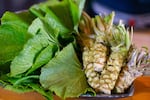
Fresh wasabi at Zilla Sake in Northeast Portland.
Jeff Kastner / OPB
Real wasabi is common in Japan but has long been a luxury in the U.S. It has to be served soon after preparation and doesn’t grow easily outside its native ecosystems. But a farm on the Oregon Coast may be changing that.

Mead and his wife, Jennifer Bloeser, own and operate Oregon Coast Wasabi in Tillamook, Oregon — the largest wasabi farm in the United States. They’ve found the perfect environment to grow valuable, real wasabi.
“Most people don’t know that wasabi is actually a plant. One of our goals in this business is to introduce more people to the wonders of fresh wasabi.”
Wasabi, when fully grown, stands 2-4 feet tall, and all parts of the plant are edible and spicy. Heart-shaped leaves grow out of a thick central stock, usually referred to as the “rhizome,” and that’s the part chefs grind into the familiar wasabi paste.
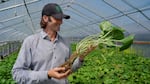
Markus Mead, co-owner of Oregon Coast Wasabi in Tillamook, holds a freshly harvested wasabi plant.
Stephani Gordon / OPB
Wasabi is native to Japan, where it’s been cultivated since at least the seventh century. It was first used as a traditional medicine, and later as a preservative for raw fish because of its antimicrobial properties. Eventually its flavor became an indispensable part of sushi and sashimi.
Wasabi only thrives in a cool, wet, shady environment, which makes the Oregon Coast the perfect spot. “Fifty-five degrees and cloudy is perfect wasabi weather, and that’s what we have 75% of the time here,” said Mead.
With all the work required to grow it, very specific conditions, and only a handful of North American farms, fresh wasabi commands a premium price — around $130 per pound. Still, a growing number of chefs say using fresh wasabi is worth it.
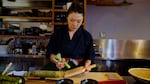
Kate Koo, owner of Zilla Sake in Northeast Portland, grates fresh wasabi.
Stephani Gordon / OPB
Kate Koo owns Zilla Sake in Portland’s Alberta Arts district — consistently rated one of Portland’s top sushi spots, and she was recently featured as a judge on The Food Network’s “Chopped.” Back in 2009, she got her first taste of Oregon-grown wasabi and was immediately hooked.
“I was absolutely blown away by the quality. I was like, wait, this is from Oregon? This is fantastic!”

Freshly grated wasabi paste at Zilla Sake.
Stephani Gordon / OPB
Koo says using real wasabi adds a unique flavor and elevates her dishes like nothing else. “What I’ve seen recently in sushi is that more and more chefs are opting for fresh rhizome.”