
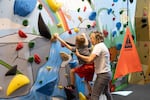
Portland-based nonprofit Ukandu's The Loft is a 21,000-square-foot community center for children with cancer and their families, located in Portland's Lair Neighborhood that opens on Oct. 21, 2026. A mother is shown helping her son ascend a two-story climbing wall inside The Loft in this undated, provided photo.
Courtesy Ukandu
Since 1986, the Portland-based nonprofit Ukandu has offered a week-long, free camp for children with cancer, ages 8 to 18, and their siblings. In 2022, Ukandu began offering a free week of camp on the Oregon coast for the entire family.
Ukandu is now about to expand its programming year-round with the opening of The Loft on Oct. 21. The roughly 22,000-square-foot community center in the Lair Hill neighborhood of South Portland includes a two-story climbing wall, an arts and crafts room, a lounge for caregivers and other amenities. Free mental health counseling for children, adolescents and parents will also be available on-site, along with support groups and upcoming workshops on financial literacy and cooking.
Jason Hickox started as a volunteer with the organization as a camp counselor in 1988 and is today the CEO of Ukandu. Shauna Lugar is a mother whose 8-year-old son, Mason, has brain cancer and attended Camp Ukandu for the first time this year with his older brother, Avery. Hickox and Lugar join us, along with the mother of a 16-year-old daughter who is a brain cancer survivor, to share their hopes for The Loft.
Note: The following transcript was transcribed digitally and validated for accuracy, readability and formatting by an OPB volunteer.
Dave Miller: This is Think Out Loud on OPB. I’m Dave Miller. The Portland nonprofit Ukandu has offered a free weeklong camp for children with cancer and their siblings since 1986. Four years ago, it started another camp for whole families. Now it’s about to expand its programming year-round. Next week, it’ll open The Loft, a 22,000-square-foot community center in the Lair Hill neighborhood in South Portland.
Jason Hickox started as a Ukandu camp counselor back in 1988. He is now the CEO. Shauna Lugar’s 8-year-old son has brain cancer. Julia’s 16-year-old daughter is a brain cancer survivor – she’s asked that we just use her first name. All three join us now. It’s great to have all three of you on the show.
Jason Hickox: Thanks for having us.
Miller: Jason first, as I mentioned you started as a counselor, a volunteer back in 1988. You were just 17. What do you remember about that first year?
Hickox: Well, that first year, camp was very fledgling at the time, and I honestly didn’t know exactly what I was getting into. I have many, many memories burnt into my mind, but I think that what camp has meant to me since then is greater awareness of how precious life is. As a 17-year-old kid, I was being a 17-year-old kid, going into my senior year of high school –
Miller: And you didn’t go there with firsthand knowledge, say a sibling with cancer or being a survivor yourself?
Hickox: Correct. I was a fill-in for my sister to be a volunteer. I didn’t know much about the program at all. Again, the program was pretty new itself. And my takeaway from that first year was just that there were people my age and younger that are much more focused on living life in a full way, I will say. And it just became a touchstone to focus on living your best life.
Miller: Why did you keep coming back?
Hickox: For similar reasons. Young people facing their own mortality are really good at living life. And it was contagious. It was a selfish endeavor. The opportunity to be around those kids was a privilege that I wanted to take advantage of as often as I could.
Miller: Shauna, I understand that your son Mason was diagnosed with a very rare brain cancer when he was 4. He’s 8 now. How’s he doing these days?
Shauna Lugar: He’s great. He’s on an incredible treatment plan that allows him to have an incredible quality of life. So he goes to school, he goes to birthday parties. He’s living his best life.
Miller: How did your friend circles or support circles change after your son was diagnosed with cancer?
Lugar: Yeah, that’s tricky. You really start to question who can handle it, who you can talk to about it that can handle the unknown of his diagnosis and the ongoing treatment for it. So talking less to those people that seem to have a negative reaction, and more to the ones who can just be there and sit with you in the discomfort of it.
Miller: How did you find out about Ukandu?
Lugar: I heard about it from multiple people in my community who all encouraged me to check it out, and so we went and had a phenomenal experience.
Miller: You’re talking there about camp?
Lugar: Yes.
Miller: When you say phenomenal, what did you hear from your family, from your son?
Lugar: On our way out of family camp the first year we went, I asked everybody in the car to give me, on a scale of one to 10 – one being, “never talk to me about Ukandu again,” and 10 being, “I can’t wait to come back” – I got all the numbers. And my youngest son said “a million.”
Miller: Off the charts.
Lugar: Off the charts.
Miller: Why? What do you think he appreciated about it, and the rest of the family as well?
Lugar: Contagious fun, joy, being together without the trappings of daily life and expectations, and just being together, having fun, outrageous fun. New experiences.
Miller: Julia, what about you? I understand that your daughter – we’re gonna use her Ukandu camp name, Zebra – was diagnosed with brain cancer 12 years ago when she was 4.5 [years old]. How is she doing these days?
Julia: She’s in high school, and she’s got good days and hard days. We are busy with making high school work, and then a lot of maintenance, a lot of health care. And that takes up a big part of our lives, but we focus on her passions and what she’s great at. And Ukandu is a huge part of what’s great about her life as a teenager.
Miller: When did Ukandu enter your lives?
Julia: It was when she was, I think, around 6 years old. She had just wrapped up treatment, and at that point she was really scrawny and bald, and had been through a lot. And we were approached by a longtime volunteer and board member who encouraged us to set our very vulnerable little kiddo off to camp for a week without any of my bubble wrap, and she’s been a camper ever since.
Miller: That’s different from what Shauna was talking about. This wasn’t family camp, this was sending … you described her as bald and weak?
Julia: Yeah, she was pretty vulnerable at that time.
Miller: But you did it. You said OK, my 6-year-old daughter who’s vulnerable right now, I will let you go to this camp without me for a week.
Julia: Yeah. The volunteers that come to Ukandu, like Jason, who have been doing it for decades, some of them look like the kind of grandmas or aunties that I wish would still take care of me. And I knew they had been doing that for many years. There are nurses, doctors and therapists, and the counselor-to-kiddo ratio is extraordinarily high. So once I got my head around what this was and I realized that they had been doing this for decades, and that there are kiddos who are in active treatment with their feeding tubes in their noses, that my kid was not the first or the most vulnerable kid to attend camp.
And the first year she had an incredibly good time. I picked her up and she just didn’t want to go home. Ukandu has been probably the happiest throughline of her life ever since.
Miller: On Facebook, we asked folks what Ukandu has meant to them. [Kameko Musolf-Gomez] wrote:
“Ukandu is place beyond giving kids a safe space to be a kid for a week during camp, or activities throughout the year. They are a full-blend, family-forward, it-takes-a-village and we-are-here-to-be-it, kind of organization. They don’t take childhood cancer lightly, and they love loudly in all the ways they grow and continue to grow, creating a full circle start to finish support. Camp Ukandu will always be a special place of hope, joy and love.”
Jason, I wanna go back to you. So you have spent years as a counselor going back to camp, but then you came back and became first Ukandu’s executive director, and then CEO. What were your goals when you came into leadership?
Hickox: Oh, wow. When I first came in, the organization was at a point financially where we really needed to stabilize so that we could continue to offer camp.
Miller: Because that was in question?
Hickox: Yeah, I mean, running a nonprofit is not for the faint of heart. And at that point in time, we’d always had lovely humans helping to organize and run, and lots of different circumstances contributed to a vulnerability of the organization’s financial existence. So our first order of business was just to stabilize, and make sure that we were going to be able to continue to run camp.
I didn’t want to be a camp director. So the choice for me to come in as the executive director included lots of conversations with board members, other volunteers and families to explore how we could better serve these families. I and others, as Julia mentioned, have been around for a while, and were able to observe a lot of what these families go through.
Camp is a beautiful place. It’s once a year. And we knew that the impact that we had could be felt more often throughout the year. And that was our goal: to provide more opportunities for that hope, joy and connection for each member of the family.
Miller: So that takes us to The Loft, which is a big reason we’re talking today, this big new space in South Portland opening next week. Can you describe it?
Hickox: The Loft is a beautiful building that was designed with a lot of intention, thought and radical inclusivity to meet the needs of our families. And in many ways, it’s just four walls. The Loft becomes special because we are able to invite families to shed some of the armor that they wear in their regular lives. And it is the intervention that they offer each other that is the biggest impact that Ukandu provides. So The Loft is a place that they know they can come to whenever they need to show up.
And we’ll have designed programs and intentional opportunities to navigate 10 years of survivorship or being newly diagnosed as a family. It’s just a space where people understand some version of a childhood cancer journey. And it is that understanding that breeds connection, that mitigates the isolation and creates community.
Miller: Shauna, one of the things embedded in what Jason is talking about there is the ways that a childhood cancer diagnosis doesn’t just affect the young person who has cancer, but the entire family system, I think in ways that those of us who don’t have a child with cancer in our family probably just can’t really fully grasp or fathom. How does a childhood cancer diagnosis affect the entire family?
Lugar: And that’s what I’ve loved about Ukandu, is it’s allowed us to bring in Mason’s older brother in a way that we didn’t before. So most of the appointments we were able to navigate while older brother was in school or at daycare, and he wasn’t going to the hospital, going to chemo sessions, seeing providers, seeing MRI scans. Ukandu has allowed us to bring him back into this family and be part of this, because he feels it. Whether or not he’s at those appointments, he’s still impacted by his little brother’s diagnosis. And now he gets to look, see, feel, hear, make friends with others who are in a similar position. I’ve loved that ability to bring him in on this journey with us.
Miller: Julia, we got this comment on Facebook from Abby Culbreth. She said:
“Both my son and I never realized how alone we felt in the cancer world. No one wants to think about kids having to deal with things their bodies and minds are not ready for. Ukandu has given us space to heal and make a community where you don’t have to hide. In this community we all know and have seen devastating things, things only these people truly understand. The one thing Ukandu is doing amazingly is they understand it is just not our son that had cancer who needs help. It is all four of us.”
What do you hear in that comment?
Julia: I feel understood and seen. I think when you’re a caregiver of basically a toddler who is having brain radiation and chemotherapy, it’s very isolating and it is very traumatizing. But you get into survival. It’s like running a marathon, and you just are gritting your teeth and you’re going forward. You don’t get to relax for years later, or you never do. Your vigilance is always on high, and you get used to really horrifying situations for your tiny person. And then you’re trying to help them grow up.
My parents, and my daughter’s sister, cousins and friends have all been along for parts of that. It’s incredible to be in a community where cancer survivors look and show up in every shape and size, and ability, and speed. And for both of my daughters to be able to build a cohort of peers where they can figure out how to talk about cancer and survivorship, and being a sibling, and the hospital lifestyle with people their own age, and start to feel like they’re part of something that isn’t quite normal, but that other people have shades of similar experiences. It’s incredibly important to have that community that has a shared experience.
Miller: What are your hopes for what this new space will provide? Because as we were saying, the camp for kids and their siblings has been around for decades now, and for families for four or so years. Now there’s this year-round space very close to where we’re talking.
Julia: I ran a bunch of activities on the calendar by my daughter, and she said, “Yes, yes, yes, yes, I want to do all of those things.” And there’s a lot of things we do every week that are really not fun. We have hours of doctor’s appointments, assessments, blood draws and medication changes.
Miller: That all follow from her cancer treatment.
Julia: We have probably easily more than a dozen specialists. We get health care on the East Coast and the West Coast. It’s a lot, and there’s a lot of parts of that that are just a big bummer. And everything that she associates with Ukandu is just a yes. She comes bounding into that building – she’s gotten to explore it a couple of times – and I feel like there’s so many different rooms that get her, how she moves, what she loves. She’s safe there, she can have abandon when she’s there, and pick up crafts or climb around, and it’s a lot like the camp experience, but she’ll get to have that year round.
Miller: Jason, we got a little bit of a sense just now from Julia about some of the rooms and spaces that her daughter is excited about. Can you give us more of a sense for what the physical space actually has?
Hickox: Yeah, I’m happy to. We have an arts and crafts room where kids can do fiber arts, and paint, and express themselves in creative ways. We have a room called the active space where we have a modular obstacle course and we have a two-story climbing wall. We have a simulator bay where kids can play zombie dodgeball or baseball, frisbee golf. Older kids can play one of 2,200 different golf courses. We have a room specially dedicated for parents and caregivers called the Lounguary. We know that caring for kiddos requires caring for the caregivers. If we can help fill their cups a little bit, which they won’t often take time to do, they may have more to offer their kids.
We have a fully integrated wellness center where we offer behavioral health, mental health. Occupational therapy is something that’s forthcoming as well.
Miller: And all of this is free?
Hickox: Everything we offer is free of charge.
Miller: Shauna, what are you most excited about in this new space?
Lugar: The behavioral health wing is really important to me because that is a very unique aspect of this journey for everybody involved. So I’m looking forward to bringing both my kids in through that space. I’m really excited about continuing the connections that are made at camp year round, at reunions, at different caregiver classes, and opportunities for us to connect and share learning with one another.
Miller: Jason, can you describe the Reflection Room in particular?
Hickox: The Reflection Room is a hodgepodge of different off the shelf technology that will allow for an immersive video journal opportunity for each one of our families and family members. We wanted to create an opportunity for survivors to chronicle their journey, celebrate their success. It’s also a space where bereaved families can upload images, and videos, and songs, poetry, to help remember the kids that die. One of our pledges as an organization is that you will always be remembered at Ukandu. And there’s an opportunity for siblings and caregivers to champion their experience as well.
The Reflection Room can be really happy reflection. It can be more somber reflection. The Loft is meant to provide lots of hope, joy and excitement. And as part of this journey, when we ask families and kiddos to explore some of their realities, there are gonna be moments where they have a different energy need. So the Reflection Room is one of the areas in The Loft where we can accommodate lots of different energy.
Miller: Jason, Shauna, Julia, thanks very much.
Hickox: Thank you so much for having us.
Miller: Julia and Shauna are mothers of kids who have or had cancer, and have been taking part in Ukandu programming for years now. Jason Hickox is the CEO of Ukandu. I should also mention, back in July we talked to Lorna MacKinnon Day about her son and their journey with cancer. You can find that conversation about a memoir she wrote on our website.
“Think Out Loud®” broadcasts live at noon every day and rebroadcasts at 8 p.m.
If you’d like to comment on any of the topics in this show or suggest a topic of your own, please get in touch with us on Facebook, send an email to thinkoutloud@opb.org, or you can leave a voicemail for us at 503-293-1983.
