
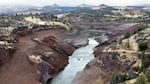
FILE - After Iron Gate Dam was removed, salmon were able to swim past the former site in Northern California for the first time in more than 60 years in October 2024.
Brandon Swanson / OPB
Since four Klamath River dams came down in 2024, researchers, tribes and conservation officials have all been waiting to see whether salmon would return to the rivers and streams they last populated 100 years ago. A study published in the journal “Nature” this summer shows that they have.
Researchers documented thousands of salmon migrating upstream in 2024 and 2025. They found that Chinook salmon in particular have repopulated 88% of their historical range in the Klamath and its tributaries.
Damon Goodman is the lead author of the study and the Shasta Cascade director for the nonprofit California Trout. He joins us with more details.
Note: The following transcript was transcribed digitally and validated for accuracy, readability and formatting by an OPB volunteer.
Dave Miller: From the Gert Boyle studio at OPB, this is Think Out Loud. I’m Dave Miller. Four Klamath River dams were removed in 2024. It was the largest dam removal project in U.S. history. Since then, researchers, tribes and conservation officials have all been waiting to see whether salmon would return to the rivers and streams they hadn’t been to for 100 years. A study published this summer has the answer. It is a resounding yes. Researchers found that Chinook salmon in particular have repopulated 88% of their known historical distribution in the Klamath and its tributaries. Damon Goodman is the lead author of the study. He is the Shasta Cascade Director for the nonprofit California Trout, and he joins us now. It’s great to have you on the show.
Damon Goodman: Yeah, thanks so much for having me.
Miller: What were you expecting in terms of salmon return numbers or geography when the dams were taken down?
Goodman: What we’re seeing on the Klamath River is truly extraordinary. You know, what I expected is that fish would explore these newly opened habitats, but what we saw was that salmon returned faster and to a larger geographic extent than what I expected. Repopulation began almost immediately. When the dams were removed, we were seeing fish pass that threshold in less than a week, and within days they were passing, and then within a few months we saw over 7,700 Chinook salmon pass. That just blew away my expectations of what would happen.
And now after two migration seasons, we’ve counted more than 20,000 Chinook salmon pass that area, that lowest dam, so it just happened so much faster than we expected. It felt like we were running to try and keep up with the fish as they explored these newly opened habitats, and it wasn’t just, as you mentioned in your introduction, it wasn’t just about how many came up, it’s about how far. Within two years they reoccupied 88% of their known historical distribution from before the dams were constructed, and that includes every primary tributary, the Klamath River and in Klamath Lake in Oregon.
Miller: How do you explain that? How do you make sense of the fact that these fish, whose, I don’t know how many generations back you’d have to go before you get to 100 years, but they never were there before, and yet very quickly they went to where their distant ancestors had once lived and swam and spawned and died. How do you make sense of it?
Goodman: Yeah, salmon are famous for returning to rivers where they were born, and that’s what you’re alluding to there, but there’s another really important part of their biology that doesn’t get as much attention. Some salmon naturally stray from their home streams to explore new habitats, and that behavior is essential to how salmon survived and adapted to changes in their environment over thousands of years.
Miller: Some of them are born to be explorers, you’re saying.
Goodman: That’s absolutely right. I mean, just think, our rivers are constantly changing. In historical times, volcanic eruptions, landslides, glaciers, natural processes open and close these habitats, and salmon need to be able to respond to that. So they’ve evolved ways to respond to those changes. And what’s super exciting about the Klamath is that that remarkable ability to explore and recolonize these new habitats is playing out across an entire watershed, and we’re all there documenting what’s going on. Straying isn’t simply a navigational error, it’s an important part of salmon resilience, and we’re seeing that play out in real time here in the Klamath Basin.
Miller: It’s really striking, as you were talking, I realize we’ve probably had literally dozens of conversations about salmon and other – going from freshwater to saltwater back to freshwater – fish on this show over almost 20 years, but we’ve almost always focused on the ability to get back home, and we’ve almost never talked about the wandering characteristic among some of them. So I’m glad you brought that up. Why, for this study, focus on Chinook in particular?
Goodman: This study is not just focused on Chinook. That was just the largest response we saw to the dam removals initially, and just a focal point of fisheries here in the Klamath and across the western U.S., but it wasn’t just a Chinook story. We also saw other anadromous species repopulate the newly opened habitats, including coho salmon, including steelhead and Pacific lamprey. All reentered these newly opened habitats within the first season.
Miller: But the Chinook were more impressive in the distribution and the numbers of their returns.
Goodman: And our information is best around Chinook salmon, so we’re starting with that story now, while we collect more information and take a deeper dive on those other species that have different life history strategies, different run timing, different ways to monitor those species. So this is really a story about entire ecosystem response and what we’re telling here is just the first story about Chinook salmon.
Miller: But for this first story, for this impressive return of Chinook, what does it mean socially and culturally to have these fish back in so much of the Klamath Basin after 100 years?
Goodman: It’s just such an important part of the culture of the Klamath Basin, and where we are now wouldn’t have been possible without tribal leadership along the way and working side by side with the Klamath Tribes: the Karuk Tribe, the Yurok Tribe, and other tribal communities to learn about these fish. One thing that I’ve noticed is, I’ve been working in the Klamath Basin for the last couple of decades on fish issues, and had spent so much time with the tribes, the Karuk and Yurok Tribes and their biologists, and hadn’t worked as much with the Klamath Tribe’s biologists.
And once we started studying these fish and tracking their return, the Klamath Tribe’s biologists started joining the team. We’re working side by side with Jordan Ortega from their program, and we’re standing on the river bar and just realizing that, hey, these dams weren’t just barriers for fish migration. They were actually social barriers that isolated our science and research communities and tribal communities from each other since that resource was no longer shared.
And we’ve very quickly built out new partnerships and new ways of working with each other, and this is an amazing initiation of … So building those relationships, you can really see the seeds of having this connection of our communities back, and not just having the fish back up there, but then the shared resources up and down the river and how that’s playing out to reconnect our communities to the river and to the resources of the salmon.
Miller: All right. We’re talking about some impressive returns so far, but this is still early days. What is it going to take to keep this recovery on track?
Goodman: We’ve crossed a huge milestone in the Klamath with the dam removals, there’s no question about that. But this is really a huge step forward in the Klamath, but we haven’t reached recovery yet. I see us at the beginning of recovery now rather than reaching that. And what I mean by that is that dam removals were a primary constraint on Chinook salmon populations, and that evidence is shown by their immediate repopulation in those newly opened habitats. They were just waiting for us to get out of the way.
But that doesn’t mean recovery is complete. We still need to address other issues to ensure these populations thrive over time. Long-term recovery will require diligence and collaboration among communities to achieve the future we envision for the Klamath.
Miller: What specifically is that going to entail? What do people need to come together to keep doing?
Goodman: For example, we still have two dams in the main stem Klamath, and there’s fishways on them, so the fish have the ability to pass, but they’re untested. They’re untested for the species that are interacting with them now. And so this is our first look at how the fish behave and respond to those fish waves. So ensuring that fish have safe passage upstream and downstream is critical, and the Oregon Department of Fish and Wildlife is leading a study right now to evaluate that. So staying focused on that is super important.
We have agricultural diversions in the Upper Klamath Basin that are currently not screened to keep fish out of them, so installing those fish protection measures is the utmost priority to keep fish safe as they enter these newly opened habitats. Working with the agricultural community and our partners there, working together to install screening technologies that will keep the fish out of those. We also have long standing water quality issues in the Klamath that we need to continue working on. And this is all under the lens of a more variable climate, and so there’s a lot of issues that we still need to stay focused on to ensure our salmon thrive here in the Klamath.
Miller: And just briefly, how is riparian zone restoration going? You have 30 seconds for that.
Goodman: There is some amazing restoration going on in the Klamath with the Yurok Tribe and rez. They’ve been doing some amazing work to recontour the banks of the tributaries and work around the Klamath to improve access to those tributaries and the function of those habitats as well. So that’s been amazing to watch.
Miller: Damon, thanks very much.
Goodman: Yeah, thanks so much, Dave.
Miller: Damon Goodman is the Shasta Cascade Director for California Trout.
“Think Out Loud®” broadcasts live at noon every day and rebroadcasts at 8 p.m.
If you’d like to comment on any of the topics in this show or suggest a topic of your own, please get in touch with us on Facebook, send an email to thinkoutloud@opb.org, or you can leave a voicemail for us at 503-293-1983.
