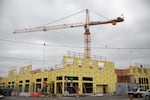
The construction site for Modera Woodstock, a residential and retail building, on July 7, 2023. Designed by LEEB Architects, the development had an entire city block purchased to make way for the development.
Caden Perry / OPB
Portland’s mission to incentivize new housing construction has done little to change the sluggish pace of development in the city.
According to a new city report, residential construction in Portland this year is on track to meet or slightly exceed last year’s rate.
That’s despite a new program that waives certain fees developers are required to pay to build in city limits. First proposed by Mayor Keith Wilson and Gov. Tina Kotek and adopted by city council last year, this program was pitched as a way to jump-start new housing construction in the city during a period of slow growth. But larger market factors have muted its impact.
“The financial incentive offered by the program, while meaningful, has not, on its own, been enough to counter strong financial forces at play in the broader market during the time the program has been in place,” reads the report, authored by Deputy City Administrator Donnie Oliveira, who oversees the city’s housing and development bureaus.
The program waives fees called system development charges, or SDCs. The city typically requires that housing developers pay SDCs to offset the cost that new construction may have on certain utilities and services, like sewer, streets or parks. Portland developers pay around $20,000 on average in these fees per new housing unit.
Councilors paused these waivers for all new housing construction beginning Aug. 15, 2025 through Sept. 30, 2028, with the goal of creating 5,000 new housing units during that time. That means roughly 1,600 new units each year.

FILE - Mayor Keith Wilson at his annual state of the city speech in 2026.
Saskia Hatvany / OPB
Around 980 housing units have received building permits, had their SDC fees waived and are under construction in the first year. Around 1,680 units have applied to participate in the program but have not yet been issued a permit. Just over 200 units have received a permit, but haven’t yet had their fees waived. It’s not clear how many projects using the waiver have been completed.
Real estate broker Eric Hagstette is selling some homes that relied on those waivers. But Hagstette, who owns Inhabit Real Estate, said the exemption is a drop in the bucket when it comes to the forces working against developers.
“Everything is appreciated,” Hagstette said of the waiver. “It’s all aimed in the right direction. But in a market like this you need the sum of all parts to come together. And that’s not happening.”
Hagstette said that the city’s permitting system remains clunky and disorganized, a dynamic that leads to long permit delays for new construction. It can be a deterrent for smaller construction firms.

FILE - (Left to right) Portland City Councilor Elana Pirtle-Guiney listens as Gov. Tina Kotek and Portland Mayor Keith Wilson speak at a press conference on housing construction in Portland City Hall, March 6, 2025. Portland City Councilors Candace Avalos and Jamie Dunphy also attended.
Alex Zielinski / OPB
“Time is money,” Hagstette said.
In 2025, the city issued around 1,375 total housing permits. So far this year, the city has issued roughly 1,070 permits, and the report believes it’s “on track to meet or exceed” 2025’s levels.
Ben Hemson with the Home Building Association of Greater Portland says the real deterrent comes long before developers apply for building permits.
“Interest rates and the broader economy, that’s stopping projects before they even get to the permit counter in the city of Portland,” Hemson, who is the association’s government affairs director, said. “But for projects that might pencil, the SDC waiver will help them get through.”
The city surveyed roughly 115 property owners enrolled in the SDC waiver program for the report. It found that SDC waivers were the most influential factor impacting whether or not to commit to a new construction project. Interest rates, market conditions, and other costs lagged behind.
Councilmember Candace Avalos, who chairs the Housing Committee, said she’s “encouraged” by these survey results. But she’s worried about the impact the forgone SDC revenue may have on the city’s fragile budget.
SDCs pay for a range of infrastructure needs, including sewage and water pipe upgrades, sidewalks, street paving and new parks.
If all 2,871 units that have applied for SDC waivers in the program’s first year are permitted as anticipated, the city would lose roughly $51 million in anticipated revenue. That will be felt the hardest in the already financially unstable Portland Parks & Recreation, which could forgo $22 million.
“This policy comes with a real tradeoff: The city is foregoing infrastructure revenue in order to spur housing production,” said Avalos, who represents Portland’s easternmost neighborhoods in District 1. “I want to see evidence that this investment is actually adding housing capacity that would not otherwise exist, especially given how badly communities like East Portland need continued investment in streets, utilities and other infrastructure.”
The city report says that the forgone revenue has already forced the city to delay planned public infrastructure projects across the city.
According to the city’s report, most of the housing permits submitted since the SDC waiver went into effect have been for small-scale projects, with fewer than 20 units.
“Larger-scale projects continue to face challenges, as they rely heavily on outside investment and take longer to move through design and permitting,” the report reads.
The current waiver lasts until mid-2028. The city said it’ll spend those years focusing on improving its permitting process and removing other barriers to larger apartment construction and other housing projects.
And then what? Hemson, with the home builders’ association, said that’s the “one, big looming question.”
“It doesn’t appear that the market conditions are changing anytime soon,” he said. “We’re still going to need help.”