
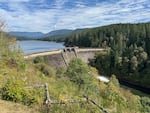
Bull Run water provides drinking water for nearly a million people in the Portland metro area. Construction on the $2.58 billion dollar treatment plant that will filter the microscopic parasite cryptosporidium, along with contamination from debris from storms and landslides. The treatment plant was previously scheduled to come online in 2027, but delays and rising costs have pushed the timeline into 2029. Photo Sept. 10, 2026.
Jule Gilfillan / OPB
Nearly a million people in the Portland area get their water from the Bull Run watershed, about 25 miles east of the city.
The City Council voted in 2017 to build the water filtration plant to protect against cryptosporidium in compliance with Environmental Protection Agency standards.
The project was originally estimated at $500 million, but it’s since risen to $2.58 billion. The water bureau says a number of factors worked to drive up the price tag, including skyrocketing construction costs and defending the project against a number of land use challenges. The filtration plant is now the largest public works project in the city’s history.
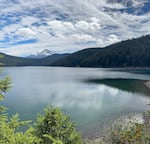
Bull Run Lake as seen on Sept. 10, 2026.
Jule Gilfillan / OPB
It was originally scheduled to be completed next year. But after delays, it is now about 40% complete and on track to be operational in 2029. The Portland Water Bureau’s Interim Chief Engineer Muriel Gueissaz-Teufel joins us, along with Lyda Hakes, the Bull Run supply and treatment manager. They share more details about why this kind of filtration is needed, how it will work and the benefits for Portland-area residents.
The following transcript was transcribed digitally and validated for accuracy, readability and formatting by an OPB volunteer.
Dave Miller: From the Gert Boyle Studio at OPB, this is Think Out Loud. I’m Dave Miller. We turn now to the most expensive public works project in Portland history. It’s a new water filtration plant for the Bull Run Watershed, which supplies water to about a million people in the Portland area. The price tag, $2.58 billion. The project is now about 40% complete and it is on track to be operational by 2029. It’s the culmination of a decades-long saga involving the U.S. Environmental Protection Agency and the Oregon Health Authority.
For more on this project, I’m joined by the Portland Water Bureau’s Interim Chief Engineer Muriel Gueissaz-Teufel, and the Bull Run supply and treatment manager for the Bureau, Lyda Hakes. It’s great to have both of you on the show.
Lyda Hakes: Thank you.
Muriel Gueissaz-Teufel: Thank you for having us.
Miller: Lyda, before we get to this new filtration system, I want to just start with the big picture. What makes Bull Run special?
Hakes: What makes Bull Run special is that 100 years ago, engineers and other staff helped make really smart decisions to make a gravity fed system. So, from the Bull Run Watershed, we flow by gravity all the way into town. We don’t have any pumping, and that makes us really unique to take advantage of that topography. The other thing is that they recognize that if you can protect it, you won’t have outside contamination introduced, and that makes it easier to keep it as a pristine source. So for over 100 years, we’ve been enjoying gravity doing the work for us, and we’ve limited human access to the watershed to help keep it pristine.
Miller: Muriel, where would you put the Bull Run Watershed – both the watershed itself and then the systems that bring that water to nearly a million Oregonians, almost a quarter of Oregonians – where would you put the system just in terms of the civic amenities that we have in the Portland metro area? Where does it rank for you?
Gueissaz-Teufel: I’m a water person. [Laughter]
Miller: So it’s number one?
Gueissaz-Teufel: So, it’s number one. “Water is life” is something that we frequently say in the industry. If we don’t have water, if we have a day without water, [we] would have severe economic impacts and health impacts. So it’s top.
Miller: But let’s get to the treatment plant. This was, as I mentioned briefly in my intro, the culmination – we’re nearing the culmination because it’s not done yet, obviously – of a long saga between federal officials and city officials over a parasite called cryptosporidium. What is cryptosporidium?
Hakes: So cryptosporidium, it’s a microscopic protozoan parasite. It is in the form of what we call an oocyst, and it has a really tough outer shell. Chlorine, which is what we would normally use to disinfect water, it’s not effective because the chlorine can’t break through that shell. So this tiny thing, it’s about 4 to 6 micron in width, about 15 times smaller than a human hair, is what we need to remove from our water now. And it makes folks sick, [which] is really the key part of it. Back in 1993 in Milwaukee, Wisconsin, there’s a waterborne outbreak, and that caused over 400,000 folks to get sick. And the estimates are about 70 to 100 people passed away from it.
Miller: And then, correct me if I’m wrong, but then the EPA eventually said, because of that outbreak that you mentioned, all right, everybody who has surface water systems like Portland has, you have to treat your water somehow for cryptosporidium. But Portland pushed back in court, unsuccessfully, and then they did get this variance from the Oregon Health Authority, which is the state body that enforces the federal standards.
As I understand it … Well, actually, I don’t need to give my version. You’re an expert here. What did Portland agree to do in that variance?
Hakes: Yeah, the key elements in that variance was we upgraded our protections for the watershed. And we also said we’re going to keep monitoring. And if we start seeing – and these are very, very small levels – any of these small levels, we will go to the next step.
Miller: And is it basically: If a deer poops and it had some of these tiny bits of cryptosporidium, and then that gets detected in the twice-a-week testing in 2013, 2014, 2015, then the game is over and Portland has to spend a ton of money to put in the EPA-mandated system?
Hakes: Correct? Yeah, in a period of about three months, January to March of 2017, in 14 water samples – they’re 50 liters – they detected 19 oocysts. That’s really the catalyst. Having those detections kicked off the next step in the process.
Miller: So for more than four years, it wasn’t detected, everything seemed to be fine, and maybe we could be the only city that didn’t have to follow these federal rules. But then cryptosporidium was eventually detected in small numbers, and there was no more get-out-of-jail-free card. We had to somehow build a system.
Hakes: Mm-hmm.
Miller: Muriel, what were the options then in front of the Portland City Council in terms of how they could proceed?
Gueissaz-Teufel: So, like Lyda said, cryptosporidium was a catalyst, but then once we looked at options … So one is a very narrow focus on crypto, and that’s ultraviolet.
Miller: Shines a certain kind of light on the water?
Gueissaz-Teufel: Yes, and it deactivates the crypto. But then that’s all it does. Then another option would be filtration. There are accepted methods by the federal government: filtration or UV. Filtration physically removes contaminants. So it’s gonna take out more than just cryptosporidium. And you have to remember or think that we’re facing climate change. Our watershed resource is open. So now that we have wildfires, we have a lot of different threats. Even though we have a protected water source, we have a lot of threats. Filtration is really a much more robust system that will not only remove crypto, but it will remove other contaminants. So when we presented the option to city council in 2017, those were the two options.
Miller: At that point, what were approximately the price differences between the much more limited treatment option, just the UV, or the more robust one, filtration?
Gueissaz-Teufel: We presented filtration as a $500 million option. It was the more expensive one, but you have to also remember that, at that time, we were under a limited time frame to come up with a solution because we had a regulatory mandate. So we went to council with a relative cost of the two approaches.
Miller: So half a billion for the more expensive, more robust one. And how much would UV alone have been?
Gueissaz-Teufel: I don’t remember UV. I actually don’t remember that figure.
Miller: Less expensive, but that’s not what the city went for.
Gueissaz-Teufel: Correct.
Miller: Lyda, how do you think about that decision now, to go with the more expensive version of water treatment that doesn’t simply get rid of or inactivate cryptosporidium, but also lets the city respond to other stuff in the water?
Hakes: Yeah, I feel relief. I have 14 operators that work 24/7 at our treatment facilities, at Headworks in the watershed and at Lusted Hill. And right now, they have limited tools to address what Mother Nature throws at us. So, as an unfiltered supply, we have regulatory limits around what’s called turbidity, and turbidity is a measure of the cloudiness of the water. So when turbidity gets over 5 NTUs or nephrometric turbidity units, we cannot serve that water to the public from the watershed.
Imagine – it just happened recently on December 19 – our operators are working, one person at Headworks, one at Lusted Hill, and we started to see turbidity shoot up at 4 in the morning. So, that operator had to call our direct responsible charge, wake them up and very quickly explain, this is what’s happening. They made the decision, and it was the correct one, to shut down the Bull Run supply and start up our groundwater system, which is our secondary source.
What we learned, because in the moment we only see the data in front of us from our analyzers, was that–
Miller: The moment you see that there’s stuff in the water, so much stuff – I imagine there’s always a little bit of something – it hit a level above which you have to shut it off.
Hakes: Right. And we’re looking at the rate of change. So we’re normally around 0.4-1 NTU, and then all of a sudden, it started shooting straight up. And that’s a really unusual response pattern.
Miller: What was in the water?
Hakes: So we had two back-to-back atmospheric rivers. And what we learned later was that there was a landslide, and it pushed all this material straight into what we call Reservoir 2. And that’s where the intakes are that pull water from the reservoir into our next structure, the diversion pool, and that’s what goes into homes from there. It enters our water system.
That landslide, what’s interesting about it, is it’s an effect from the 2023 Camp Creek Fire. We had 3% of our watershed burned in 2023, and 3% of that burn area was severe. And it’s right on one of the main tributaries into our reservoir, too. So that’s a straight conduit into where we pull our water from.
Miller: The timing here is interesting. Over two years after that fire, there was a ton of rain that led to a landslide. But you’re saying the landslide was made much more likely, or maybe it happened because of the fire two-and-a-half years earlier.
Hakes: Yeah, because we don’t have the vegetative material holding that soil in place anymore. And we found out, after we went out and hiked, and looked to see what was happening – we did drone surveys and plane surveys – that we were fortunate that a natural berm formed from rocks and logs. And that would have been a worse landslide. We were only offline from the watershed for about eight days over the winter holidays. And it would have been much longer if we had more material dumped into the reservoir.
Miller: When something like that happens, let’s say in 2031, the new filtration system would be robust enough to be able to handle all of that stuff in the water?
Hakes: Correct. So, when we went through the design process for the facility, we developed what we call level of service goals. How much water do we want to make of what quality after what kind of event? And one of the big ones was, you have turbidity in your water. How long can you run your treatment plant after an immense amount of turbidity comes in? And we designed it to handle not just a normal storm, but an immense storm.
Miller: Muriel, there is a certain irony here because on this show, I remember in 2008, 2009, 2012 to 2017, when finally the answer was “no, you have to build this,” Portland officials pushed so hard against this, and Portlanders did. The argument the whole time was, it’s not that officials were not taking seriously the risk that cryptosporidium poses to humans, but they said that it’s the likelihood of a serious outbreak, of a large one, is really small, and we’ve got pristine water. Don’t force us to spend, at the time – we’ll talk about money in just a second – already a huge amount of money, half a billion dollars, on this thing that they said we don’t need.
Now you’re both saying not only that we need it, but it’s a good thing that we’re doing this because of climate change and because of all of what that could mean for the water supply. How do you think about these two things together? The long push to try to prevent this from happening and what you’re saying now, that it’s a good thing we’re actually spending this money.
Gueissaz-Teufel: It’s a great question. For those of us who are in the industry, we do believe we’re absolutely convinced this is the right solution for Portlanders.
Miller: And maybe part of what you’re saying here is that you’re not an elected official who has to explain to your constituents, let’s raise rates and let’s spend now over $2.5 billion. You are an engineer who can see the wisdom of this infrastructure. Is that sort of what it boils down to? Is that the difference?
Gueissaz-Teufel: Yeah, it’s a line with 100 years of Water Bureau engineering. The first waterworks was in 1895, and that was a very long-range planning effort that served Portlanders for a long time. We see this investment in a similar fashion where it’s going to serve generations to come.
Miller: Let’s turn to the money here, and the delays. The city’s plan for this new filtration plant, it’s actually not that far from Portland. It’s a little bit south of Oxbow, a little bit north of Camp Namanu, if my geography is right. It’s not on Mount Hood. It’s a lot closer to Portland than that. But the city’s plan was appealed by local residents, businesses, nonprofits, including 1000 Friends of Oregon. And then eventually it’s a long land use Board of Appeals process, but the short version is that eventually the city prevailed and this is going forward now.
How have various land use challenges affected the timeline and the cost?
Gueissaz-Teufel: So, our permit was approved three times. The first time is when we went ahead with the project. So we got a contract in place for construction, issued notice to proceed, and that’s when the parallel process of the opposition movement and the appeals started happening. All in all, we had an initial delay. Well, we also had an initial delay just from the complexity of the application, so it was a lot longer than the normal process. It took about 275 days to get the permit application approved, which delayed the start of the program by about nine months. So if you think that the end date, which was a regulatory mandate, did not move, it compressed the construction phase, and that costs money.
Then after that, we started the project and the appeals came in, eventually forcing us to shut down construction. That also had a seven-month delay to the process. Eventually, we got the land use permit approved, including some conditions of approval that also had to be included in the project. So those were major contributors to the delays to the project, and that adds cost
Miller: And that’s how you go from a project that, in 2017, was supposed to cost $500 million to one now supposed to cost $2.58 billion – $2 billion dollars more – which is, I should say, way more than could be explained by inflation alone. Way, way more.
Gueissaz-Teufel: Correct. No, I wouldn’t attribute the increase from $500 [million] to $2.6 [billion] to land use. The initial $500 million, it’s a technology choice between filtration or UV. We didn’t have the site. We didn’t have the pipelines. We didn’t have anything built around it, and we didn’t have a design. So then it went from $500 million to $1.5 million in 2019, which was really still a very early design, 5% design, but the site had been selected.
Then 2019, we went through COVID, we went through the pandemic. And we also had a very competitive market in the Portland area for infrastructure projects. So when we got the first market bids, so to speak, for the project, the cost went to $2.1 billion. And from $2.1 to $2.6 [billion] is related to the land use and delays.
Miller: OK, but it’s important for listeners and to remember that the first gigantic increase of a billion dollars, that was because the first estimate clearly was just way off in terms of how much this was going to cost. And when more meat was put on the bones of the plan, that’s when the first ballooning of the cost occurred.
Lyda, how much and will this affect the taste of people’s water? It’s an issue that came up recently when we were talking with Gresham, who was in that conversation. We learned that they’re disconnecting from Bull Run, and some people are upset about the groundwater flavor that they’re now getting, no longer getting Bull Run. For people who do get Bull Run water, will they notice any difference in the taste?
Hakes: We don’t anticipate it. We’ll be using the exact same source water. It’s still coming from the Bull Run Watershed. And we took advantage of a miniaturized filtration plant that we have to test out the different technologies, learn and get familiar. And we went and tested the water from there. We have a panel of folks who, this is what they do: Every week they do what’s called a flavor profile analysis and a flavor rating analysis.
Miller: Every week in Portland, special people with very highly developed taste buds taste the water. Is that something people can apply for?
Hakes: I mean … [Laughs] You can work in our operations department. It’s pretty fun.
Miller: These are water Bureau employees.
Hakes: Water Bureau employees.
Miller: Are you among the testers, either of you?
Hakes: I am not. I don’t know if I have a good enough palette.
Miller: Wait, does it ever happen that someone tastes the water and says, “no, something’s wrong,” or is it, every week, just a kind of pro forma thing, “yeah, tastes about like last week?”
Hakes: It is. And then that regularity is really important because it keeps people, their taste skills up to date. So, we try to maintain the exact same panel members week after week, and we do it on a regular basis.
We have done these analyses based on our own water. We compared it to water through our miniature pilot, we call it. And we also looked at what happens when we have wildfire ash in the water. How does that get removed and then how does that water taste? And what we found was that folks really rated the water high, and that means that they would enjoy drinking it every day.
So, we’re using the exact same source. We’re using many of the same chemicals. And we don’t anticipate that the water that Portlanders love to drink [is] going to taste much different.
Miller: How are we all going to pay for this? Close to $2.6 billion.
Hakes: Yeah, Muriel, if you want to cover that?
Gueissaz-Teufel: Yeah, we have different funding scenarios, but we’re using a combination of rates. We’ve issued low rate bonds, so low borrowing rates and bonds, and we’ve also secured what we call WIFIA loans.
Hakes: Water Infrastructure Finance and Innovation Act.
Gueissaz-Teufel: Thank you. And those are all sources of funding, to fund a $2.6 billion project.
Miller: OK, but what in terms of ratepayers? Because if we have to pay back those loans, that comes down to ratepayers?
Gueissaz-Teufel: It does. So the bonds and the WIFIA loans, they’re very low rates: 1.8% and I believe a little under 5%. They are incorporated on our–
Miller: Way better than mortgage rates.
Gueissaz-Teufel: Yes, they are. So the WIFIA loans save Portlanders about $400 million on the bill because of that low borrowing rate. And they are incorporated in our rate model, with that in mind, so it prevents the rates from going up and down significantly.
Miller: In light of, just briefly … because in the previous segment we talked about arsenic found. This was in groundwater as opposed to surface water, wells in Malheur County. Is arsenic something that you test for in the Portland water supply?
Hakes: We do, yes, we test our source water for that, and we do not have that in our surface water in our Bull Run supply.
Miller: Lyda Hakes and Muriel Gueissaz-Teufel, thanks very much.
Gueissaz-Teufel: Thank you for having us.
Hakes: Thank you.
Miller: Lyda Hakes is the Portland Water Bureau’s Bull Run supply and treatment manager. Muriel Gueissaz-Teufel is the interim chief engineer for the Water Bureau.
Editor’s note: This post has been updated to accurately reflect the number of people who get drinking water from Bull Run. The number dropped below a million this year after Gresham and the Rockwood PUD changed water supply sources. OPB regrets the error.
“Think Out Loud®” broadcasts live at noon every day and rebroadcasts at 8 p.m.
If you’d like to comment on any of the topics in this show or suggest a topic of your own, please get in touch with us on Facebook, send an email to thinkoutloud@opb.org, or you can leave a voicemail for us at 503-293-1983.
