A small group of farmers and other community members is in the early experimental stages of exploring which crops can grow in Harney County with less water, in hopes they can help farmers in this remote high desert region adapt to a drier future.
Farmers in that corner of the state have long used groundwater to irrigate thousands of acres of alfalfa that feeds livestock. But late last year, Oregon water regulators made a pivotal decision that will reduce how much groundwater irrigators can draw from beneath the earth.
That decision is sure to bring economic pain to an area whose economy largely depends on agriculture.
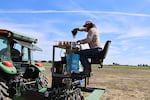
In this undated image provided by the High Desert Partnership, Christopher Bernau loads seeds on a tractor on the Burns Paiute Indian Reservation in Burns, Ore.
Heather Emmons / Courtesy High Desert Partnership
So the nonprofit High Desert Partnership, a group that has long tackled complicated problems in that community, is asking a simple question: How can Harney County continue to farm with less water, while supporting local foods?
The team is looking for solutions on an acre-plus field behind state Rep. Mark Owens’ house, a Republican from Harney County and a farmer, and another plot at the Burns Paiute Indian Reservation in Burns.
The concept comes out of a need to support the entrepreneurial spirit of larger-scale food crop producers, said Brenda Smith, the executive director of the High Desert Partnership.
Growers have come to rely on the Harney Basin, an aquifer that spans 5,240 square miles of southeast Oregon’s high desert. Almost all of the groundwater that’s used each year, about 97%, is pumped out for commercial agriculture.
For the last three decades, there’s been a problem: The water in parts of that basin is drying up.
Last year, state water regulators designated the Harney Basin a critical groundwater area. That designation gives the state more authority to reduce how much water irrigators can pump out of the aquifer.
Farmers currently growing alfalfa, a water-intensive crop, will face tough choices as the state reduces how much water they can access.
“You may be losing water, so you may be motivated to take that incentive to try it,” Smith said.
“It’s sort of those folks that are willing to take a risk and want something different.”
Experiments began with corn, winter squash and watermelon with drip irrigation. These crops, Smith said, could be easily picked and processed for programs such as farm-to-school if a smaller producer wanted to go that route.
Smith admits those crops might not work on Harney County farms, where roughly 80-acre irrigated pivots deliver water to alfalfa fields that have very different water needs.
“But we wanted to demonstrate more of a larger scale drip irrigation experiment, and that’s where that came in,” Smith said.
They’ve now tried black barley, flint corn and fava beans. And while Smith said the beans were a “miserable failure,” the barley did grow.
“I think we have potential with the grains,” Smith said. “Those annual crops, they are going to need some water at some point, but they’re not going to need the [amount of] water alfalfa would need.”
But it’s one thing to successfully grow a crop, it’s another to be able to have somewhere to sell it to, said Bill Buhrig, a faculty research assistant at the Oregon State University Malheur Experiment Station.
“And the geographic isolation of the Harney Basin, it’s just one more hurdle that has to be jumped to get that crop to market,” Buhrig, who’s been advising the group, said.
The agricultural infrastructure in Harney County has mostly grown around alfalfa, and there isn’t much of a market for other crops in that area, Buhrig said. He added there’s a lot of uncertainty about what can work, but that’s part of the process of the search for solutions.
People in the Harney Basin will have to improve how they use water, which is a “very precious resource” in the basin, Buhrig said. But if they work together successfully, he said, they may be able to serve as an example to others in the future.
Looking ahead, Smith said, the team will look at how to replicate these small test plots at a larger scale and collect more data. There’s a lot they need to figure out, and there are a lot of questions they’re asking themselves too.
“We need to be working on the marketing side, the infrastructure piece and could growers get equipment to get [these crops] harvested and how might we go about that?”