
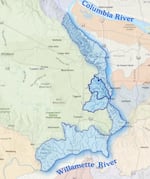
Map of the newly formed West Willamette Watershed Council.
West Willamette Watershed Council
When Craig Rowland retired from the U.S. Fish and Wildlife Service, he wanted to continue helping nature. So, he volunteered to clear invasive species from Heron Creek, near where he lives in West Linn, Oregon.
“A native habitat is better for the fish than non-native,” he said. “It helps with erosion. It helps with biodiversity, which brings food for the fish.”
On a recent Friday, Rowland showed a group of about 40 watershed enthusiasts around Mary S. Young Park. First, he pointed out an area thick with invasive blackberry brambles and English ivy. Next, there was Heron Creek that he had helped clear, fresh with newly planted native species like Oregon grape, salal and sword fern.
Rowland thinks his tour illustrates what the new West Willamette Watersheds Council is hoping to achieve.
“I think if it helps encourage more people to volunteer and to get out and manage their local watershed areas, I think that’s a great thing,” he said.
Oregon has about 90 watershed councils covering more than 90% of the state. Most were formed in the 1990s as a response to salmon species being listed for protection under the federal Endangered Species Act. Participants wanted to help clean up Oregon’s rivers. But in the west hills of Wilsonville, West Linn and Portland, the population was so dense and the streams so small, that no council was formed.
“There just wasn’t quite enough momentum to form a bigger organization around these small creeks,” explained Alexis Barton Castro, the co-director of the new West Willamette Watersheds Council.
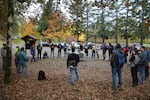
Watershed enthusiasts tour Mary S. Young Park to see how the new West Willamette Watersheds Council should be able to help clean up its rivers and streams, on Nov. 6, 2026.
Kristian Foden-Vencil / OPB
But now, the new council hopes to change that. It will cover a 42-mile swath of Portland’s West Hills, extending from Sauvie Island south to nearly Newberg.
“People have always cared, but are caring even more so now,” Barton Castro said.
The new council consolidates the existing Oswego Lake and Tryon Creek Watershed Councils. It adds 300 miles of streams and 140,000 people.
It hopes to answer important questions like: Where is the cold water? Where can habitat for native fish be restored? Which neighborhoods lack the tree canopy that cools streams? And where is the biggest wildfire risk?
“The second biggest threat to biodiversity is invasive species, second only to habitat loss,” Barton Castro said.
The threats to Oregon’s watershed are varied. The Oregon Climate Change Research Institute projects that by 2045 summers could be 10% drier and 3 degrees Fahrenheit warmer. Extreme rain events are projected to increase 7%, accelerating erosion and flooding.
The emerald ash borer, an invasive, tree-killing beetle, also threatens Oregon ash trees, which are important for shade and keeping water temperatures lower.
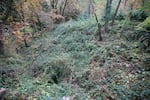
Heron Creek, in Mary S. Young Park, covered in invasive shrubs like blackberry and English ivy, in West Linn on Nov. 6, 2026.
Kristian Foden-Vencil / OPB
In populated places like Portland’s West Hills, one of the more troubling threats to the watershed comes from car tire wear. Rains wash chemicals right into salmon habitat.
Terri Preeg Riggsby, the executive director of the Network of Oregon Watershed Councils, said building stormwater collection basins will help.
“What happens when you’re in urban areas is that you have pollution coming off the roads. And if you have a place where the stormwater can collect and seep into the ground, that means we’re able to recharge the groundwater,” she said.
“The earth is a really effective filter.”
The watershed is home to about seven federally listed species including Chinook salmon, Fender’s blue butterfly and the Willamette daisy. The area is also habitat for three species that are being considered for listing: the northwestern pond turtle, the monarch butterfly and Suckley’s cuckoo bumble bee.
Barton Castro hopes that forming the new council will inspire locals to get out and improve the watershed. They don’t have to be landowners, she said. They can volunteer to pull invasives in a park or simply plant a butterfly sanctuary in their window boxes.
In addition to attracting more volunteers, the new watershed council should help secure new grants.
Barton Castro points to Heron Creek where Rowland and others have pulled invasives. There’s a steep area that’s very difficult for volunteers to reach.
“That’s a place where we can secure grant funding and bring in contractors to do that work and increase the impact of the restoration,” she said.
Cities like Portland, West Linn and Wilsonville have conducted their own watershed restoration efforts in the past. But off the record, experts will tell you that watershed councils sometimes work better than local governments because they don’t come with strings attached. Watershed councils are completely voluntary. They have no enforcement powers.
Up to now, there’s been no strategic watershed plan for the area, because no single organization has been able to work across jurisdictions. That changes on Jan. 1, 2027, when the new watershed council launches. Staff are already developing a restoration plan and grants.
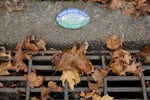
A sign in the Mountain Park neighborhood in Lake Oswego gently reminds people that any chemicals they splash on the street will end up in the watershed, on Nov. 6, 2026.
Kristian Foden-Vencil / OPB
