
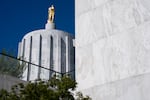
FILE - The Oregon Pioneer statue sits atop the Oregon State Capitol in Salem, Ore., on Sept. 8, 2026.
Eli Imadali / OPB
With a looming Dec. 1 deadline to introduce her next two-year budget, Gov. Tina Kotek has a bit more money to spend.
Oregon’s latest revenue forecast, delivered to lawmakers by state economists Wednesday, predicts the state can expect about $245 million more in the upcoming budget cycle than previously expected.
It’s not an amount of money any Oregonian would scoff at, but in the context of the state budget, Chief Oregon Economist Carl Riccadonna cast the new forecast as something of a snooze.
“The overarching theme of this forecast is: no news,” Riccadonna told reporters in a briefing Tuesday evening. What the economist meant, he said, is that the latest numbers largely bear out a prediction he delivered three months ago, when he told lawmakers Oregon’s economy appeared to be picking up steam.
Riccadonna said healthy consumer spending and corporate profits continue to buoy the state and national economies. He acknowledged that Oregon had begun to once again lag behind the rest of the country when it comes to economic growth, but said he was “optimistic” that would be temporary.
The state failing to match or exceed national growth since the pandemic was one key reason Kotek announced a new focus on improving the state’s business climate last year.
The upshot of their forecast, Riccadonna and senior state economist Michael Kennedy said, is a slight revision to the current two-year budget, which runs until June 30. The forecast predicts roughly $11 million more than previously expected for that budget, though the economists acknowledged a lot can change in a seven-month period that includes a tax-filing season economists acknowledged could upend expectations.
“We’ve seen big changes in tax seasons before,” Kennedy said.
As things stand, the state is not predicting a “kicker” rebate, which sends money back to taxpayers when actual revenue comes in at least 2% higher than predicted when lawmakers passed the two-year budget.
Kennedy said the state does expect a corporate kicker because business taxes are anticipated to come in roughly $71 million higher than initially projected. All that money will go toward funding schools, not back to corporate taxpayers.
Economists predicted a larger increase in revenues for the next budget cycle, which stretches from July 2027 to June 2029.
Kennedy and Riccadonna said growing wealth among richer Oregonians has prompted them to predict around $233 million more in the 2027-29 biennium. Taxes on corporate dividends, capital gains from selling assets like stock, and retirement disbursements are a major piece of that shift, they said.
“We’re continuing to see these come in higher among the higher-income households than we were thinking even a quarter ago,” Kennedy said, adding that the trend would have to revert eventually. “When we’ve seen these types of booms in the past… they have been followed by corrections. What goes up must come down.”
The question neither economist could answer is when.
