
Something about Portland Public Schools’ final recommendation for school closures wasn’t sitting right with Alexis Córdova.
“When something like this doesn’t make sense, or I’m trying to just wrap my head around numbers,” Córdova goes down a rabbit hole, he said Tuesday. Córdova, a software engineer and Irvington parent, shared his concerns with the Portland Association of Teachers, who organized a meeting between Córdova and reporters Tuesday.
What Córdova found in Portland Public Schools Superintendent Kimberlee Armstrong’s memo, shared ahead of Tuesday’s school board meeting, was a confusing discrepancy. If the district kept all of its schools open, it would cut more than 260 positions. Under the plan to close 10 schools, the district would cut more staff: over 300 positions.
“There will literally be less FTE to go around for everybody even though they’re saying that it is going to be better,” he said.
Córdova’s question is just one example of the many concerns that parents and educators are lobbing at PPS as its leaders attempt to push through an unpopular plan to close schools and consolidate programs and offerings. With a vote scheduled for Dec. 15, the district’s plan is facing persistent criticism for a lack of information about the factors leading to school closures and the effects the changes will have on staffing, transportation and school capacity.

FILE - A was held at the Dr. Matthew Prophet Education Center on Tuesday, Oct. 6, 2026, in Portland, Ore., before a Portland Public Schools board meeting. PPS announced plans being considered by the district, including closing up to 14 schools and changing school boundaries.
Eli Imadali / OPB
PPS is not alone in this. Salem-Keizer and Tigard-Tualatin are also planning to close schools, with several other Oregon districts considering the move as a way to address declining enrollment. And things are not looking up anytime soon. Wednesday’s revenue forecast projects school enrollment “will decline by 69,500 (or -12.9%) in the next ten years.”
Córdova says the way Portland is going about this process has led to confusion.
“PPS essentially has created a universe where 2+2 equals a range of numbers,” Córdova said.
He also questions the enrollment forecast PPS is using in its modeling process. Portland State University’s projections for his daughter’s school, Irvington, have been off for the last few years.
Ethan Sharygin, the director of PSU’s Population Research Center, said accuracy for individual school projections can vary. Sharygin reports districtwide errors of less than 2% within five years. But using a group of seven elementary schools as an example, Sharygin shared an example of the possible variation. For a group of seven elementary schools in Southwest Portland, the net error for the group of seven schools overall was 1.1%. But from school to school, net error was between 0.4% at one Southwest school and up to 10% at another.
PPS officials have said they’ll review enrollment every year, and take on boundary reviews and a “systemwide middle school review” in 2029-2030.
“Change is hard for school communities, and PPS does not take these decisions lightly,” Armstrong shared in her memo.
“But these decisions have been delayed long enough, and acting now puts the district on a more stable footing for every student.”
In addition to parents like Córdova, Portland Association of Teachers President Alisha Chavez is asking the district to slow this process down and take more time to engage students, parents, staff, and community members.
“We still have yet to have an adequate plan,” Chavez said on OPB’s “Think Out Loud” Wednesday. “We still don’t know what staffing’s gonna look like, transportation, the supports for our students who have [individual education programs].”
At a board meeting Tuesday night, board members also had questions and concerns about the recommendation. But before they vote on the recommendation next month, they’re holding sessions to hear from school communities. Some board members have said they’ll propose amendments to change the recommendation.
Changes to staffing and transportation
Córdova has a second grader at Irvington Elementary in Northeast Portland. Under Armstrong’s recommendation, his daughter’s school is set to close.
“Initially, we’re very gutted, and we’re thinking of our kids, and, you know, our next school’s more than a mile away,” Córdova said. “It very quickly turned to: What’s going to happen to our staff?”
As he looked at the recommendation and materials for Tuesday’s school board meeting, Córdova wrote out his findings, just one example of the many parent-led efforts that have surfaced in the last several weeks.
Córdova calculated that PPS would reach its FTE reduction goal without closures, according to the memo. But with closures, there will be even more cuts, Córdova said.
“Help me see how this makes sense,” Córdova said. “It seems that the outcomes will be just worse for kids, and worse for the teachers.”
PPS Senior Director of Data and Accountability Richard Smith said that’s not the case. He said the district will “re-invest” the difference of about 40 FTE between the two scenarios, meaning the staff numbers will be the same, whether or not schools are closed.
But it’s not clear what re-investment looks like in terms of actual staff or where they’ll end up. One page of the memo outlines how a smaller “re-investment” of 15 or 20 staff would look if they were spread across the 19 schools set to receive students from schools proposed to close.
Chavez, the PAT president, said the district hasn’t outlined the specific ways this plan will make things better for students.
“I have not seen a staffing model about what our schools will look like and what well-resourced schools actually are for, for our students,” she said.
Capacity of receiving schools in question
Under this plan, there are 19 “receiving schools”.
And some of those schools will be packed with students if the school board approves Supt. Armstrong’s recommendation. Parents from several North Portland schools argued a receiving school in their area will be immediately overcrowded.
“Chief Joseph [Elementary School] will be too full on day one,” wrote representatives from Beach, Sitton, and James John elementary schools in a letter sent to district officials on Monday. Under the plan, Beach Elementary would close and its students would move to Chief Joseph. In the letter, parents wrote that a crowded Chief Joseph won’t have the space for specialized supports Beach students need, like rooms for speech and language services, therapy, and de-escalation.
The “functional capacity” of Martin Luther King Jr. Elementary in Northeast Portland is 584 students. Under the superintendent’s recommendation, projected enrollment is 572 next fall, after students from Sabin Elementary are moved over. The district says it will “conduct a site review” if utilization exceeds 100%.
But while some schools will be bursting at the seams, others are projected to be much smaller.

FILE - Sam Ellingson, who is the a second grade parent at James John Elementary and the Parent Teacher Association president, chants before a Portland Public Schools board meeting inside the Dr. Matthew Prophet Education Center, Oct. 6, 2026 in Portland, Ore.
Eli Imadali / OPB
The district predicts both James John Elementary and Sitton Elementary will have “very low” enrollment of under 260 students. Three middle schools are also projected to have a projected enrollment of below 400 students.
PPS defines a “sustainable” school as one with at least 360 students in K-5 and 500 students for middle schools. PPS says “sustainable” schools offer a variety of academic and elective offerings with counseling and nursing support on site.
But under Armstrong’s recommendation, only 50% of K-5s will be considered “sustainable,” compared to 18% now. 47% of middle schools would be “sustainable” under the recommendation, compared to 13% now.
Smith said the recommendation puts PPS on the “path to sustainability,” but it won’t get there with this plan.
Board members also asked for more information from the district about what transportation will look like with students moving to different schools. The district shared sample transportation routes Tuesday, but board members wanted to see more specifics.
Ahead of the Dec. 15 board vote, school board members say they plan to file amendments to the superintendent’s recommendation. That means there could be changes to what the school board finally approves.
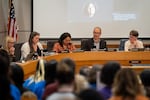
Portland Public School Board chair Edward Wang speaks during Portland Public Schools board meeting inside the Dr. Matthew Prophet Education Center, Oct. 6, 2026 in Portland, Ore.
Eli Imadali / OPB
Board chair Eddie Wang asked board members to file their amendments in 12 days, by Nov. 30. They plan to discuss amendments and ask questions about Armstrong’s recommendation at a Dec. 1 board meeting. They may use a Teaching, Learning, and Enrollment committee meeting on Dec. 2 to further discuss amendments.
That all leads up to the vote on Dec. 15. If the board approves a plan to close schools, the district said it will spend January through March working on school-specific transition plans, with several more months of activities after that.
