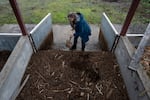
April Jones Thatcher works on part of a static aerated compost structure on her farm on Nov. 13, 2026, in Ridgefield, Wash. One of the biggest projects the Clark Conservation District has worked on with Thatcher is the compost structure, which makes it easier to safely turn manure and other organic materials into compost that can be used on crops.
Jenny Kane / OPB
A “high performing district,” “invaluable,” and “one of the few government resources that I use” — these were some of the comments landowners used to describe the Clark Conservation District during a recent public hearing on whether or not to fund it.
The district is one of 45 small government agencies in Washington offering free natural resource advice to land managers and helping them pay for things like septic inspections and habitat restoration projects.
In 2025, the district made more than 200 site visits, treated about 11,000 gallons of wastewater, gave away more than 4,400 trees and conducted more than 50 wildfire risk assessments.
Since its founding in 1942, the agency has been entirely grant-funded. At a recent public hearing, the Clark County Council decided to change that.
“You obviously are kicking butt,” Councilor Matt Little told Clark Conservation District Executive Director Zorah Oppenheimer on Nov. 17, after hearing 18 testimonials in support of the district’s request for a rate system that would cost less than $25 per year for most property owners in the county.
The council ultimately decided by a 4-1 vote to approve a lower rate tier — $15.08 per parcel and $0.10 per acre for 10 years — citing already high tax burdens for property owners.
It wasn’t everything Oppenheimer asked for, but she said it was still “monumental” for the district.
“This has been an effort that has gone on for 20 years … for so long this was sort of a pie in the sky outcome,” she told OPB. “ I am so grateful and so excited to move forward in this new paradigm of stable funding. It’s incredible.”
Until this point, Oppenheimer said, her agency has had to launch projects like wood chipping without knowing if there would be funding for them beyond the active grant cycle.
“It’s challenging to invest a lot of time and funding into developing a program if you have no idea if that program is gonna be there in a year,” she said.
The district will still apply for grants going forward, but the roughly $2.5 million in estimated annual parcel fee revenue will make it easier to move money around to cover gaps from lost grant funding, Oppenheimer said.
The agency is set to lose a large federal grant in February for its popular septic reimbursement program, Poop Smart Clark. Old leaky septic systems can pollute water and make people and animals sick. Poop Smart Clark offers ways to “prevent a Revenge of the Turds situation,” according to its website.
With the new rate system, Oppenheimer estimates the district will be able to fund 115 reimbursements each year for septic inspections and repairs.
The district will also be able to continue some forestry projects like wood chipping and forest thinning, pilot a school garden program, and maintain native plant nurseries, among other services.
There are some conservation needs community members have identified that the district won’t be able to meet, Oppenheimer said, since the county council approved a lower rate than what the district’s board recommended. But she said the consistency will make it easier for the agency to go after more grant funding that could eventually expand services.
Securing stable funding for the first time was the highlight of the public hearing for Oppenheimer, but she was also touched by the support from the public.
“We feel like a resource,” she said, “and that is rare for a government agency to feel like a resource.”