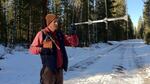
Bilogist John Stephenson uses an antena to try to locate the radio collar signal from wolf Oregon-7.
Amelia Templeton
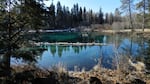
(Editor’s note: EarthFix Field Notes are reporters’ personal impressions and experiences from their coverage of the Pacific Northwest. In this entry, Reporter Amelia Templeton describes her pursuit of Oregon-7, a lone wolf that's trekked hundreds of miles through Oregon to the mountains near Crater Lake.)
PROSPECT, Ore. -- Snow fell on the eastern slopes of the Southern Oregon Cascades a few weeks ago, creating a record of every person and animal that has passed since then.
In an airy pine forest south of Crater Lake, a coyote walking on the tips of his toes left dainty footprints stamped in the snow. A man walked by with his dog.
John Stephenson is looking for larger tracks. Stephenson, a biologist with the U.S. Fish and Wildlife Service, is soft spoken and lanky. He walks with a long, swift gait that calls to mind the wolf he’s tracking.
The wolf goes by a number, Oregon-7, and wears a radio and GPS collar. It is the first wolf that could conceivably establish a pack in western Oregon, though the odds of that happening are long. Stephenson says if this wolf can locate a mate, it could help wolf recovery. All on his own, Oregon-7 is a biological dead end.
“We’re out here trying to find out which way it’s going to go,” Stephenson says.
In September, the 2½ year old male left the Wallowa mountains in search of a new territory and company, a process called dispersal. The GPS collar recorded the wolf’s location every three hours. Oregon-7 traveled more than 700 miles.

Both Oregon and Washington are counting on this natural dispersal process to drive wolf recovery. The states expect wolves from packs in Eastern Oregon and Idaho, home to about 65 breeding pairs, to disperse, eventually working their way west to the Cascades. To some extent, the natural process appears to be working. Several new packs have recently appeared in Oregon and Washington, as far west as Cle Elum. There have been two credible reports of wolf activity in Southern Oregon prior to Oregon-7's arrival.
“We expect recolonization to be very slow,” Stephenson says. “The dispersing wolves have to find each other.”
Deliberate re-introduction of wolves into suitable habitat could recover populations in the northwest much more quickly, but Stephenson says it’s too controversial.
“What they did in Yellowstone, introducing 30 wolves into great habitat, those populations expanded very rapidly.”
Oregon-7 has spent the last month roaming a territory that stretches across the volcanic country of the Sky Lakes Wilderness to the edge of the agricultural land of the Klamath basin.

OR-7's tracks. Credit: Amelia Templeton
Stephenson is carrying a radio transmitter in a leather case, and he holds a branching metal antenna out in front of him. The antenna hisses, but underneath the crackle Stephenson can hear a steady beep when he’s pointed in the direction of Oregon-7. The signal is coming in strong, and Stephenson thinks the wolf is somewhere in this forest, within a mile or two of us.
Workers recently set fire to big piles of slash wood and brush, melting out the snow. A few of the piles are still smoldering.
Stephenson finds the tracks he’s looking for at the edge of a burn pile. He pulls out a ruler. At first he thinks they were left by a cougar.
“Look at that. It’s a big old paw” Stephenson says. “I can see some nail marks. I think this is our wolf.”
Stephenson follows Oregon-7’s massive tracks for 30 feet or so into the woods. They look a few days old. Stephenson says they don’t show anything conclusive. But when the wolf passed through here, it was clearly alone.
Without help hunting, survival could be difficult for the wolf. It has eaten at least one good meal recently. Data downloaded from Oregon-7’s GPS collar showed the wolf spent a few days hanging around the edge of a logging road.
Ray Mitchell works for a local logging company. Mitchell says he found an elk snagged in a fence near that spot. He untangled it, but the elk couldn’t stand.
"I would have liked him up or dead," Mitchell says. Predators are not humane. They probably ate him alive." When Stephenson reaches the fence, he spots a large bare ribcage, and a few other scattered remains of the elk

At least one local farmer has expressed concern about his sheep. Stephenson says he’s working to get the man a special electric fence outfitted with fluttering ribbons that he hopes will keep Oregon-7 away.
As habitat generalists, wolves can survive in a broad range of places. They key question is whether humans will tolerate them. Wolves were once common throughout the northwest. Starting in 1843 state and federal governments offered a cash bounty for killing wolves. By the 1940s they were locally extinct.