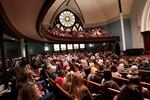
A 2015 file photo of Wordstock attendees at First Congregational United Church of Christ. The annual event has since been renamed the Portland Book Festival.
John Rosman / OPB
Many churches have long been involved in providing support for people who are living on the streets. Some institutions had to scale back their soup kitchens or other efforts during the pandemic. Others stepped forward in new and creative ways.
We talk to three faith leaders about how their congregations are grappling with one of the biggest challenges of our time: Brigitta Remole, pastor at First Congregational United Church of Christ in downtown Portland, Bernie Lindley, vicar of St. Timothy’s Episcopal Church in Brookings, and the Rev. Sara Fischer at Saints Peter & Paul Episcopal Church in the Montavilla neighborhood of Portland.
The following transcript was created by a computer and edited by a volunteer.
Dave Miller: This is Think Out Loud on OPB. I’m Dave Miller. For millennia Christian churches have provided support for people in need. The Bible is full of quotes from Jesus about helping the poor. In contemporary times that has often meant soup kitchens or homeless shelters. The pandemic increased the need for these kinds of services. It also made it more challenging in many cases to provide these services. Now, at the end of the COVID public health emergency, it doesn’t mean the end of COVID’s aftershocks. So we thought this was a good time to check in with faith leaders in different parts of Oregon to hear how they are responding to homelessness and to hunger right now.
Brigitta Remole is the pastor of the First Congregational United Church of Christ in downtown Portland. Bernie Lindley is the vicar of St. Timothy’s Episcopal Church in Brookings. The Rev. Sara Fischer is the director at Saints Peter & Paul Episcopal Church in Portland’s Montavilla neighborhood. It’s great to have all three of you on the show.
Guests: Thank you. Thanks.
Miller: Sara Fischer, first. You wrote a book a couple of years ago called ‘Open: Adventures in Radical Hospitality.’ What is radical hospitality?
Sara Fischer: Radical hospitality is… it’s one of those terms that once people kind of live into it, everybody has their own experience and definition of it. But I think the simplest thing I can say is that it is meeting people where they are, and it’s hospitality that doesn’t have strings attached. I think in Christian language, I would say it’s the kind of hospitality that Jesus practiced. So many of the places that people that we serve go for services, need them to provide an ID or a social security number or their full name and other kinds of information. I think we started using the term radical hospitality when we just started saying to people – over the last 20 years of serving, particularly vulnerable women, at our church through what is now Rahab’s Sisters – we just said to people: ‘Come as you are. Just bring yourself, and you don’t have to sign on any dotted lines to be here.’ I think that that has really far-reaching implications for how we work with people on a bunch of different levels.
Miller: Father Bernie, can you give us a sense for the kinds of services that you were providing before the pandemic in Brookings?
Bernie Lindley: We were still feeding people before the pandemic. Well, we’ve been feeding people since 2009. What changed was that we increased the number of days that we were offering meals because our goal is to have seven-day-a-week coverage for prepared meals that people can come and eat. Certainly during the pandemic we needed to do, you know, we couldn’t gather inside the building, so they were to-go meals. But, it took a while for the other congregations that participate in what we call our community kitchens program to kind of figure that part out. So we stepped up and filled in the gaps. There was one church, a Presbyterian church in town, they continued to serve their Thursday meal all the way through. But at one point we were doing six days a week.
So what we did during the pandemic was we didn’t close our doors to…. It was kind of ironic; on Sunday morning, there would only be maybe four of us that would gather to worship, and then everything would be online. But during the week, we kept our doors open, in a way that made sense, for the people who still needed to have their hygiene needs met by coming in and using our shower or getting a cup of coffee or plugging in their cell phones and having access to the internet. So we continued to welcome people into our building in that capacity, even as we had to limit the number of people who worshiped. We kept doing the same things that we had been doing, during the pandemic. It was unusual because we were still doing it when a lot of the other groups weren’t.
Miller: And that meant that more people were coming to get food from you, people who maybe would have gone on different days to different churches, say?
Lindley: Yeah, that’s right. So there were more people coming to our building than there would have been before. Yes.
Miller: What was it like to have more people regularly coming for basic human needs, in this case for food, than coming to gather to worship?
Lindley: Well, feeding people is a form of worship for us. So, for us, it really fed our soul. Even the people who weren’t able to come into the building – that would normally be here on a Sunday morning – still gathering virtually, still shared in that joy. But when we expanded our services, the number of days that we fed, the thing that made that possible for us is we empowered the people that we were serving to do the serving. So, people who were unsheltered were the ones preparing the meals. We would get them through the training for our food handlers card, and we would set them about the business of feeding the other folks.
Miller: What was the reason for that? I mean, was that a purely practical decision or was there something deeper involved?
Lindley: Oh, it’s deeper. See, to me that’s when things become transformative, is when the lines are blurred between who is serving and who is being served.
Miller: Hmm. Why? Why is that transformative?
Lindley: Well, go ahead, Sara.
Fischer: Oh, I was just gonna say that it is also a really good illustration of radical hospitality, is that blurring between who is serving and who is being served. We’re all on the same level.
Miller: Brigitta Remole, Pastor Brigitta, I’m curious what you make of that line that we just heard from Father Bernie, that feeding is a form of worship.
Brigitta Remole: I think it’s beautiful. I’m writing that down as I speak. It reminds me of the practice and understanding that, ‘My liberation is tied to your liberation’ and that interconnectedness that we all share together. So, I love that.
I will say that I’m very inspired by the work that both pastors are doing in their parishes. I serve a church in downtown, and I’ve been here since last August. I get the sense that perhaps, unlike the other two parishes, I would say this church was really decimated by the COVID experience. Then on top of that, unexpectedly losing their leadership, their pastor. And, as perhaps people are aware of, downtown hasn’t really come back, in terms of people coming back to offices and whatnot. So that also impacts the church. For an example of the kind of things that we most recently have tried to undertake, we put out a PDX Free Fridge on our porch, and we tried that for about six months. That’s providing food for the houseless. Unfortunately, that just became… it became problematic…
Miller: In what way– So this was a refrigerator that had perishable food that people could…
Remole: Yeah.
Miller: …just go on their own and get what they need?
Remole: Yeah. So you could come [inaudible] help themselves. Yeah.
Miller: And what was problematic about it?
Remole: Well, it ended up being a magnet for illegal activity. It was just not successful, so we had to stop that. And then the dilemma of… I just love what Sara said about radical hospitality, but for this congregation – and they have a long history of social justice and activism – it has gotten to the point where we’ve had to put up a temporary fence on the portico because it’s out of the rain and so homeless people would come and then they would overdose, and there were assaults. It was just really unsafe for people. And that just felt so contradictory to who we are as a people of God. So we have this temporary fence, and it’s definitely temporary, but we’re trying to find a way. Is there a way to be radically welcoming and create an environment that’s safe? That’s something we’re really wrestling with.
Miller: Sara Fischer, have you dealt with your own versions of that, where your deepest desire is, as you said, to be radically hospitable, to meet people where they are, to give them what they need. But have there been times when you can’t do that because it has unintended consequences?
Fischer: Sure. Yes. And that’s very, very, very hard. It’s hard to say no. It’s hard to put up fences whether they’re literal or figurative. I think during the pandemic, one of the ways that the church and other organizations that use our church found to practice radical hospitality was to kind of take it on the road. We’ve had a meal program for decades, which actually had shifted prior to the pandemic to be a more kind of to-go version of itself because that matched the number of volunteers that we had and the number of people that needed to be fed. So we moved all of that into the parking lot. We took meals out to people, and we drove around with hot soup and hot drinks and gloves and hats. I always described that as ‘radical hospitality on the road’ because we tried to practice the same principles while doing it in a way that was protecting other people who were around the church.
First Congregational is a beautiful grand church, and ours is not. [laughing] So, I don’t want to talk about protecting our property. But we do want to keep people on the property safe. So we just keep kind of trying to pivot. We have a red wagon that we fill up with supplies and hot drinks – we didn’t invent this at all – there’s other churches that do that. But we walk around the neighborhood, and we go from tent to tent on Sunday mornings, reaching people where they are and offering them what we think they might need, as we can.
Remole: I wanted to add to what Sara said: One of the things that I’ve noticed is, in the city of Portland anyway, many of these agencies, I can’t quite figure out how the city of Portland is addressing homelessness. It seems like there’s just all these silos, and it’s hard for me to get the lay of the land. But one thing that we have concluded as a congregation is that, rather than create from whole cloth another support, let’s find out what’s already in place in our community around us, and let’s walk alongside them and help them and support them. For example, members of our congregation help with Potluck in the Park, which feeds the homeless every Sunday, hundreds of people. Also we have people in our congregation who help with the Transition Projects, which is another nonprofit that helps the homeless. So, when you were asking me earlier at the beginning about ‘who’s your neighbor?’ I think that’s one thing we’re trying to [see] – now that the dust is kind of settling, post COVID – is ‘Okay, who’s around us, and how can we work together, walk with each other and help each other?’
Miller: Father Bernie, you were talking about the increase in people who you’ve been feeding, making it daily as opposed to once a week. That ended up becoming a real issue after the city of Brookings passed an ordinance limiting the number of days that places like yours could offer free meals. So you sued at the beginning of 2022 as a result of that. Now, as I understand it, the city is threatening to fine the church $720 a day. What does this mean for you?
Lindley: Well, it means that we needed to get our lawyer, our legal team, involved in challenging that, and they have. Right now that’s been tabled, I guess you would say. So we’re not currently facing that $720 fine right now. We’re gonna make an appeal to the planning commission here sometime next month. There’s like a two-prong thing: Not only does the city of Brookings say that we can’t feed people, they also say that we’re a social services agency, and they want us to no longer provide social services to unsheltered people because we’re not zoned for that purpose.
We’re zoned to be a church. The zone that we’re in is residential, but we have a nonconforming use, as a church. What we’re doing is, we’re not a social services agency, we’re a church. So, either churches are all called to be social services agencies, for millennia, or we are a church that happens to care deeply for all of our neighbors, regardless of whether they are housed. It’s a confusing thing, and I’ll be curious to see what the Planning Commission’s response will be when I go testify before them in the appeal process.
Miller: Sara Fischer, is there a difference in your mind between a church and a faith-based social service organization?
Fischer: Yes. I think that there’s a huge difference because we’re a worshiping community, and in our practice we break bread together. Not to get all sacramental on you, but…
Miller: Well, we invited three Christian faith leaders here, so please do it.
Fischer: I mean, when we share the bread and wine together on Sunday morning or Sunday night or whenever we do it, we’re taking into us the body of Christ, which we in turn then go out into the world to be the body of Christ. I think what that looks like is being the hands and feet of Jesus in the world. There may be individuals who work at faith-based social service agencies that are doing the same thing, that they believe that that’s what they’re doing. But I think being in a physical space where the sacred and the secular very much overlap and going out into the world as the body of Christ, is a way that churches I think are different from faith-based social service agencies.
Miller: Well, I asked you because of the plans that you have under way, if I have this correct, to bulldoze your campus and then to build housing for people transitioning out of homelessness. To literally get rid of the church you have, as we know it. What are your hopes for what the land you have will be?
Fischer: My hope, and the hope of the leaders in our church community, is that it will be a space for people who are transitioning out of homelessness, as you said, what we call deeply affordable housing or permanent supportive housing. And that the first floor of that new space will be a space for residents of the building and for the whole community to get the services that they need to be fed spiritually, physically, emotionally. And there will be a church there. It’s not gonna have a steeple. It might not look like the traditional ways that we think about church. But there will be a space that looks like a sacred space and that feels like a sacred space when you walk in.
Somebody used a phrase a few years ago when we were talking about this, about, ‘building a building that looks like God lives there.’ That can look like a lot of different things. But I’m hoping that our building is gonna look like God lives there because it’s gonna be beautiful. It’s gonna be a nurturing space for all sorts and conditions of people. It will be a place for people to live out their faith in a lot of different ways. And, well, for people of all faiths and for people of no faith. I wanna be really clear about that. But there will definitely be a place as part of the first floor space that is a sacred space.
Miller: Pastor Brigitta, we’ve been focusing on the pandemic and the ways in which the pandemic has been changing the provision of social services in churches. But we’re getting to maybe a larger issue here, which is, if and how the pandemic has changed churches more broadly. What do you see?
Remole: I wanna also just say, I think the difference between a faith community and a social service agency that’s faith based [is] that a faith community is about mutuality, and I’m not sure you necessarily experience that in a social service agency that’s faith based. There’s a sense of community and relationship and mutuality in a faith community.
To answer your question, absolutely. I honestly feel, and I don’t think I’m alone, that the church – big C, the institution of church, or how we used to do church, a lot of how we used to do church – doesn’t work anymore. Just like the pandemic revealed a lot of, or starkly revealed the social inequalities apparent in our communities and our nation, I think that the COVID sort of revealed many of the ways that no longer really speak or work in a faith community. So it’s gonna require adaptive change. That means not just sort of shifting things around but actually doing new things we’ve never done before.
Miller: What are examples? I mean, what’s something that’s not working and something you think can be thrown out and be replaced by something better? We have about a minute and a half left.
Remole: Oh, gee. Yeah. Well, I think it requires an honest vulnerability about, I think going back to this idea that we’re on a journey together. In my particular tradition, although I’m trained and I’m called as a pastor, there needs to be a lot more mutuality. The pastor standing up and lecturing for 15 minutes, giving a sermon and everyone passively sitting in the pew, I think, for example, those days are over and probably were over for a long time. I want to hear about your journey and what gives you hope and strength because your story helps me with mine.
I’m really frustrated, I have to say, that this silos thing is… Here we are trying to get back on our feet, and the city of Portland has decided we need a new sewer. They need to upgrade, and we need to upgrade. Now, we’ve been blessed with a pause of a year. But we’re still looking at over a cost of half a million dollars, which may very well shut down this anchor in this community. So it’s [the] left hand not knowing what the right hand is doing.
Miller: I did not think we’re gonna end this conversation with a sewer, [laughter] but that’s the beauty of live radio. You never know where things are…
Remole: Sorry. Well, there it is. [laughs]
Miller: There it is.. It is necessary. Pastor Brigitta Remole, Sara Fischer and Father Bernie Lindley, thanks very much.
Remole: Thank you.
Fischer: It was great. Thank you, thank you.
Lindley: Thank you.
Miller: Brigitta Remole is a pastor of the First Congregational United Church of Christ in downtown Portland. Father Bernie Lindley is the vicar of St. Timothy’s Episcopal Church in Brookings. Sara Fischer is the rector at Saints Peter & Paul Episcopal Church in Montavilla.
Contact “Think Out Loud®”
If you’d like to comment on any of the topics in this show, or suggest a topic of your own, please get in touch with us on Facebook, send an email to thinkoutloud@opb.org, or you can leave a voicemail for us at 503-293-1983. The call-in phone number during the noon hour is 888-665-5865.