On August 8, 1920, The Atlantic Monthly published “The Story of Opal: The Journal of an Understanding Heart.” Said to be the diary of a child prodigy, it quickly became a bestseller. However, it also hinted that author Opal Whiteley was the kidnapped daughter of a French prince. Within months, critics were calling the book a fraud.

Portrait of Opal Whiteley, circa 1920.
Courtesy of University of Oregon, Libraries Special Collections and Archives
A child prodigy in the Northwest logging camps
Opal Whiteley grew up in the logging camps of Washington and Oregon at the turn of the twentieth century. She spent most of her formative years in the small community of Walden near Cottage Grove, Oregon.
From an early age, she stood out for her encyclopedic knowledge of nature. She was known for collecting and labeling thousands of specimens of plants and insects.
Longtime Opal researcher Steve Williamson describes her on his website: “She had a talent for teaching children. Opal was nine years old when she started taking children on nature walks, describing the beauty of the outdoors and inspiring them to love its Creator.”
By her teenage years, Opal gained national attention and was touring the state as a religious leader for the Junior Christian Endeavor movement.
From Oregon to Hollywood, and unexpected fame
In 1916, Opal attended the University of Oregon. In her second year, she left school for Los Angeles, where she reportedly taught the children of Hollywood stars and producers. In 1918, she self-published her first book, “The Fairyland Around Us.”
With that book in hand, 21-year-old Opal traveled to Boston to meet with Ellery Sedgwick, editor of The Atlantic Monthly. Sedgwick declined to publish her “Fairlyland” book but asked about a childhood diary she had mentioned in a cover letter.

This publicity picture shows Opal Whiteley assembling pages from her diary, circa 1919.
Courtesy of the University of Oregon, Libraries Special Collections and Archives
She told him a younger sister had torn up the diary, but Opal had kept the pieces. Sedgwick was intrigued.
Over the next several months, Opal meticulously reassembled thousands of pieces that she claimed she had written as a young girl of about six years old.
In the spring of 1920, The Atlantic published the work in installments as the diary of a gifted child. In August of that year, it featured the installments in a single book, “The Story of Opal: The Journal of an Understanding Heart.”
The book became an immediate success, reaching number two on the bestseller list.
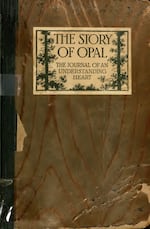
This image shows the book cover of "The Story of Opal: The Journal of an Understanding Heart" published in 1920.
Courtesy of the New York Public Library
A child’s fairyland
According to Opal, she wrote the diary on scraps of paper that she saved.
In the diary, she described a child’s fairyland. Her days included going to the small community school, helping with chores and wandering the forests with her many animal friends, whom she named after famous people in history.
“I do have conversations with them,” she wrote. “They do tell me many things.”
“— Opal Whiteley, "The Story of Opal: The Journal of an Understanding Heart"Under the steps lives a toad. He and I - we are friends. I have named him. I call him Lucian Horace Ovid Virgil. ”
A kidnapped princess?
Some readers soon found hidden messages in the text suggesting Opal was not a Whiteley at all.
Readers pointed out her use of acrostics—letters of several words spell out a hidden message.
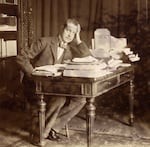
This from 1896, shows prince Henri d'Orléans at his desk. Opal claimed to be the long lost, illegitimate daughter of the prince. He died in 1901, when Opal was a toddler.
Courtesy of the Museum of the City of Paris
Within the pages of the diary, Opal wrote: “I did sing to the rivière a song. I sang it Le chant de Seine de Havre, et Essonne et Nonette et Roullon et Iton et Darnetal et Ourcq et Rille et Loing et Eure et Audelle et Nonette et Sarc.”
The message spelled “Henri D’Orlèans," a French nobleman and 19th-century explorer who died in 1901, when Opal was a toddler.
It all seemed too fantastical for critics. They accused her of writing the diary as an adult and inventing her royal lineage.
In 1921, the editor of the Cottage Grove Sentinel, Elbert Bede, wrote, “It takes too great a stretch of the imagination to believe that a child would forget its own name while remembering trivial incidents that took place a year or two before that name was taken.”
Ultimately, Opal left the country in search of answers and began calling herself Françoise Marie de Bourbon-Orléans. Reportedly, Henri’s mother believed her claims and paid to send Opal to India to research her parentage. Opal came to believe she was the illegitimate daughter of Henri and an Indian princess.
For a time, Opal lived at the guesthouse of the palace of the Maharana of Udaipur, where she took photographs and wrote about her travels.
Later life
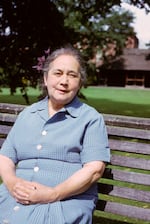
This undated photograph shows Opal Whiteley at the Napsbury Hospital outside of London.
Courtesy of the University of Oregon Libraries, Special Collection and Archive
By the 1930s, she was in England, barely making a living. Friends said that her writing became more erratic and she seemed to struggle with her mental health. In the 1940s, she was committed to a mental hospital in London.
“The hospital accepted that she was of aristocratic heritage but considered her mentally ill,” Williamson said. The official diagnosis was schizophrenia, though Williamson, a longtime mental health professional, believes she may have been on the autism spectrum.
Until her death in 1992, Opal maintained she was the kidnapped princess from the House of Bourbon.
Oregon literary legacy
Though she never returned to her hometown, Cottage Grove never forgot her. The city features a large mural of Whiteley and a statue outside the library. Today, her books appear in several languages, and her story continues to fascinate.

Behind the Scenes
Watch the full documentary OPAL WHITELEY.
I first spoke to Steve Williamson in 2009 while producing the Oregon Experience documentary “Opal Whiteley.”
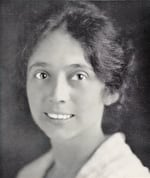
This image of Opal Whiteley dates to about 1919.
Courtesy of the University of Oregon, Libraries Special Collections and Archives
Steve spent many years not only researching Opal — and honoring her memory — while also working with people experiencing mental health issues. After much research and professional experience, he concluded Opal likely had autism spectrum disorder (ASD), specifically Asperger’s Syndrome. It was the first time I had heard of Asperger’s. Today, I know a lot about ASD.
My child is autistic. Like Opal, she loves nature—especially rocks of all kinds. We are learning to rock hound, and she already has so many rocks from all over Oregon!
I am so grateful that in our society today my amazing child can thrive.
But I can’t help but wonder what might have happened if Opal had the same kinds of encouragement and support. What would she have done with her life? How would we remember Opal today? As one of the state’s great naturalists and writers? I like to think so.