It may be hard to believe, but 25 years ago, Portland was not a food city. So how did it become the culinary juggernaut it is today? That was the question Portland Monthly set out to answer in their winter issue, which takes a deep dive into the 25 restaurants that shaped the last 25 years of Portland’s food scene.
Portland Monthly senior associate editor Matthew Trueherz oversaw the months-long project and spoke with All Things Considered host Crystal Ligori.
Crystal Ligori: This project is, frankly, massive. It’s 10 pages covering 25 restaurants in a semi-chronological order over the past quarter-century. How did the idea for the project come about and how did your team narrowed it down to just 25 spots.
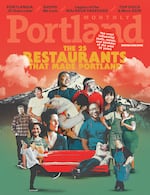
A months-long project from Portland Monthly leads the winter issue, highlighting the 25 restaurants that shaped the past 25 years of Portland's culinary scene.
Illustration by Max-o-Matic / Courtesy of Portland Monthly
Matthew Trueherz: We’ve been talking about it for over a year. Brooke Jackson-Glidden, our editor in chief, had the idea to sort of use the symmetry of 25 years and 25 restaurants, and was there a way to pick places that weren’t necessarily the best restaurants of the last 25 years in Portland, but the 25 restaurants that reshaped the dining culture, the food scene here, to feel like what it is now.
So, we started batting this idea around broadening our food team of the magazine; Brooke and myself, as well as Alex Frane, our food editor, Jordan Michelman, who is our restaurant critic at large, and Karen Brooks, who is also a restaurant critic at large. And if anybody’s read about food in the last 25 years in Portland, they know Karen’s name. So taking that idea of ‘How can we capture the influence — not the best — but what were the most influential?’ What place made its mark and shaped the places that came after it?
Ligori: Midway through the piece is a map of sorts that traces connections between dozens of different restaurants and chefs. At the very center of the map is Ripe. For folks who were not in Portland in the early 2000s, can you tell us what Ripe was and why it is at the center of that map?
Related: The 25 Restaurants That Made Portland
Trueherz: So the map came out of a project Nick Woo had made, and we talked about using that as a way to triangulate [the restaurants]. You might recognize the name Ripe Cooperative, which was what Naomi Pomeroy’s restaurant Beast turned into during COVID, but Ripe was actually one of her first restaurant projects that she did with her former husband, Michael Hebb. It was a catering company that became a pop-up in the Gotham Coffee Shop that sort of broke what the idea of a restaurant was. It became the opposite of what dinner out was in the aughts; there were communal tables [and] it was basically a party, which doesn’t sound weird today, but in 2005 was unthinkable.
The Gotham Coffee Shop became the Gotham Tavern, which has a sort of notorious flash of the pan, quite literally. Lots of people worked there, including Gabriel Rucker, who went on to start Le Pigeon, Canard, and Little Bird; Tommy Habetz who started Bunk Sandwiches and Bunk Bar, as well as Pizza Jerk; Troy MacLarty, who started Bollywood Theater, worked there as well. And there are other people that went on to become sous chefs and then later started their own places, so this map really shows how everybody’s connected in some way, back to Ripe.

With the help of software engineer and food blogger Nick Woo, Portland Monthly mapped some of the most influential chefs and restaurants in Portland for their latest issue which explores that last 25 years of Portland's culinary world.
Nick Woo / Courtesy of Portland Monthly
Ligori: Each restaurant has its own profile in the piece. Some of them come from your team, but some of them were told by notable folks who experienced these restaurants at the height of their fame. How did you find these stories from folks like the Pink Martini bandleader, Thomas Lauderdale or The Splendid Table host, Francis Lam?
Trueherz: In the spirit of talking about influence and not just making a restaurant critic’s list of 25 best places, but getting a sense of what the city has felt like over these 25 years, we wanted to talk to notable people that were the mainstays of different places. Thomas Lauderdale is a great example because, as much as Portland has a “man about town,” I think it’s Thomas Lauderdale who spoke about Bluehour. Bluehour felt quite different than any other restaurant in Portland. It was very much a place to see and be seen. Thomas talked about how it bridged different parts of the population of Portland because it was fancy, but it wasn’t super expensive. So you had artists and you had the uber-wealthy crowd and everybody kind of mixed there.
Francis Lam, we knew, had worked at Higgins very early in his career and so we thought, ‘Why don’t we see if we can get a hold of Francis and hear what it was like to be a kid starting out in food and see what Greg Higgins is doing at Portland’s OG farm-to-table restaurant.’
Another great example is talking to Darra Goldstein, who is a food scholar who started the peer-reviewed food journal Gastronomica. Particularly, she’s a scholar of Russian food, and so we interviewed her about Kachka and asked what did this restaurant mean in Portland? What was its effect? Why was it important that somebody opened specifically a Russian restaurant in Portland, and how did that kind of ripple through the culture?
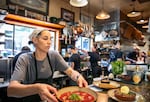
Dez G plates orders in the kitchen at Higgins restaurant in Portland, Ore., July 25, 2025. Following an announcement detailing a possible closure, the restaurant has seen an upsurge in reservations from returning patrons.
Morgan Barnaby / OPB
Ligori: There are a few givens on the list of 25 that I think almost anyone even peripherally familiar with the food scene in Portland would probably know: Beast, Paley’s Place, Nostrana, Pok Pok. But there are also a few that people may have never heard of, like Tanuki. How did the lesser-known spots on this list contribute to the food scene?
Trueherz: When we were assembling the list, there were places that stood out to different people and you’d kind of raise your hand and say, ‘I wanna do that’. My colleague Alex Frane had fond memories of Tanuki, which served a mix of Japanese and Korean food, but it definitely was not a Japanese restaurant, and they would post printed-out signs saying “We’re not a Japanese restaurant” in the window. And was a kind of red-lit den where there was not-safe-for-work content on the TV’s and the food kept iterating on itself and becoming this really unique thing. So Tanuki was really this gem — very Portland in the sense that it was in its own world and completely irreverent and almost actively pushing away clientele and press. And what you’re left with, if you do go and survive a visit, you feel this kind of earned relationship to it and this sense of having been there and ‘seen the thing.’
Other ones that really stand out in terms of looking back at who shaped where we are now: Navarre, which really upended everything that you thought was going to happen in a meal. Navarre didn’t really make sense in the way that a restaurant menu would make sense with appetizers, entrees, and desserts. It had a menu where you wrote checkmarks next to what you wanted; it was just lists of very sparsely named ingredients: ‘I’ll have the carrots and the lamb,’ and you just see what comes. Karen Brooks went back and talked to chef John Taboada while writing about Navarre and he sort of said, “I can’t believe this restaurant still exists today”. The whole mission was to take back the freedom of what eating at a restaurant means. It doesn’t have to fit this formula.
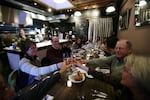
This Sept. 27, 2013 photo shows patrons toasting at Naomi Pomeroy's Beast restaurant in Portland, Ore.
Don Ryan / AP
Ligori: What do you hope that readers take away from this piece?
Trueherz: We didn’t want it to be this comprehensive end-to-end list written through the history of 25 years in Portland. We wanted to get the most affecting, influential places and create the odds and ends of that world for the reader. One of the biggest examples was the story of the first night of Beast. Karen Brooks talked to Mika Paredes, who was Naomi Pomeroy’s right hand through a few decades of restaurant ventures.
Beast was this little one-room restaurant that was kind of not even a restaurant. I think there was a hood vent, but not a stove, just little induction burners. It was really a ‘making something out of nothing’ spirit, but it was presented as a restaurant and it’s still what Pomeroy is known for: what her cookbook came out of, what the James Beard Awards came for. And so to be there on the first night of Beast — there’s so much lore and there’s so much magic and preserving that magic is what keeps the spirit alive, but also knowing what it was like is fascinating.
Mika talked about the scramble to get things ready — they were running to the neighboring restaurant to cook duck since they didn’t have a grill — it was this mad dash. And then she hits on this moment right before service happens: they broke everything down, the kitchen they’d been cooking in all day becomes the dining room, and then they’re open and it’s this mad success. I think it is such a Portland restaurant story. It’s almost like pretending until it becomes real, but that feels like underselling it. It also was this ingenuity, just making something and showing that you could make something. You hear that story and you’re like, ‘Yeah, I went to a pop-up the other day.’ It doesn’t feel weird today, but the point of this whole package of stories was to say that that wasn’t always the way … before it was very much the white tablecloth dinners your parents did, and this was breaking that mold.