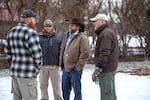
Ammon Bundy talks with occupiers at the Malheur National Wildlife Refuge in January 2016.
Kristian Foden-Vencil / OPB
On Jan. 2, 2016 a dozen armed men took over the headquarters of the Malheur National Wildlife Refuge in Eastern Oregon. Today we listen back to a documentary OPB reporters made about the 41 days that followed.
Note: The following transcript was transcribed digitally and validated for accuracy, readability and formatting by an OPB volunteer.
[Shouting at rally]
Frankie Gould: My two-year old and three-year old were just like, “Oh, those guys are scary. Why do they have guns?”
Rally organizer: I’m not here to start a war. Is anybody here to start a war?
Crowd: No!
LaVoy Finicum: When I was thinking there, I says, well, you Bundy boys, I rode with you once. I’ll ride with you again. So, I’ve cast my lot with them and we’ve crossed the Rubicon and, and there’s no turning back.
Georgia Marshall: Have we ever had anybody put together a refuge plan in this [beep] nation? Hell no, we haven’t! But it happened here and it happened in Harney County.
David Fry: I don’t like killing people. I don’t really want to kill people. I just … but I don’t want to be put in prison. And if I have to make it to where I have to die somehow, I’ll do that.
Georgia Marshall: My fear is that it won’t end the way we want it to peacefully. And I know that if that happens, our community will never be Harney County again. It just won’t be.
Dave Ward: A young man, a very troubled young man, said if everybody says hallelujah, I’ll come out. I heard hallelujahs from the SWAT team. I heard hallelujahs in unison out of an entire building, the people that were watching that with their fingers crossed, hoping to God that they could get people out alive. Right now, we have the opportunity as people in this great nation, the best nation on the face of the earth, to come out and work through our differences and start getting things back together.
Dave Miller: This is Think Out Loud on OPB. I’m Dave Miller. It was 10 years ago today, a cold, snowy day in Eastern Oregon, when about a dozen armed men took over the headquarters of the Malheur National Wildlife Refuge in Harney County. It quickly became national news, a 41-day occupation and one of the most dramatic episodes in Oregon history. Next week we’ll talk about how that occupation reverberates to this day, but we’re going to spend this hour listening to a special hour we made right after the occupation ended. Here’s my former colleague, Amanda Peacher.
Amanda Peacher: At the very beginning, it was ostensibly about a local family. Dwight and Steven Hammond are ranchers in Harney County.
Miller: In 2012, they were found guilty of setting fires on federal land. They were prosecuted under an anti-terrorism law that carried mandatory five-year sentences.
Peacher: But Federal Judge Michael Hogan said those sentences would shock the conscience. He sentenced Dwight Hammond to three months in prison, and Steven to a year and a day. The father and son served that time.
Miller: But federal prosecutors appealed the judge’s more lenient sentences and won. An appeals court said the men had to serve out the balance of their mandatory minimums. The Hammonds were expected to report to prison on Monday, January 4.
Peacher: As with so many aspects of this saga, the backstory is more complicated. Even as many Harney County residents said the Hammonds had been wronged by the legal system, others pointed out that the Hammonds had a contentious history with federal officials, including making death threats. In any case, the Hammond’s story started spreading.
Miller: And in November it got picked up by Ammon Bundy.
Ammon Bundy: This is basically my update. The Hammonds need your help. They need you to stand, whether they’re afraid or not, whether they’re willing to stand or not or not. And by standing with the Hammonds, we stand for our children and our children’s children, and it’s time to unite. It’s time to get educated. We need to straighten this out.
Miller: Forty-year-old Ammon Bundy is deeply religious, a father of five and a small business owner who always wears a cowboy hat. He’s a son of Cliven Bundy – that’s the Nevada rancher who, you might remember, staged an armed face-off with federal officials back in 2014.
Peacher: Cliven Bundy does not recognize the federal government’s right to own land in Nevada. He refused to pay fees to graze his cattle on federal land for more than 20 years.
Miller: In 2014, the feds said that Cliven Bundy owed more than a million dollars in fees and tried to impound his cattle, but Cliven Bundy called for militias to help him. It became known as the Bunkerville Standoff.
[Sounds from standoff]
Reporter: It was getting ugly fast in Nevada. [Background noise, people yelling] A powder keg was about to explode, but today the rent collector, the government, blinked. The Bureau of Land Management in a written statement saying, “We have made a decision to conclude the cattle gathering because of our serious concern about the safety of employees, Bundy and members of the public.”
Peacher: The feds backed off and released Bundy’s cattle. For almost two years, his debts remained unpaid and no one tried to arrest him. The message some people took from Bunkerville is that if you have a big enough militia, the federal government will blink.
Miller: When Cliven Bundy’s son, Ammon, heard about the Hammonds, he saw a parallel to his own family and a chance to get involved. Ammon Bundy offered to safeguard the Hammonds from federal officials, if Dwight and Steven refused to report to prison. But he couldn’t convince the Hammonds that this was a good idea. The Hammonds said they intended to go to prison as promised.
Peacher: That didn’t matter to Ryan Payne. He’s an electrician from Montana, who participated in the first Bundy standoff. He said the Hammonds had been beaten down by federal oppression.
Ryan Payne: The Hammonds need to be defended. They’re being brutally oppressed. They can’t defend themselves. They can’t ask for help. It’s asking a
sheep to all of a sudden defend itself from the wolves.
Miller: By December, the calls had become direct. In a YouTube video from December 26, four members of what would become the armed occupation said it was time to come to Burns. This is Joe O’Shaughnessy.
Joe O’Shaughnessy: Basically where we’re standing right now, this is a call out, an alert to all Patriots, constitutionalists, militias and good Americans who believe in the Constitution. We are doing a Patriot convoy in Burns, Oregon. We’re gonna meet at the Safeway in Burns. It’s at 246 West Monroe Street, Oregon 97720, and that will be January 2.
Peacher: That call to action worried some in Burns, including Harney County Sheriff Dave Ward. Ward and County Judge Steve Grasty were the most high profile local leaders during the 41-day standoff. Ward is emotive, often delivering remarks with tears in his eyes. He received death threats from across the U.S. after he told Ammon Bundy he wouldn’t create a safe haven for the Hammonds.
Sheriff Dave Ward: I haven’t slept a full night for close to two months now, but what we’ve been threatened with here is civil unrest and the insinuations of armed rebellion. We cannot have what happened at the Bundy ranch here. I won’t allow it from law enforcement. And I won’t have it from citizens.
Miller: When Ward talks, his face often flushes red. You might call Sheriff Ward the heart of Harney County, which would make Judge Grasty the brain. The judge is essentially the county chair.
Judge Grasty: One of the guiding principles of these militia groups and Mr. Bundy is that local decision making ought to be taking place. I find it interesting that that’s their principle and that they would come in here and they want to re-educate us on how we ought to be doing things, no different than when we see a conservation group overwhelming what we’d like to do here locally.
Peacher: Both Grasty and Ward worried that the Bundys’ call for supporters could become something bigger. And they had good reason to worry. On Saturday, January 2, two days before the Hammonds were supposed to turn themselves in, more than 300 people marched through Burns. One of the organizers spoke to the group at the beginning of the rally.
Rally organizer: I’m not here to start a war. Is anybody here to start a war?
Group: No!
Rally organizer: I don’t think, I don’t think anybody’s here to start a war.
A protester in the crowd: Tell them to stop [beep] with us.
Rally organizer: Amen. We’re here to stop it. We are here to put the government back in its constitutional confines. There are rogue elements working within our government that are harassing people that are taking away rights and sometimes people get scared and they need their story heard, and that’s what we’re here to do. We’re here to stand up for our brothers and sisters, and show the world and show America that we stick together.
Miller: Many of the protesters were from Harney County, but plenty came from far away. What those protesters didn’t know is that Ammon Bundy and a few close associates had planned a very different kind of demonstration.
Peacher: After the rally, Bundy and an estimated dozen or so people drove about 30 minutes south of Burns and took over the Malheur National Wildlife Refuge. One of the militants, Dylan Anderson, said the takeover of the refuge was easier than Bundy said it might be.
Dylan Anderson: He said they’d probably set up a roadblock and we’re going to go through it anyways. And I pictured in my mind, we’re going to crash into it, and get shot at, and go unlock our guns, and go to the back and get our gun clips, but no worries here. We just drove right on through.
Miller: And suddenly this local story was national news.
News broadcaster 1: There is a standoff tonight in Oregon where anti-government activists are occupying a federal office building at a wildlife refuge …
News broadcaster 2: They’re armed and staying put. A group of protesters broke into an unoccupied building at an Oregon federal wildlife refuge Saturday.
Newsbroadcaster 3: The group says they’re patriots. And initially they were standing up for two ranchers facing prison time, but now they’re saying their fight is bigger than that.
Stephen Colbert: It’s about a group of heavily armed protesters who have occupied something called the Malheur National Wildlife Refuge in a remote area of Southeast Oregon. I have not seen this many angry, bearded men in Oregon since I referred to Blue Moon as a craft beer. [Laughter]
Miller: Arizona rancher LaVoy Finicum was a part of the group that took over the refuge. Finicum was a devout Mormon and father of 11 children. At the refuge, he wore a cream-colored cowboy hat that had attached earmuffs. Finicum was a longtime supporter of the Bundys, but he said that neither he nor Ryan Bundy – that’s Ammon’s older brother – knew what they were getting themselves into.
LaVoy Finicum: Ryan and I, we didn’t know Ryan Bundy, who rode with me, he had only one change of clothes because we’re headed back the next day and no winter clothes. And anyway, so there’s about four or five vehicles, one truck with the trailer and all the supplies. So we start driving the hot and I’m the rear guard, and I don’t know where we’re going, but we’re headed out through the snow flat and I’m sitting there. And if you heard the term crossing the Rubicon?
Peacher: Yes.
Finicum: Once you cross, you can’t come back. And I’m driving, I’m in my truck all by myself, and I’m thinking lots of thoughts. I think, you know, I’ve not yet crossed the Rubicon. I’ve not yet taken the federal buildings, and I said, you know, once I do, I can’t go back. So I’m just thinking and as I’m sitting there. At a fence posts alongside the roads up ahead there’s a beautiful bald eagle, a huge bird, beautiful, watching us come. And as we pass, it lifts off and flies, and I go, you know, this is about freedom. I’m crossing the Rubicon, but it was quite a shock to my whole family.
But I had ridden with the Bundys before at the Bunkerville Standoff. I was one of the cowboys on the horses there. But anyway, when I was thinking there, I says, well, you Bundy boys, I rode with you once, I’ll ride with you again. So, I’ve cast my lot with them, and we’ve crossed the Rubicon and there’s no turning back. The public, the whole world, the country needs to understand that these buildings never ever go back to the federal government at any time.
Miller: Those Bundy boys, as Finicum called them, commanded a following.
Anderson: Ammon inspires me when I go near them. I know I’m doing the right thing, just following him.
Peacher: That’s Dylan Anderson again, who back then would only identify himself as Captain Moroni. Moroni is a crucial figure for the Church of Latter-Day Saints. Many of the occupation leaders are Mormon, including the Bundys, although the mainstream LDS Church denounced the occupation early on.
On that first morning of the occupation, the temperature was 12 degrees. There was a fresh layer of snow on the sagebrush. Anderson and the other militants were seeing a landscape full of religious symbols.
Anderson: Here comes a small flock of geese and another one, and that’s exactly what happened at the Bundy ranch. It’s just a giant flock of geese came flying over. I just knew it was the right thing.
Miller: We should take a moment now to tell you about this land because it really is such an important part of the story. The Malheur National Wildlife Refuge and the area all around it are a part of Oregon’s high desert, a vast expanse of sagebrush country that serves as a seasonal watering hole for tens of millions of migratory birds every year. The refuge was established in 1908 and it now encompasses nearly 190,000 acres. The headquarters complex is a collection of old stone buildings and includes offices, a visitor center, a barn and residential buildings.
Peacher: The refuge is not just for birds. It’s used by hikers, anglers, hunters, and some ranchers who graze cattle there. And if there’s one thing that everyone seems to agree on, no matter where they stand in this story, it’s that this land is stunning.
Isabelle Fleureau: It’s the most beautiful place I’ve ever lived in, in my life.
Miller: That’s Isabelle Fleureau, who’s originally from France. She lives in Burns now, but has lived all over the U.S.
Fleureau: I have never lived anywhere where I actually will stop the car and cry because it’s so beautiful. It is beautiful. I want everybody to come. I want all the journalists to come back in April when the birds are here. It’s just the most amazingly beautiful place on earth.
Miller: The occupiers talked less about natural beauty and more about the constitution. They had plenty of demands.
Peacher: They wanted the Hammonds to be released from prison. They thought all federal lands should be turned over to local control. For rancher LaVoy Finicum, this was the big picture.
Finicum: This is for all Americans. This is for the camper. They’re closing off access. This is for you, who wants to come and access these public lands. This is to preserve the public lands. This is to preserve public access. This is to preserve the rights for the citizens to come and hunt and to reclamate [sic], and it’s for the rights of the citizens to use the resources to use that grass to prune and harvest the forest in a reasonable manner. And so this is about all Americans.
Peacher: As for the Malheur refuge itself, Ammon Bundy said that the land he was occupying was never federally owned to begin with.
A. Bundy: It was an unconstitutional act of President Theodore Roosevelt, and they took ranchers and removed them, literally removed them, off the land so that they can make this refuge. And those purchases are unconstitutional. The federal government must first get consent from the state legislatures before they can purchase land inside a state.
Nancy Langston: Yeah, I think that’s a very incorrect reading of history.
Miller: Nancy Langston is a professor of environmental history at Michigan Technological University. She wrote a book about the Malheur Refuge.
Langston: President Teddy Roosevelt, one of the great Republican presidents, established the wildlife refuge in 1908, so that was a long time ago. But he established it not on ranchers’ lands, not on state lands, but rather on federal lands that had actually been repossessed from the Paiute Tribe. So if there’s any group of people in the basin that do have prior claims to the refuge lands, I think the Paiute are the group that we need to consider.
Miller: Charlotte Rodrique, the chairwoman of the Burns Paiute Tribe agreed.
Charlotte Rodrique: Everybody in the area acknowledges that the Tribe are the rightful owners, even the ranchers. It just really rubs me the wrong way that we have a bunch of misinformed people in here going on national TV making statements that have no foundation and they’re not the original owners.
Peacher: Eric Iron Cloud Hawley is another member of the Tribe. He took a historical view.
Eric Iron Cloud Hawley: As a Native, of course I’m not all keen on the government and everything, but this just doesn’t feel right. To me, it feels like the 1800s again. This is probably what my ancestors felt like, having people come in here and wanting more of the land. It’s more of a land grab and privatizing what’s there for everybody now.
Peacher: Members of the Paiute Tribe weren’t alone in feeling upset about the occupation. In fact, impacts were immediate across the community.
Miller: Harney County schools were closed for a week, federal offices were as well. Many of the refuge workers were traumatized and advised to leave town. National and international media descended on Burns, and friends, neighbors and family members found themselves having to pick sides.
Peacher: And picking sides was actually no small feat. This is a small, tight knit community. It’s one thing to say there’s government overreach, but government employees aren’t just faceless bureaucrats in D.C. More than 40% of the county’s employed residents work for either local or federal government. They’re members at your church, parents of your kids’ friends, they’re family members.
Miller: On the third day of the occupation, Ryan Bundy said that if the community asked the occupiers to leave, they would. So Sheriff Ward organized a town hall meeting, and Georgia Marshall, the fifth-generation rancher, we heard from earlier, decided to go.
Marshall: I think that night when I went into town for the town hall meeting. I went in because the occupier said that if Harney County wanted him to leave, they would. And I thought, well, I’m going in because if there’s a vote, I’m going to make sure I raise my hand. And I sat and I listened. As it got towards the end of the meeting, I just got up and I walked over to my son. He was standing a ways off and I said, “I think I’m gonna have to say something.” And he says, “well, all right, mom.” [Laughter]
Marshall [speaking in the town hall meeting]: We have a plan that was done just a couple of years ago that is unprecedented across these United States on refuges. Have we ever had anybody put together a refuge plan in this [beep] nation? Hell no, we haven’t, but it happened here and it happened in Harney County! And you know why? Because we love this county, because we care about it and we care about how it works for us.
Peacher: Marshall was talking about something we heard from many different people in Harney County. They saw it as a kind of dark irony that the occupation was taking place in the county that’s known as a poster child for the West for collaborative solutions. Over the last decade, environmental groups, federal officials and ranchers have come together to hammer out deals about the Steens Mountain Wilderness, the greater sage grouse and the Malheur Refuge itself.
Miller: By day seven, even members of the community who’d been allies of the Bundys were questioning the occupation. The Harney County group that Bundy helped create, called the Committee of Safety, agreed with the mission of the occupiers to turn federal lands over to local control, but they were upset by the occupation. Committee member Melody Molt shared a letter they wrote asking Ammon Bundy to leave.
Melody Molt: We were very upset that you chose to take the aggressive action of occupying the refuge and did it without our knowledge or any other local approval, and in the fashion that created huge distrust and loss of credibility for us as a group of residents within the community.
Peacher: In fact, plenty of people who are against the tactics of the occupiers were quick to point out that they actually shared many of their frustrations. That’s essentially what Greg Walden said on the floor of the U.S. House of Representatives. Walden is the only Republican member of Oregon’s congressional delegation.
Miller: During the first week of the occupation, Walden got up to give a short, prepared speech about the situation in Harney County, but he ended up disregarding his text and speaking for an impassioned, impromptu 24 minutes. Here’s part of what he said.
Greg Walden: It is the public’s land, that is true. But what people don’t understand is the culture, the lifestyle of this great American West, and how much these ranchers care about the environment, about the future, about their children, about America, and how much they believe in the Constitution. And now we see the extent they will go to defend what they view as their constitutional rights.
Peacher: Like most elected officials, Walden also said he wanted the occupation to end, and peacefully. But things in Harney County were about to get much worse.
Miller: The occupation started on this day in 2016 and ended 41 days later. Many local residents were frightened when the takeover first happened. But the occupiers did welcome visitors and they loved talking to local residents. In fact, with the guns mostly out of sight, the occupied refuge often didn’t seem like a scary place. My former colleague Amanda Peacher picks it up from here.
Peacher: Curious Harney County residents stopped by, some with their kids, to see what was happening. Eighth grader Travis Cady visited with his family.
Travis Cady: I came to check it out and see what’s going on because school got canceled, so we figured we’d come and do some learning and talk to people, ask questions. It’s not what social media says it is, not at all. Supposedly it’s a bunch of armed people, which I’ve seen maybe one gun. And they’re all super nice and answer questions.
Miller: This story got even more complicated about a week after the occupation began. That’s when a group called the Pacific Patriots Network came back to Harney County. They agreed with the occupiers’ mission to turn the refuge lands over to local control, but didn’t agree with the occupation itself. On day eight, about two dozen members of this new group came to the refuge, many carrying semi-automatic rifles.
Peacher: One of the leaders, Brandon Curtis, spoke to reporters, saying they were there to quote, de-escalate the situation. But that wasn’t the way LaVoy Finicum saw it. He interrupted the press conference.
Finicum [Speaking to Brandon Curtis]: Brandon I’m glad so glad you’re here to help. OK, but my concern is that there’s long guns here and that’s what always gets out of the media, people packing long guns trying to look like this is violent, and that sells a lot of newspapers. We want the long guns put away. We want those put up, OK? We don’t want things to look threatening. This thing is not to be threatening. This is to be peaceful.
Miller: The Pacific Patriots Network said they wanted to be a buffer between law enforcement and the militants at the refuge, so they stayed in Burns. They had some local supporters. Rodney Johnson is a rancher and cowboy who spoke in favor of the group.
Rodney Johnson: You know, three weeks ago, the militia, just that name when he threw it out there, just kind of scared people. I’ll tell you right now, I’m a lot more scared of those feds up there in that building that barricade themselves in right now than I am these militia guys. [Applause]
Peacher: But many in Burns were distressed by the armed outsiders who now seem to be everywhere. Frankie Gould is a young mother who fiercely opposed the militia’s presence.
Gould: It was a Sunday and we’re getting ready to go to church and we’re driving by the Sundowner and there’s just all these guys with assault rifles strapped to their chests walking around in that area. My 2-year old and 3-year-old were just like, “oh, those guys are scary. Why do they have guns?” I don’t want to see their faces everywhere I go in town and it’s just been a very big hassle for everybody in town. I think that everybody is suffering in one way or another because of this.
Peacher: Here’s Sheriff Ward again.
Sheriff Ward: It’s time for you to leave our community. Go home to your families. And end this peacefully.
Miller: New supporters were now showing up at the refuge from places like Idaho, Ohio and Arkansas. Kristi Jernigan is a Christian missionary from Tennessee.
Kristi Jernigan: I just knew that God said go.
Miller: She’s one of dozens of supporters who began trickling into Harney County during the second week of the occupation.
Jernigan: My husband makes the final decisions in our household because of our biblical principles. And he said you need to follow what God is leading you to do.
Peacher: Women like Jernigan did the cooking and cleaning, welcoming visitors and sorting incoming supplies. The occupation started to feel strangely routine. The militants held daily press conferences and strategic meetings. The snow began to melt. People prayed. A 27-year old Ohioan named David Fry arrived and started building a website for the occupiers using government computers.
Miller: As the days wore on, the militants took on various projects around the refuge. They built a road and expanded a parking lot on what is actually a protected archaeological site. They rifled through federal records of grazing permits. They removed a fence separating private land from public.
Peacher: And on day 17, they invited local ranchers to Crane Hot Springs to spread their land management gospel. Here’s Ryan Bundy.
Ryan Bundy: So if you want to clear yourself from this unconstitutional mess and claim the rights that you truly already own and use them the way you should, then you need to take that contract, and you need to tear it up, and you need to tell them that you’re never signing another one again.
Miller: Buck Taylor has been ranching in Harney County for more than 50 years, and after the meeting he said he was considering Bundy’s proposition.
Buck Taylor: I am drinking the Kool-Aid. I haven’t swallowed it yet, but I am drinking the Kool-Aid.
Peacher: Other ranchers like Scott Franklin weren’t convinced.
Scott Franklin: Some of the stuff that’s been going on, I think it’s a split in this community. Heck, we usually have one good fight a year and it’s usually over water, but we have plenty of snow, so we’re not going to be able to fight about water. So maybe this is it.
Peacher: That fight was playing out just down the road in Burns as well. As the conversation in town spiraled away from the Hammonds, two camps began to form. There were those who wanted the occupiers out and those who supported the Bundys.
Miller: Tensions came to a head on day 18 of the occupation. There was a community meeting in the high school gym, the same night the wrestling team practices. You could even hear the high school wrestlers grunting and shouting in the background. Katie Beatty is a graphic designer.
Katie Beatty: We’ve all stood shoulder to shoulder to save our theaters, send our kids on numerous trips, save our sports programs, raise money to help locals pay medical bills, and the list just goes on. Why is it that now when the entire nation is watching our every move, do we decide to tear each other down? And it doesn’t matter what side of the fence you stand on, but the way you compose yourself during this time will follow you forever.
Our community needs to focus on changing and healing. Neither will be accomplished if the malice that is at the heart of the great Harney County divide is not addressed. Choose wisely the way you express your opinion, as doing so in a manner that is hurtful, slanderous or just plain nasty will be your burden to carry after the cameras leave. [Applause]
Peacher: I was actually at that meeting, and at first it was community members expressing a lot of frustration with one another, with the occupation, with the federal government. It was already a charged scene, but midway through the meeting, the Bundys showed up and actually sat in the bleachers. And then you could feel the tension in the room magnify tenfold.
Miller: The gathering was supposed to be for Harney County residents, but suddenly most speakers were addressing Ammon Bundy directly.
Peacher: Here’s what Eddie Brown had to say.
Eddie Brown: Mr. Bundy, I agree with you 100%. We have way too much government, but in the same hand, get the hell out of my yard! [Applause] Are you happy that you did this to the community?
Peacher: Bundy wasn’t allowed to respond, but that didn’t keep other community members from addressing him too. Here’s Isabelle Fleureau, the French woman we heard from earlier this hour.
Fleureau: Instead of invading our wildlife virtues and then daring to come here in our public school, while our children are practicing their sports, you should just go home and I hope somebody catches you on the way and you go to jail where you deserve to be! [Applause]
Judge Grasty: Mr. Bundy, be very clear, I’m happy to meet you any place outside of my county. It is time for you to go home.
Miller: That last voice was County Judge Steve Grasty again. In spite of the chanting, the Bundys weren’t ready to just go home, and as the occupation continued, many people started to get frustrated with the way federal law enforcement was handling the situation.
Peacher: The occupiers had complete freedom of movement. They could come and go as they pleased, shopping in town, picking up supplies. They were able to receive packages from supporters and detractors in the mail. And LaVoy Finicum actually drove down to Utah and back.
Miller: Environmental groups started getting fed up that their voices weren’t being heard. A group in Bend called the Great Old Broads for Wilderness organized a rally against the occupation.
Alice Elshoff: And we are against all bullies, but especially today we are against those bullies over at Malheur that are desecrating our wildlife refuge.
Peacher: Their event was planned on short notice in the middle of a workday, but still, more than 100 people showed up. Alice Elshoff organized the rally.
Elshoff: We are ready to go over and send those bullies back to their mamas. [Laughter]
Miller: Other rallies in support of public lands followed. In Portland, La Grande, Boise and Eugene. A group of environmentalists started camping and speaking to the media just down the road from the refuge.
Peacher: But still, the occupation wore on. There wasn’t a law enforcement vehicle in sight within miles of the refuge. All of this led many to demand that the FBI take action like shut off the power or close the roads.
Miller: Now it was clear throughout the occupation that the FBI didn’t want a repeat of deadly incidents like Waco or Ruby Ridge and neither did Harney County residents. This is Georgia Marshall again.
Marshall: My fear is that it won’t end the way we want it to peacefully, that it may end up the FBI going in and having to take them out. I don’t want that. I know that if that happens, our community will never be Harney County again. It just won’t be.
Peacher: Even with those concerns, Oregon leaders started speaking out publicly about what they saw as an overly cautious approach on the part of the FBI. Here’s Governor Kate Brown.
Governor Kate Brown: I want them to take action, and I want them to make sure that the wrongdoers are held accountable. This must end. The situation, no action is not an option for this community.
Peacher: Harney County Judge Steve Grasty agreed.
Judge Grasty: I think it makes some sense, but I think the level of angst in this community and in the state is past that time to move.
Miller: Grasty talked about what it was like to request federal action and not get an answer.
Judge Grasty: So they proved the fact that sometimes the federal government doesn’t listen to small communities, and I abhor that fact, that they would solidify that belief that the feds aren’t going to listen to local government, local communities, and dang it, that’s discouraging.
Miller: By day 24 of the standoff, LaVoy Finicum was one of the real leaders of the occupation, a kind of father figure and spokesman. He thought that things were going to come to a head.
Finicum: I do believe that they are ramping up militarily. You look at the amount of armaments they’re bringing in, the increase in the militarized personnel, and they firmly do not intend to have us remain here. And we firmly intend not to leave and so it is important for America to know that we’re not negotiating an exit strategy. We’re here to do a job and we shall stay here, and it’s important that America knows that these buildings shall never ever return to the federal government. When we walk away from here, they will be safely returned to Harney County and its citizens. And the federal government is determined that that shall not happen, and we are determined that it shall happen.
Miller: What you’re describing seems like an untenable situation. You both can’t have your way.
Finicum: So I believe that here in the near future, we shall see who shall carry the day. We shall be as gentle and friendly as possible, but we shall be as firm as necessary, and that’s kind of just where we leave it at.
Peacher: It turns out that Finicum was right. The feds were finally getting ready to make their move. It happened the very next day.
Miller: On the 25th day of the occupation, the leaders, including Finicum, were driving from the refuge to a meeting in the town of John Day, which is about an hour north of Burns. At least 200 people were waiting to hear their message. They never made it.
Tad Houpt: Hello, my name’s Tad Houpt. I’m the person that brought this meeting to me, I guess, and I have really bad news. Our guest speakers aren’t gonna be here tonight. So it seems that there was an altercation between here and Burns.
Peacher: But at first, no one was quite sure why the Bundys hadn’t made it to the meeting. Over a few tense hours, the story began to emerge. State police and FBI had stopped the two cars on a remote, tree-lined stretch of highway about 20 miles north of Burns. Eight people had been arrested, including the Bundys, and LaVoy Finicum was dead.
Miller: The first account of what happened came from Victoria Sharp. She’s an 18-year-old girl who’d come to the refuge as part of her family’s Christian singing group. She was heading to John Day to sing at the meeting there, and she was in the car with Finicum at the traffic stop.
Victoria Sharp: And he took off and then they had a roadblock set up, so he ran into a snow bank. And then like when we crashed, they stopped for a second. He got out of the car and he had his hands in the air. He’s like, just shoot me then. That’s what you want to shoot me, and they did. They shot him dead. I swear to God he’s walking with his hands in the air.
Miller: Sharp’s account rocketed through social media and fueled a controversy about Finicum’s death. So the FBI released aerial footage of the chase, which seemed to show a different story. FBI Special Agent-in-Charge Greg Bretzing said that Finicum sped away from the traffic stop and then drove off the road to avoid a roadblock.
George Bretzing: He nearly hits an FBI agent as he maneuvers to the left. The truck gets stuck in the snow bank. Finicum leaves the truck and steps through the snow. Agents and troopers on scene had information that Finicum and others would be armed. On at least two occasions, Finicum reaches his right hand toward a pocket on the left inside portion of his jacket. He did have a loaded nine millimeter semi-automatic handgun in that pocket. At this time, OSP troopers shot Finicum.
Peacher: Bretzing said they were releasing the video to quash rumors about the circumstances of Finicum’s death, but those rumors continued. We’ll hear more about them later.
Miller: Meanwhile, with Finicum now dead and the Bundys in custody, there was chaos at the refuge. So Pete Santilli stepped in. He’s a conservative internet radio talk show host who’d become a fixture at the refuge and in Burns, live streaming day after day.
Peacher: On the night that the Bundys were arrested and Finicum was killed, Santilli was trying to end the occupation safely.
Pete Santilli: OK, listen, they need to give us a freaking chance to get people out of there, OK?
Unknown Speaker: They will.
Santilli: Seriously, OK. Nobody needs to get freaking hurt. FBI, If you’re hearing this, just slow your roll a little bit, OK? We’ll get them out. If they’ve taken Ammon into custody, OK, it’s time for … there’s women and children up there, OK.
Miller: Some occupiers did leave that night. Rancher Andy Dunbar lives right next to the refuge headquarters. He said the remaining occupiers went into a kind of frenzy.
Andy Dunbar: When Bundy and them got arrested and Finicum was shot, they’d become desperate. They were scared. They were panicking and they were desperate. And those are combinations to have in people that are armed that doesn’t make me comfortable.
Peacher: The militants came within 30 feet of Dunbar’s house as they fled.
Dunbar: You know, I didn’t know what was to stop them from thinking, “Well, maybe we can have some hostages.”
Peacher: The FBI established roadblocks leading up to the refuge that night. The next morning, day 26, only about a dozen occupiers remained. They parked a tractor on the road into the refuge to keep the FBI out.
Miller: Gary Hunt had arrived the day before. He said the people who were leaving weren’t committed to the ideals of the occupation.
Gary Hunt: They’re cowards, they left. Those that come this direction are true Americans. Those that left have words but no actions to go with them.
Peacher: Barbara Berg said she was ready for whatever was coming next.
Barbara Berg: I’d rather die standing up for what I believe in than live on my knees being a slave to all the tyrannical bureaucratic lies.
Peacher: Strong words, but a day later, Ammon Bundy released a statement asking the remaining occupiers to leave – and eight of them agreed.
Miller: That left four unlikely holdouts at the refuge: David Fry, Sean and Sandy Anderson, and Jeff Banta. Fry said the group didn’t have a leader.
David Fry: No, we’re actually, we’re all like the little lost Indians just stuck here, so we’re all just questioning each other and wondering. We’re wondering, yeah, we’re all kind of making judgments based on when we have group meetings, we’re just wondering what’s going on, like what should we do.
Miller: And you feel like you’re all on the same page?
Fry: We all feel like we should be allowed to just go home in peace because we were willing to leave and you guys already got all the leaders. You killed one and got all the leaders, so the movement’s been killed. It’s done. So the people who are caught in the aftermath, I mean, we thought it was going to be a peaceful revolution, like a peaceful protest, you know. Nobody was going to try to kill anybody, but it ended up, people ending up getting killed, so everybody decided it’s time to go. But we didn’t know exactly what’s going on during that chaos and we got stranded here.
Peacher: At first, they said that they were going to stay and that they were prepared to die, but the next day their tone was different. David Fry said they were willing to go under certain conditions.
Fry: We’re waiting here. We got everything ready to go. We got our things packed.
And all we ask is that the police give us safe passage home without having to detain any of us.
Peacher: For the next several days, the final four camped at the refuge, apparently no longer using the buildings. They called it Camp Finicum. They were waiting for assurances from the FBI that they could leave without consequences. Fry released occasional video updates.
Fry [video recording]: And so here we are. We’re just cruising along. And I want the FBI to see this. I want the FBI to see this because this is how I want to say screw you, piss off your little charges. You see this? It’s a U.S. government vehicle. You see that? It’s a U.S. government vehicle and I think I’m gonna take it on a little joy ride. [Car beeps] Yeah, yeah, let’s start this baby up. Now you got another charge on me, FBI. I am driving. I’m driving your vehicle right now! You’re gonna put another charge on me. Here’s another charge for you!
Miller: And while the final four remained at the refuge, controversy was mounting over the shooting of LaVoy Finicum. The Pacific Patriots Network organized a rally at the courthouse in Burns to protest Finicum’s death. They also demanded that local officials like Sheriff Ward and Judge Grasty step down.
Peacher: By this point, many in Harney County had had it with outsiders. On day 31, locals organized a counter protest to show support for elected leaders.
Tara McLain: For a while, we’ve had groups that have come here and have told us how we need to react to things and what we need to do. They’ve called for resignation of our elected officials. They’ve told us what we need to do and we’ve got lots of people here that may or may not agree about federal government and all of those things, but the one thing we do agree on is that we’re citizens of Hardy County and we’ll say when we want our elected officials to go, and we don’t need their help.
Peacher: Tara McLain was among hundreds of people who stood holding signs in front of the courthouse. It was the largest and probably the most emotional gathering in Burns over the course of the whole occupation.
Miller: Protesters and counterprotesters faced each other over the icy sidewalk at the courthouse, at times arguing, shouting and chanting.
Crowd: [Boos and chants]
Miller: For many in Burns, this protest was the first time they’d really confronted outsiders. After weeks of turmoil and angst in the community, their frustration came out as they faced off with the self-described militia. Helen Patton, a retired school principal in Burns, spoke about the protest.
Helen Patton: Well, it made a lot of us feel better. It gave us a good, good opportunity to yell. And I think that’s what a lot of us have been wanting to do for a long time.
[Singing]
Miller: Meanwhile, on day 35, LaVoy Finicum’s family and friends gathered in Kanab, Utah, for his funeral. By this point, many of Finicum’s supporters had come to believe that the FBI was lying or at least covering up some of the details of his death. This is Finicum’s oldest daughter, Thara Tenney.
Thara Tenney: And so today, we celebrate our father’s life. But going forward, we are calling for a private, independent investigation …
A couple voices: Yes. Here, here.
Tenney: … to find out exactly what happened to our dad.
Peacher: Back at the refuge on the afternoon of the 40th day of the occupation, the moment that many had been waiting for finally happened. The FBI began closing in. They surrounded the occupiers’ camp with armored vehicles.
Miller: From that point on, the world could hear much of what was being said by the occupiers. David Fry called the conservative activist Gavin Seim, who live streamed the audio on YouTube for much of that night and the following morning.
Gavin Seim: Listen, David. David, I got you live streaming. I’ve got it. I’ve got it hooked up next to a microphone and I’m passing you through. So talk to people, narrate what’s going on. Try to stay as calm as possible. I know this is an unheard of situation here.
Fry: Basically, these guys are ready to roll us. As soon as we don’t comply with these demands, as soon as the sun goes down, we’re going to die. That’s what’s going to happen.
Peacher: At times, something like 60,000 people were listening to the stream. Assemblywoman Michele Fiore of Nevada, a close ally of the Bundy family, arrived at the Portland airport and essentially turned herself into a crisis negotiator.
Michele Fiore: You and me and Jeff and Sean, we’re putting on our big girl panties now we are taking America back, and we’re doing it the right way. We’re doing it to lead by example. We’re doing it by the rule of law because our government has acted lawless. Are you guys hearing me?
Unknown Speaker: We are.
Fiore: OK, so I’m driving. I’m driving to you. And let me tell you, I need you guys to just stay calm.
Miller: It was hard to listen to and hard to turn off.
Sandy Anderson: We have our weapons at our sides, and they told us to put our weapons down, that we’re threatening them. Our weapons are at our side. Please don’t let us die in vain tonight. Please, people, stand up. This is going to be a revolution. I just know it. If they shoot us and kill us, it’s going to be a revolution!
Miller: After hours of conversation and negotiation, the last occupiers relented. Sean and Sandy Anderson and Jeff Banta turned themselves in in the late morning.
Peacher: But when it was David Fry’s turn, he balked.
Fry: They haven’t even promised anything really, like for me, I didn’t agree to any of this, really. You know what I’m saying? I’m kind of worried that they’re just going to ignore us. They’re gonna do something.
Seim: But we’re not.
Fiore: No, they’re not. They cannot ignore us, David. They cannot ignore us anymore. It’s not possible.
Seim: It’s in God’s hands, too.
Fiore: Do you know what happened, David? If you don’t follow through, then they will portray you as the distrusted one and they will portray you as the villain. You cannot let that happen.
Seim: Set an example for them.
Fry: I’m actually like, I’m actually feeling suicidal right now.
Peacher: For about 30 minutes, it seemed that the world might hear a live audio stream of a man’s death.
Miller: Finally, David Fry finished a cigarette and surrendered. His last demand was that FBI agents say hallelujah as he turned himself in. Here’s Sheriff Ward describing that moment.
Sheriff Ward: When I was listening to a live feed, I’m sure a lot of people heard it. A young man, a very troubled young man, said if everybody says hallelujah, I’ll come out. I heard hallelujahs from the SWAT team. I heard hallelujahs in unison, out of an entire building, the people that were watching that with their fingers crossed, hoping to God that they could get people out alive. I’m so proud of all the people who came here, every agency that worked together to work towards the most peaceful resolution that they could find in this situation.
Peacher: After 41 days, the occupation was over.
Miller: Right now, 25 people are facing conspiracy charges in connection with the occupation. Cliven Bundy is in jail as well. He was arrested at the Portland airport on February 10.
Peacher: The wildlife refuge is now a crime scene. The FBI says it could take weeks, if not months to complete its investigation. Members of the Burns Paiute Tribe are excited to get back to their sacred land, and nervous about what they might find. This is Jarvis Kennedy, a member of the Tribal Council.
Jarvis Kennedy: We’ll probably have to have some ceremonies to bless that area because of all the negativity that was there. Then you’re probably going to have a celebration and so forth and a lot of prayers for what’s being disturbed. The earth’s been moved and we don’t know what artifacts are still there and it’s just going to be a long process of healing.
Miller: For Georgia Marshall. The healing has already started. She’s the rancher who was worried that a violent end to the occupation would change Harney County forever. Ironically, it was the biggest, loudest, most rancorous protest, the one at which hundreds of her neighbors turned out to tell outsiders to go home. It was that protest that gave her the most hope.
Marshall: In part it is because the community got together and we held our signs and we let our voice be heard, faced off with the Pacific Patriots Network. That just seemed to be a moment that started people saying we can do this. It just feels like we’re getting our legs under us again. And this is the Harney County that I will always love and cherish, and that I believe so much in.
Peacher: Burns faces a long road toward healing. The community may never be the same, but there are those in town who are determined not to let the occupation define their community.
Miller: In early February, some residents decided to make a unity display. They tied big orange ribbons. To utility poles and to wagon wheels downtown, but just this week, someone tore down those ribbons and broke some of the spokes on the wheels.
Peacher: The woman who organized the ribbon effort says she’s heartsick, that Harney County has a ways to go to come together. But she’s going to keep going. She and others have already started to fix the wagon wheels and the ribbons are back. You can see flutters of orange on almost every street.
Miller: This documentary was produced by Amanda Peacher, Dave Blanchard, Phoebe Flanigan and me, Dave Miller. We relied on reporting from Conrad Wilson, John Sepulvado and Amelia Templeton.
Peacher: Special thanks to the entire OPB news and digital teams for coverage of all 41-days of the occupation. Our music is by Melissa Ferrick.
Miller: That was my former colleague Amanda Peacher, helping me narrate a documentary we made in the days following the armed occupation of the Malheur National Wildlife Refuge. It started on this day, exactly 10 years ago.
“Think Out Loud®” broadcasts live at noon every day and rebroadcasts at 8 p.m.
If you’d like to comment on any of the topics in this show or suggest a topic of your own, please get in touch with us on Facebook, send an email to thinkoutloud@opb.org, or you can leave a voicemail for us at 503-293-1983.