Portland General Electric expects to add more than 1,000 megawatts of renewable energy and battery storage capacity to its system within three years, in the company’s biggest renewable energy addition to date.
That’s as much electricity as it would take to power a quarter of the homes and businesses Oregon’s largest investor-owned utility currently serves on the highest-energy use day of the year.
Renewable energy advocates say the addition is significant, and will help keep rates from climbing. But they also said the utility needs to do more to meet the state’s upcoming greenhouse gas emission reduction benchmark.

Solar panels at PGE's Wheatridge Renewable Energy Facility in Morrow County, Ore., in 2022. The company will be adding more solar generation and battery storage at the site in the coming years, as it announced this week.
Kristyna Wentz-Graff / OPB
On Thursday, PGE announced its 950,000 customers will soon benefit from more solar electricity. The company says by the end of 2028 it will expand two existing renewable energy projects and add 400 megawatts of battery storage capacity — boosting the reliability of its system.
This comes at a time when energy demand is increasing due to a proliferation of data centers and as more people electrify their homes.
According to PGE’s senior director of commercial initiatives, Brett Greene, the 1,015 megawatts of renewable energy the company is adding to the grid is about one quarter of its peak demand during summer.
Peak demand is when energy use is at its highest, especially during really hot or cold days when people are using more energy. For PGE, energy use is highest during those really hot days in the summer, Greene said.
The addition is one of its largest renewable energy investments in the company’s history, he said.
“We’re just super excited that we’re able to do this on behalf of customers,” he said, adding that PGE focused on these projects because they will support customer affordability, energy reliability and the company’s carbon emissions reduction effort.
Related: Oregon to miss its 2035 greenhouse gas reduction benchmark by 2 years, report says
The additional solar power generation will expand existing renewable developments located in Sherman and Morrow counties. Both projects will also see battery storage as part of the expansion.
“Those projects really are unique as we think about customer affordability because they rely on existing interconnection and transmission infrastructure, so it doesn’t require a new build out of substations or transmission,” Greene said.
Building new transmission costs billions of dollars, he said, and takes decades to get done.
Transmission challenges have been a major obstacle to bringing renewable energy online in the Pacific Northwest, and one PGE is able to avoid with this project.
Greene said the company is looking for ways to provide additional renewable energy to its customers affordably. In this case, that means looking at existing projects and “trying to squeeze what’s left out of the transmission system” instead of building projects at new sites where new transmission lines would be necessary.
PGE will also boost battery storage capacity at two sites in Washington County.
Greene said the projects PGE announced this week also qualify for expiring federal tax credits that will reduce construction costs.
Last year, the Trump administration’s One Big Beautiful Bill made sweeping changes to when and how developers can receive tax credits for building renewable energy projects.
The tax credits could fund between 30% to 50% of most solar and wind projects, but the Trump-backed bill left developers with less time to start and end construction and tightened the requirements to quality.
Greene said three out of the four projects PGE is starting will receive a 40% tax credit and the other project will receive a 30% tax credit.
“Capturing those tax credits before they expire is incredibly important for customer affordability,” he said.
Making strides toward Oregon’s greenhouse gas reduction goals
Oregon’s effort to reduce greenhouse gas emissions significantly by 2050 is nearing a critical benchmark. Lawmakers have required utilities to eliminate 80% of the carbon emissions associated with the electricity they provide by 2030 and to fully eliminate these emissions by 2040.
But an analysis released in October says data center proliferation and changes in federal policies are expected to put the state two years behind on upcoming benchmarks toward those goals.
Greene said PGE has made significant progress toward meeting the upcoming 2030 reduction goal with the projects it is now announcing, saying with these investments the company “obviously had several bites at the apple.” He said the company may be very close to achieving the 2030 goal on time, as it plans to add even more renewable energy projects in the next four years.
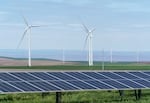
Solar panels and wind turbines work to create clean electric power, at Wheatridge Renewable Energy Facility, May 24, 2022. Portland General Electric announced this week that the Morrow County, Ore., site is one of several locations where it will make significant investments into renewable energy in the coming years.
Kristyna Wentz-Graff / OPB
“Everything we’re doing is in support of those decarbonization goals, so you know, checking all those boxes, which is very unique,” he said. “And I think we’ve done a tremendous job of demonstrating that for a small utility and in the northwest corner of the U.S. — I think we punch above our weight.”
While PGE has made significant steps towards meeting the state’s goals, all of the region’s investor-owned electric utilities face challenges as they work to reduce their reliance on fossil fuels and meet the increased power demand from data centers, Renewable Northwest’s regulatory affairs director Mike Goetz said.
Having a diverse range of renewable energy and storage capacity can help PGE strengthen its system, especially as it faces growing demand from data centers in Washington County.
“The two battery storage projects that it’s announced in Washington County will add significant capacity and flexibility benefits to the PGE system, which will ultimately also help to lower costs to its customers,” he said.
But while the expansion and addition of battery storage is significant, Goetz said, for PGE to meet the 2030 benchmark, it has a steep hill to climb.
“Any procurement at this point is a step in the right direction,” he said. “We think that this round of procurement is sufficient to demonstrate continual progress in the near term. However, as PGE has acknowledged, they are going to have to procure a pretty vast quantity of resources to make sure that they can meet House Bill 2021’s mandates in future years.”
Related: Lawmakers say ‘virtual power plants’ could help Oregon. Utilities say they’re already here
Joshua Basofin, clean energy program director of Northwest-based advocacy group Climate Solutions, agrees.
“We would really like to see a lot more,” he said. “However, I would characterize 1,000 megawatts as a good start, but we need to be seeing 5,000, 10,000, 20,000 megawatts of clean generating resources and battery storage in the pipeline.”
Basofin said utilities need an “all of the above” approach to adding more renewable energy sources on the grid. He said that includes bigger utility scale energy projects that exceed 1,000 megawatts.
He also said Oregon needs to allow other kinds of energy generation, like rooftop solar, that can help when energy demand is at its highest.
Basofin also said PGE’s addition of new power resources could help keep ratepayer costs down, for now, because it is adding electricity without having to build a fully new facility.
“I think that these resources will have a long lifespan and serve PGE customers very reliably into the future,” he said.
Beyond the projects announced this week, PGE expects to add more renewable energy and battery storage projects soon. The company estimates it will bring on an additional 2,500 megawatts before 2030.
Editor’s note: PGE is bringing new solar and battery sources online. An earlier version of the article incorrectly said the company would also add wind sources. OPB regrets the error.