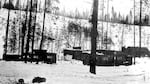
The only known photograph showing Black residences in Maxville, a now-abandoned, segregated logging town in northeastern Oregon. Circa 1923-1933 by an unknown photographer.
Courtesy of the Maxville Heritage Interpretive Center
When Gwen Trice dug into her family history, she learned that her father had come to Oregon from Arkansas in a boxcar to live and work in the logging town of Maxville.
Maxville was once one of the largest towns in the county. It had a post office, hotel, roundhouse and many homes. Nine decades later, a broken down railroad trestle and one building are the only remaining evidence of this company town. The Missouri-based Bowman-Hicks Lumber Company created it in 1923 to house loggers and their families. The company recruited experienced loggers, including immigrants, Native Americans and Black men from southern states. This was at a time when Oregon’s constitution explicitly banned Black people from the state. Housing and schools were segregated in Maxville, but the workforce was integrated. Even after the town essentially closed down in 1933, some Black families, like Gwen’s, remained in Oregon.
You can watch the Oregon Experience documentary focused on Gwen Trice called “The Logger’s Daughter” here and find recent coverage of the archeology dig at Maxville here.
And there’s a new multimedia exhibit called “Maxville & Vanport: Hidden Histories of Everyday Life” at the Patricia Reser Center for the Arts on the Oregon State University campus in Corvallis Feb. 27 through April 11, 2026.
Listen to all episodes of The Evergreen podcast here.