Higher education advocates entered the 2026 short legislative session with big financial questions for lawmakers. And they got some of the long- and short-term answers they were seeking.
K-12 advocates again made repeated visits to Salem, pushing for funding increases and policy improvements to help students. Schools will see some tweaked policies on immigration enforcement and attendance, but the most sweeping goal — to overhaul how the state sets school funding levels statewide — stalled.
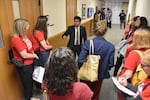
Rep. Ricki Ruiz, D-Gresham, speaks with parents, teachers and other advocates about education funding and his plan for state budgets on April 30, 2025, in Salem, Ore.
Picasa / Courtesy of Otto Schell, Oregon PTA
Lawmakers confront universities ‘on the brink’
Many of Oregon’s public universities are in dire financial straits this year, with someof them looking to close multimillion-dollar budget deficits over the next year or two.
The passage of HB 4124 is an endorsement of potentially big steps to overhaul higher education in the state.
The measure directs the state’s Higher Education Coordinating Commission to study Oregon’s public colleges and universities and provide recommendations on how to make the system financially sustainable.
“I’m supporting this because I believe that the technical and regional universities and community colleges are on the brink right now,” said Rep. Paul Evans, D-Monmouth, in a work session for the bill last month.
The bill comes out of a report the HECC conducted last year, which found the state’s public universities are operating efficiently. But the institutions face ongoing budget problems if they don’t deal with the financial pressures they’re under, including declining enrollment and rising costs.
The report recommended some controversial ideas to stabilize universities like institutional mergers and degree program audits. Those ideas are mirrored in HB 4124.
The bill faced strong opposition from university leaders and faculty, many of whom said Oregon’s lawmakers should focus on allocating more state dollars towards higher education rather than pushing institutions to find efficiencies. Oregon is far behind most other states when it comes to funding public universities. It ranks 46th in the nation in per-student state funding for public universities, according to the State Higher Education Executive Officers Association.
The bill dictates that the HECC file a preliminary report on university and college viability to the legislature by October 1, 2026.

Emergency funding from the legislature will help buoy Southern Oregon University for at least another year.
Southern Oregon University
Lawmakers are taking immediate action to help Southern Oregon University, an institution facing particularly strong financial headwinds. The regional university, located in Ashland, has experienced several budget deficits and has undergone difficult workforce cuts over the past few years.
SOU leaders project another $14 million shortfall by the end of the 2026-2027 school year. And the university recently announced it would not have enough money to cover its payroll in a year.
Lawmakers have stepped in with a temporary band-aid.
Legislators set aside more than $15 million in their end-of-session budget bill to go to the university. The HECC will coordinate the funds and work with SOU on a long-term financial sustainability plan, expected by the end of April.
Southern will also have to submit monthly financial statements to the legislature.
From immigration to homelessness, lawmakers prioritize vulnerable students
Oregon legislators passed two bills this session, SB 1538 and HB 4079, aimed at strengthening support for immigrant students and their families.
HB 4079 requires schools, universities and community colleges to create a system to notify a school community when federal immigration enforcement has entered school property. It also requires educational institutions to make an effort to notify students or their guardians if a district has provided any student information to federal immigration officials.
Under the bill, notice will be provided to students, parents or guardians, school employees, and any community-based service providers who opt in to notices.
The bill goes into effect at the end of September.

Parents and community members volunteer to participate in the ICE watch near Poynter Middle School in Hillsboro, Ore. on Friday, Oct. 24. During school drop-off, participants are stationed on strategic intersections to monitor for activity from ICE agents.
Saskia Hatvany / OPB
SB 1538 adds immigration or citizenship status to the list of protected classes in education anti-discrimination law.
Oregon is already a sanctuary state, but SB 1538 would ensure that school policies related to immigration enforcement detail how school employees should respond to officers, and that superintendents should approve any response to requests related to immigration enforcement.
“What families and districts have raised with us is the desire for school-specific procedures that reflect the operational realities of K–12 settings,” said Jessie Ventura, who directs the Office of Immigrant and Refugee Advancement in the Oregon Department of Human Services, in testimony to the House education committee.
SB 1538 takes effect July 1.
Through HB 4149, the state legislature codified state support for homeless students that currently exists in the federal McKinney-Vento Homeless Assistance Act. Education advocates nationally have expressed concern that President Trump’s actions to close the U.S. Department of Education could undermine federal support for homeless students.
In testimony supporting HB 4149, several organizations thanked legislators for bringing forward legislation at the state level.
“Without the protections of the McKinney-Vento Act, many youths lose hope in maintaining their education, achieving a fulfilling career, and breaking the cycle of generational poverty,” shared members of the Maslow Project Youth Advisory Council, who work in Jackson and Josephine counties.
The state takes baby steps in improving attendance tracking
Oregon has one of the country’s worst problems with chronic absenteeism, with about one-third of students missing at least 10% of the school year. Oregon is also less proactive about tracking attendance than other states.
Currently, the Oregon Department of Education reports attendance and absenteeism rates once a year, in the fall, for the previous school year.
With the passage of HB 4154, Oregon will start reporting and publishing attendance data four times a year, starting next fall. It’s a step in the right direction for a state that has not acted urgently when it comes to improving student attendance.
“A more action-oriented approach is to calculate and publish chronic absence data throughout the school year,” said Hedy Chang, CEO of the nonprofit Attendance Works, at a hearing last month.
“When states do this, leaders at both the state and local levels have the opportunity to deploy strategies and interventions that will move the needle in real time,” Chang told lawmakers.
Oregon Rep. Lamar Wise, D-Portland said the bill is a companion to HB 3199, which passed last session and requires a legislative study of statewide attendance efforts.
“Together, these efforts move Oregon from reacting late to acting early,” Wise said.
Related: Labor advocate appointed to serve remainder of Oregon Rep. Hòa Nguyễn’s term
From Outdoor School to inside the federal tax code, limited action on school funding
This session, Oregon legislators considered several ways to overhaul how to calculate financial needs for public schools, including SB 1555 to evaluate a decades-old framework called the Quality Education Model.
It didn’t make it out of committee.
School funding was the focus of at least one other bill, HB 4050. That bill would have directed Oregon’s Legislative Policy and Research Office to study how other states and Canada fund education, including how they align funding with costs. That bill was supported by former Oregon Sen. Michael Dembrow and the Oregon School Boards Association.
“Our current system in Oregon is not well-suited to ensuring that funding matches costs,” shared OSBA Director of Government Relations and Communications Stacy Michaelson in testimony. “Each time the Legislature passes a new requirement without providing funding, those costs get absorbed into a district’s budget— meaning, the money comes from somewhere else in the budget.”

Gov. Tina Kotek speaks to reporters ahead of the legislative short session on Jan. 28, 2026 in Salem, Ore.
Saskia Hatvany / OPB
Where public schools got some help was through SB 1507, called the “disconnect” bill, which passed both chambers and has the support of Gov. Kotek. It separates some of Oregon’s tax policies from the federal tax code. At a media availability late last month, Gov. Tina Kotek called the bill a “modest approach” to find revenue for K-12 schools, universities, and community colleges and prevent further cuts to funding.
“We have districts right now who are making reductions,” Kotek said. “This would keep the state’s commitment level to through the rest of the biennium…so we’re not taking any state dollars away from our schools, community colleges or universities.”
Kotek shut down the possibility for Oregon to tap a financial reserve called the Education Stability Fund.
“I don’t anticipate additional dollars outside the current budget for our schools and universities and community colleges,” Kotek said.
“Right now, the legislature is not taking up any reserves.”
Legislators also maintained status quo when it comes to the state’s popular Outdoor School program, which provides outdoor education to thousands of middle schoolers every year.
In 2016, Oregon voters approved a ballot measure that sends 4% of lottery revenue to Outdoor School. Last June, legislators passed a budget that included a 20% cut to Outdoor School budget allocation — $12 million.
As a result, some schools had to cut down on what’s offered to students, or cut programs altogether.
This session, Oregonians from across the state rallied to support HB 4112, a bill to restore $6 million to Outdoor School for the remaining time of the biennium. They said the program has changed students’ lives and commented on how much schools are struggling after last year’s cuts.

Sign for Outdoor School's Arrah Wanna site near Welches, Ore.
Rob Manning / OPB
Without sufficient state funding for Outdoor School, local districts are patching budget holes.
The Northwest Regional Education Service District, which operates Northwest Outdoor Science School, said it had to use one-time reserves to make up for last year’s cut. But they don’t have reserves for next year.
“Without HB 4112, the class of 2033 will have a drastically different experience, with far less hands-on scientific inquiry and nature-based learning than their older peers,” said Jenna Jones, NWRESD’s Director of Government Relations, in testimony to the House Education committee.
In a recent report, Oregon State University Extension Service projected that school districts in the current school year are receiving just 83% of the amount they needed for outdoor school the year before.
“In an already lean budget year, our district is covering nearly a $100,000 shortfall just to keep outdoor school operating,” Eugene 4J outdoor school coordinators said in the report.
Even though the bill did not make it through the legislature, Friends of Outdoor School associate director Dan Prince is thankful there weren’t more cuts.
“We’re grateful and relieved we didn’t receive a further cut, but we are devastated that we did not receive a restoration of what voters intended for kids,” Prince said.
Prince said next steps are reaching out to Gov. Kotek to ask for full Outdoor School funding in her 2027 budget.