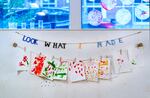
FILE - Artwork hangs on the wall at a preschool in Southeast Portland, Ore., Oct. 26, 2023.
Kristyna Wentz-Graff / OPB
Danisa McLean has taken the helm of Multnomah County’s Preschool for All program after her predecessor resigned abruptly last summer amid an external investigation into a conflict of interest. The program is funded by a 1.5% marginal tax rate on high-income earners, which some, including Gov. Tina Kotek, have said is having negative effects on Oregon’s economy. In addition, estimates on how many preschool spots are needed and how much money that will cost have been difficult to match up in forecasts. McLean joins us to explain her vision for the program.
Note: The following transcript was transcribed digitally and validated for accuracy, readability and formatting by an OPB volunteer.
Geoff Norcross: From the Gert Boyle Studio at OPB, this is Think Out Loud. I’m Geoff Norcross. Multnomah County’s Preschool for All program has had a rough few months. The program former director Leslie Barnes, resigned last summer over questions about conflict of interest. Business and government leaders have also balked at the taxes on high earners that funds the program. Some lawmakers even proposed killing those taxes in the last legislative session. This is the environment that the new director is coming into. Danisa McLean has been leading Multnomah County’s Preschool for All program since late January. She joins us now in our Portland studios. Danisa, welcome.
Danisa McLean: Thank you, Geoff, for having me.
Norcross: Given all this controversy, all the scrutiny, all the uncertainty, why did you want this job?
Danisa McLean: That’s a great question, thank you. I wanted this job primarily because I had a really great experience as an educator. As an early learning educator, I was able to have opportunities to see children grow. I also was a strong community partner with Preschool for All as a childcare resource and referral director, had opportunities to really work in community with Multnomah County and saw the opportunity to really impose policy that’s responsive to our community partners.
And then, as a young child, I actually got into early learning because of my experience as a pre-K student, actually. I grew up with cerebral palsy and had the opportunity to really see myself from the lens of my preschool teacher. My preschool teacher was the first person that really believed that I could actually climb those monkey bars, and I wanted the opportunity to do that for young learners now; as well as the opportunity to really tell my story as the Preschool and Early Learning Division director, to allow people to really see themselves in this work as educators, as children, as families, and that’s why I’m here.
Norcross: Where was your preschool experience?
McLean: I actually grew up in Singapore and I went to the Singapore American School and had a pre-K teacher, Mr. Zhou. For a long time I didn’t have functionality of my left limbs and I wore braces for a really long time. And I remember standing on the playground, till this day, saying,
“I can’t climb those monkey bars,” and my preschool teacher said, “Yes, you can. I will catch you.” And from that point on, I wanted to be that influencer for young kids that may have not seen themselves as having the ability or the opportunity to do the things that they really wanted
to do.
Norcross: You touched a little bit on your professional background that you’re bringing to this position. Can you tell me more about that? What did you do before you did this?
McLean: I started my career as a toddler and preschool teacher in early learning, and then I also went into QIS, it’s quality rating and recognition systems for the state of Washington. I actually served as an instructional coach looking at best practices within environments, preschool environments specifically, worked with family childcare providers as well as community based organizations.
I’ve also had a Head Start background so I had the opportunity to really think about public funding, the comprehensive services, I’m working alongside families providing that family support element and health services for families within our community.
Norcross: When you were in any of those roles, did you have any interaction with Multnomah County’s Preschool for All Program?
McLean: Yes, absolutely.
Norcross: What was that experience like?
McLean: It was amazing. As a partner, it was amazing. I was the former childcare resource and referral director, and we operated the Preschool for All coaching system, and I had the opportunity to work alongside the Preschool and Early Learning Division to really define what coaching services would look like for Multnomah County.
And I would say as a partner one thing that really drew me to Multnomah County was the culture. The culture that was really cultivating community voice and cultivating an opportunity to think critically and strategically and redefine systems and implementation.
Norcross: Did you see any shortcomings with the program, though, that you are now in a position to do something about?
McLean: I wouldn’t say shortcomings. I would say learning opportunities. I think we’re really still a new program for Preschool for All. I would say that one thing that’s really drawn me to Preschool for All is that we take community perspective and community voice and it’s centered in the ways in which we get to implement and develop the program.
Norcross: Your predecessor, Leslie Barnes, resigned after Willamette Week reported that she owned a preschool in Portland that was being audited for wasteful spending of state dollars. How did you prove to the county that there wouldn’t be any similar questions about you?
McLean: I think the county has a really robust conflict of interest declaration, essentially, and I would say that what I proved to the county, it’s really the trust that I have with the community. I declared everything that I have in terms of affiliations. I’ve continued to be a strong partner prior to becoming the Preschool and Early Learning Division director, and Leslie’s situation was separate from what it is now.
Norcross: The goal of this program, and this is the real pie in the sky, universal preschool for all three and four-year-olds in Multnomah County by the year 2030. How close are you to that goal right now?
McLean: We are well on the way. Actually, really exciting news, April first is the application launch date for families, so I encourage all families in Multnomah County that have a 3 and 4-year-old to apply on our online application at pfa.multco.us. It’s an easy online application. Families have the opportunity to pick up to eight choices. I encourage families to go out into the community and look at what types of programs their child would be most responsive to.
We have family childcare, school district settings, as well as community-based organizations and community-based settings. We’re at the point where we’ve really grown and evolved in terms of our seats, so I would encourage that families think about diversifying their choices of what they would think that their kiddo would respond to.
Norcross: How many seats do you have now?
McLean: We are far above what we have aimed to reach.
Norcross: How many more are you going to need, though, to reach this 2030 goal?
McLean: I think that we’re likely going to surpass the 2030 goal. We’ll have more information as the application launches on April 1.
Norcross: But how many seats do you actually need to have in order to reach your goal?
McLean: We are engaged in our population assumption evaluation, and they know that we would have more information as we continue to look at our data and evaluation of our program.
Norcross: I know that it’s a shifting target because I had originally heard that you were going to need 11,000 seats, but demographic modeling suggests you’re not going to need that many. I’m just wondering what an anticipated drop in the demand tells you about what’s happening in the county.
McLean: It tells us maybe that our birth rates are different than what we had assumed post-pandemic, and I think that as we continue to look at our data and our evaluation we’ll have a more concrete answer.
Norcross: What are the hurdles as you see them now to reaching your goal of 2030?
McLean: Just given the climate of public constraint, lMultnomah County is positioned well because it’s designed for the long-term goal of reaching universal preschool, having the ability that we saved early in order for us to continue to grow and have a sustainable program.
I would say some of the hurdles, and I wouldn’t call it hurdles, I think we’ve been really focused on growing rapidly and now we’re going to be really focused on redefining implementation in our program.
Norcross: Are there enough preschool facilities in the county, or are some more going to have to open?
McLean: You know, access equals facilities. And Preschool for All continues to invest in facility funds so that small business owners have the opportunity to have access to additional funding to help grow the facility models within Multnomah County.
Norcross: This program is funded by a marginal tax of 1.5% on incomes over $125,000 for single filers or $200,000 for joint filers. I’m sorry, I have more numbers here, but I just want to be absolutely clear about the cost.
There’s also an additional 1.5% on incomes over $250,000 for single filers or $400,000 for joint filers in Multnomah County.
Not everybody loves those taxes, and even Governor Kotek has noted that there are downstream effects to those taxes including the fact that high earners like these may leave Multnomah County because of it. And I’m wondering what that says to you about the governor’s support of the program.
McLean: I look forward to the opportunity to continue to collaborate with our governor. Having a rich preschool experience grows our community tremendously. Not only are we providing opportunities for families to make different choices or choices that they may have not been able to make with access to universal preschool. It also provides economic stability for all of Multnomah County regardless of whether you have a preschooler or not.
Norcross: This tax is levied on Portlanders who also have to pay an arts tax, so they’re paying taxes that no one else in the state has to. And I’m wondering if you’re concerned about tax fatigue in the county?
McLean: I think that people can see the ongoing benefits of having access to high quality early learning and you’ll also see it in our economic stability as we’re continuing to grow our workforce.
Norcross: I come back to this again and again because lawmakers have tried in the last two sessions to end this tax that is your main funding source. Are you not concerned about the taxes going away and therefore the revenue for the program going away?
McLean: I think that we are a community-based program. We were voted by a community and it passed in 2020, and our community continues to be strong and allows the opportunities for lifelong learning and the opportunities for families to make different decisions than they would have if they had not had access to free universal preschool.
Norcross: Do you think that the funding model for this program should change in any way to be more sustainable and not so subject to the whims of politics?
McLean: I think with any program there’s opportunities for change. And really thinking about it strategically, the beauty of Preschool for All is that we really do take into consideration the community voice and the needs of the community. As we lead into the 2027 program year, I’m sure that there will be things that will change with implementation that would be guided by our community.
Norcross: One of the main tenets of this program is universal access. Every kid, 3 and 4-year-old, should have preschool regardless of their family’s ability to pay. Talk to me about why that’s important.
McLean: It’s important because we want every child to have the opportunity, that’s 3 and 4, to have a high quality early learning experience. Not only does it set them up for success, but it’s actually preventative. Some of the things that we are dealing with within our community that are more reactive, having a rich environment and a rich experience within preschool allows children to be successful, not only in their school experiences but also those experiences as they enter into adulthood.
Norcross: I don’t think anybody would argue otherwise, but public dollars can be scant. What do you say to people who think that the money should just be spent on those families that are in need, that don’t have the ability to pay for preschool?
McLean: You’re investing in our most vulnerable population. I would say that a thriving preschooler equals a thriving community equals a thriving economy.
Norcross: Regardless of a student’s ability to pay. OK. What is the economic argument for universal pre-K?
McLean: The economic argument for universal pre-K allows access for all. It’s a rich environment for all children regardless of their zip code, the language that they speak or the income of their family. They still have access to a preschool experience.
Norcross: Are there any cities or counties or maybe even states that are doing universal preschool that you can look to as a model?
McLean: Absolutely, we’ve been in contact with our partners in New York and D.C. New Mexico also has some similar modeling to universal pre-K.
Norcross: How’s it going for them?
McLean: You know, I am fairly new to this position. I look forward to continuing to learn from them. We also have opportunities for them to learn from us.
Norcross: Can you envision other Oregon counties adopting this model?
McLean: Hopefully.
Norcross: Yeah?
McLean: Yeah, hopefully.
Norcross: Is there a county in particular that you think is just ripe for this?
McLean: I’m not quite sure.
Norcross: How about the whole state? Could this scale up to all of Oregon?
McLean: I think that there’s opportunity so long as it continues to have public investment.
Norcross: What is your message for Multnomah County parents who have preschool age children or who are about to, and may be concerned about the future of this program?
McLean: Our application opens April first. We’re growing. This is the biggest amount of seats that we’ve had in our history. If you have a preschooler that is 3 or 4 years old, please apply, make your selection. Diversify it. You have up to eight choices, and we look forward to having your children in our community and in their early learning opportunities.
Norcross: I’d like to bring it back to you. You spoke very well about your experience in preschool in Singapore. I’m wondering how might things have been different for you if you hadn’t had that?
McLean: If things were different, I think, as a child with a disability, or as an adult with a disability, I probably wouldn’t have learned how to walk as quickly as I did. I wouldn’t have seen myself to be able to climb those monkey bars. I actually still envision those monkey bars as an adult; and it actually allowed me to see myself in a different light than I would have seen it because someone believed in me and that started as an early 3-year-old.
Norcross: Danisa McLean, thank you so much for this. I appreciate it.
McLean: Thank you.
Norcross: Danisa McLean is the Preschool and Early Learning Division director which oversees the Preschool for Everyone Program in Multnomah County.
“Think Out Loud®” broadcasts live at noon every day and rebroadcasts at 8 p.m.
If you’d like to comment on any of the topics in this show or suggest a topic of your own, please get in touch with us on Facebook, send an email to thinkoutloud@opb.org, or you can leave a voicemail for us at 503-293-1983.