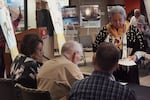
Tamastslikt Cultural Institute director Bobbie Conner distributes signing paperwork during a ceremony commemorating the transfer of the Fred L. Mitchell & Family Collection to the Confederated Tribes of the Umatilla Indian Reservation at the Nixyaawii Governance Center in Mission, Ore., March 31, 2026.
Antonio Sierra / OPB
On Tuesday, the Confederated Tribes of the Umatilla Indian Reservation signed an agreement with Fred Mitchell to acquire his vast collection of Columbia River Plateau tribal artwork and artifacts. The collection includes 15,000 stone points and tools, 1,250 historic photographs, 800 beaded bags and pouches, baskets and other items. Mitchell is a retired former mayor and firefighter from Walla Walla, Washington who started collecting arrowheads when he was 5 years old and amassed other tribal items over the past seven decades.
The Fred L. Mitchell & Family Collection also includes objects collected by Mitchell’s parents and other relatives, according to Bobbie Conner, a member of the Confederated Tribes of the Umatilla Indian Reservation and director of the Tamástslikt Cultural Institute. The museum has featured several temporary exhibits in recent years with items loaned by Mitchell, such as one that showcased beaded depictions of horses made by Columbia Plateau tribes. Conner joins us to discuss the cultural and historical significance of the items within Mitchell’s collection, including Native American cradleboards, or infant carriers, that will be featured in an exhibit at TCI in June.
Note: The following transcript was transcribed digitally and validated for accuracy, readability and formatting by an OPB volunteer.
Dave Miller: From the Gert Boyle Studio at OPB, this is Think Out Loud. I’m Dave Miller. The Tamástslikt Cultural Institute was founded nearly 30 years ago. The museum was created by the Confederated Tribes of the Umatilla Indian Reservation to tell the story and the history of the Columbia River Plateau from a tribal point of view.
This week, the museum announced an unprecedented expansion of its holdings. It signed an agreement to acquire the Fred L. Mitchell & Family Collection – that includes more than 15,000 tribal artifacts and artworks. Bobbie Connor is a tribal member and the director of the museum. She joins us now to talk about what this acquisition means and how it came to be. It’s great to have you back on the show.
Bobbie Connor: Qayciyáw̓yaw. Thank you, Dave.
Miller: I mentioned that number, which is one easy way to talk about the scale of this collection, but I feel like it falls short. Can you give us a sense for just the breadth of this collection.
Connor: Certainly. So when you use the 15,000 number, you’re only talking about stone tools. You’re talking about arrowheads, spear points, net weights, mortars and pestles. So there are 15,000 lithics from the mid Columbia River and its confluence and the Lower Snake River. That is the heart of our homeland. So 15,000 lithics. Add to that, 1,250 historic photographs, many of which feature the artifacts that we’re acquiring in the historic photograph; 800 beaded bags and pouches; 50 huckleberry baskets; more than 50 beaded vests; at least 70 pairs of beaded gauntlets; 15 cradle boards from the Columbia River Plateau; corn husk bags, jewelry, horse trappings and so forth.
Miller: Given the scale of what you just outlined, I hesitate to ask this question, but I’m gonna do it anyway. Are there any parts of this collection that have particular meaning to you personally?
Connor: Certainly. [Laughter] When I go to visit Fred in his home, there is an image of my great grandfather, my great grandmother and my grandfather as a child as I walk in the door. If I open the notebook full of boarding school photographs, I see my grandmother and my great aunt who were born in 1899 and 1889, respectively. So yes, there’s a personal relationship to the goods.
Fred has, in his collection – which we displayed last year as part of a pride and patriotism beadwork show – two beaded bags that show images of the Liberty Bell from a pamphlet that was handed out in 1915. At the time, a couple of months after the Lusitania was sunk, Woodrow Wilson, then President of the United States, decided to gin up support for the possible entry into World War I by sending the Liberty Bell around the United States by rail. And it made two whistle stops on our reservation. The beadwork on this pouch and this bag are the cover of the pamphlet with the cracked Liberty Bell and two flags overlaid across that design. My grandmother is in one of the photographs, on the train two weeks after her 15th birthday, with that Liberty Bell that is featured in those two pieces of beadwork.
So, there are lots of connections personally for me to this collection that I cherish and treasure, but what’s more exciting for me, honestly, is knowing that those connections are going to be here in our facility, and visiting other tribal museums and non-Indian museums in the Columbia River Plateau where other tribal people can make connections to their grandparents and great grandparents’ things.
Miller: I want to talk more about that – what it’ll mean that this collection is now your collection as we go. But just to take a couple steps back, when did you first learn about Fred Mitchell’s collection?
Connor: My first visit to Fred’s home was in 2016 as I was working on an exhibit with some friends from Lewiston, Idaho. We were working on the 100th anniversary of the Jackson Sundown Saddle Bronc Championship at the Pendleton Roundup in 1916 and the 100th anniversary of the opening of the Happy Canyon Night Pageant. And these friends, a man and woman, took me to Fred’s home and said, “you’ve got to see this.” That was my first time spending an afternoon with Fred in his home and seeing not only the beadwork but the photographs, and visiting with Fred about his lifetime of collecting what he reveres most in his life: Columbia River Plateau goods.
Miller: What have you learned about what drove him? My understanding is that this has literally been a lifelong interest going back to collecting arrowheads when he was 5 or something. Why? What was driving him?
Connor: We teased Fred that he’s got Columbia River water in his veins and that very well could be possible. He’s 90 years old. His childhood was in a time our country was in great economic strife. We had not yet entered World War II. Inexpensive ways to entertain yourself were outdoors. And he spent his childhood weekends with his parents, and his aunt and uncle, and his brother on the Columbia River. And of course, before the dams were built, there was a lot more of the natural shore and meander to the river.
With every wave and every elevation change of the river – which used to change 20 or 30 vertical feet – there would be things exposed, and arrowheads were amongst those. And Fred, his first arrowhead that he picked up when he was five, learned very early as he looked upon that point and held it in his hand, he would contemplate, was the last person who held this 100 years ago? 4,000 years ago? 10,000 years ago? And he began as a child to make those connections to the generations of people who had lived here before.
Miller: How do you feel about the fact that this priceless collection of objects, art and tools made by, used by Native people was created and held by a non-tribal member?
Connor: So there are different communities of thought around private collectors and it really depends a lot, from my perspective, on the integrity of the owner of the collection. Fred’s fascination and obsession with these things is to look for the finest specimens he can of the kind of work that he’s collecting, that represents well the people and the history of this place that we call home.
So, when Fred sets about collecting these items, there are people who are in the hunt that have unethical methods of acquiring objects. Fred’s a man of great integrity, so I don’t have any question about how he acquired what he’s acquired. But we do know that many items left homes on the reservations in the Columbia River Plateau illegally by family theft or theft of others. We also know that we’ve lost things through flood, fire and many other ways, including our own low-income socioeconomic status for more than 100 years. In order to put a new engine in your car to get to work, you might have had to sell a priceless possession you did not want to part with.
Economic necessity is part of the equation. So is drug addiction and alcohol addiction, which may have caused someone to sell a priceless family object that they should never have had their hands on for that purpose.
Miller: And maybe we’re given a pretty unfair price compared to what the buyer was able to do with it as well?
Connor: Very likely, Dave. Because I have visited Germany, museums in Germany, and other countries that have some of our priceless belongings, I think that Fred as a carekeeper who acquired these things to enjoy them during his lifetime, but he’s allowing them to come home to us so that our families can see them, touch them and experience them in the Columbia River Plateau. We don’t have to go to a museum in California or New York to see our belongings. And for me, that’s a gift back to our own communities who have suffered so much loss and devastation. And it’s a way for us to give back to our own community things that they can only see in family photographs from the past.
Miller: How did you broach the subject of transferring this collection to the museum?
Connor: When I first met Fred, I knew that there were other museums in our region who had already broached the subject of acquisition and donation. And quite candidly, what I can say to you is that I knew that the museums we were up against were never going to offer Fred a payment of any sort. They were going to offer in-kind services to transfer and care for the collection. But this is a man who was a civil servant to the city of Walla Walla and that community for more than 60 years.
Miller: Am I right, former mayor and firefighter?
Connor: And councilman. And he loves his community. And from my perspective, I have to mention that my former work was for the Small Business Administration and I worked with small business entrepreneurs for about 13 years. And when we said to them, if you want us to invest in your business, you have to have saved enough money to make a down payment on your small business if you want to borrow.
So it’s the same idea for us about this collection. If we’re going to be trusted to care for this collection, we have to show him how we value it. And one of the ways we do that is through care, kindness, interpretation, and listening to every story about every object and recording it for the future; but also to show him that we know he spent his lifetime of earnings collecting these things and that we’re grateful that he did, and we showed that to him in a remuneration.
Miller: Did he have stipulations of his own? Did he have questions about what you would do with these objects? Separate from your decision to give him some money for the collection, did he say – it’s weird to even put it this way – that you will be good stewards of the stuff that I found that your people initially made?
Connor: Dave, I don’t think we ever really visited with Fred in a transactional mindset. This is a relational mindset. So we are partners, we are friends. We appreciate and revere the same things. And what we said to him is, we won’t sell your things out the back door. That’s a museum ethics issue. We will keep the collection together. For those things that were likely traded to our people from neighboring cultures, for those things that were produced and manufactured by our culture, they will stay together as one collection.
The minor percentage, 1% to 3% percent perhaps, of items that he has that are not from our homeland or from the trading patterns of our people, we may make those available, not for money, but for trade with other museums in those homelands. But we are not in the business of doing anything but keeping this collection together.
Miller: Can you tell us what the ceremony on Tuesday was like for you?
Connor: Touching, many really gripping and heartfelt moments. It was the culmination of a 10-year exploration in the relationship, but it also was an official signal to our community that Fred has transferred the ownership of these belongings that are precious to him to the Confederated Tribes of Umatilla for the care by the Tamástslikt staff.
It also signaled an opportunity, as we do in Indian Country, I think, pretty well. It was an opportunity to say thank you to every single partner that we could that contributed and donated funds and time to this project. So we were delighted to have Erin Borla, Kathy Deggendorfer and Frankie, Erin’s son, with us so that we could say thank you to the Roundhouse Foundation because they made the first pledge. I was still exploring a campaign strategy to raise the funds for this acquisition. And I asked Erin to read the draft document I had. And it was but a few days later, Erin and her mother spoke and talked to their board, and she called me back and said, “we’d like to make a half million dollar pledge to help you.”
It was like, whoa, it blew my mind, and to thank Fred in person, wrap a blanket around him and show him that the tribe is delighted. And we revere what he’s done for us, to show his partner and trustee Eric Swanson gratitude for helping us get to this point in the relationship where we could do the legal transfer and copyright assignment for the part of Fred’s book that he’s copyrighted. And to show our board of trustees who contributed their support to this project – our governing body who represents the entire confederacy of more than 3,100 people – to say thank you for investing in the tribe’s future by putting support behind this project, not only in terms of staff time, but in terms of the acquisition payments.
So, we got to show gratitude to Fred and the donors on Tuesday. And for us, that is ceremony, to thank people and give them gifts so that they can say, I got this on the day that I witnessed this event. It’s a big deal.
Miller: Bobbie Connor, thanks so much for joining us today and congratulations.
Connor: Thank you so much for including us in this hour.
Miller: Bobbie Connor is the director of the Tamástslikt Cultural Institute.
“Think Out Loud®” broadcasts live at noon every day and rebroadcasts at 8 p.m.
If you’d like to comment on any of the topics in this show or suggest a topic of your own, please get in touch with us on Facebook, send an email to thinkoutloud@opb.org, or you can leave a voicemail for us at 503-293-1983.