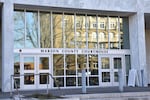
Undated photo of the Marion County Courthouse in downtown Salem, Ore.
Alan Cohen/Salem Reporter
For years in Marion County, hundreds of people facing criminal charges lacked a lawyer.
Now, that number is down to nearly zero.
The near-total reduction comes after years of effort by defense attorneys and state leadership to address a statewide crisis in legal representation that denied hundreds of people who couldn’t afford a lawyer their right to adequate representation.
As of April 10, only two people with criminal charges in Marion County are without representation, a state dashboard shows. As of April, the county no longer has a public defense “crisis,” according to the Oregon Public Defense Commission. It’s the first time in years that’s been the case.
Over the last year, the number of unrepresented people charged with a crime in Marion County has dropped by around 600 cases, according to a recent state report.
Without a lawyer, a case can take longer in court, defendants are denied their constitutional right to representation and victims are not provided with timely justice, according to local prosecutors and public defenders.
“We believe in the justice system, and the justice system requires appropriate representation … It’s the premise of why we do what we do. So we had concerns. Obviously, that’s why we were such aggressive participants in ensuring that people have appropriate representation. Frankly, cases are easier when there’s a good lawyer on the other side, right? That’s the way it should be,” Marion County Chief Deputy District Attorney Brendan Murphy said in an interview.
Ongoing work by public defenders was key to making progress in the crisis, prosecutors and lawyers said in interviews with Salem Reporter. But state attorneys and a new effort to quickly resolve criminal cases was instrumental in bringing the crisis to a manageable level before hitting near-zero.
Since early February, Marion County has maintained fewer than 10 people facing charges at any one time without an attorney, state data shows.
Crisis building
The crisis started around 2022 for Marion County, as public defenders strained to represent criminal defendants who generally can’t afford a lawyer.
That means hundreds of people facing criminal charges went without a lawyer for days or months.
Two groups handle most public defense in the county — the Marion County Association of Defenders, a consortium of private attorneys, and the Public Defender of Marion County, a nonprofit firm.
Olcott Thompson, executive director of Marion County Association of Defenders, said the strain started when the Public Defender of Marion County lost staff and his consortium took on its lawyers’ share of serious felony cases.
Shannon Wilson, the nonprofit firm’s executive director, said staff left in 2023 in a “huge exodus” due to judges forcing attorneys to take on cases despite objections over protecting their caseloads.
“The consortia has always done as much as we could. But that meant there were days when, sort of, there was nobody there to accept appointments,” Thompson said.
Throughout 2023, the number of unrepresented defendants with criminal charges climbed from handfuls of people at a time to more than 300 by December, according to state data.
The number continued to grow through 2024, and reached a peak of 1,000 people around November, according to Thompson. A state dashboard shows that in late November 2024, at least 850 people, in and out of jail, lacked a lawyer.
Throughout that period, Marion County judges randomly assigned cases to public defenders in order to ensure defendants had representation. Attorneys struggled to balance new assignments with their regular caseloads.
“If there was no attorney available, they would just … randomly appoint somebody, which meant attorneys lost control of their calendar, and they never knew when an appointment was going to show up. It happened when they’re on vacation. It happened when they’re in the middle of a trial,” Thompson said.
At Thompson’s consortium, he said attorneys took on as many cases as possible and didn’t object when judges assigned cases. Meanwhile, lawyers with Public Defender of Marion County regularly objected to taking on cases beyond their ethical limits, but were still forced to take on more clients, according to Wilson.
The random assignments decreased attorneys’ willingness to sign up to represent clients on set days in court, a process Thompson referred to as “attorney of the day.” Through that process, attorneys already had a set number of cases they worked on. With the random assignments, they became “way overloaded,” he said.
The strain on attorneys trickled down to defendants, crime victims and law enforcement agencies.
With attorneys facing larger workloads, they lost communication and time in-person with their clients, according to Thompson.
“It made the clients feel better (to) have the actual face there,” he said. Sitting down with defendants in person helps keep them updated on their case and reassure them someone is working on their behalf.
Murphy said delays in representation can lead to more serious sentences for people who commit medium-level crimes.
For someone accused of a property crime who’s likely to get probation, a delay in legal representation means more time for a potential second offense. If the person commits multiple property crimes, the likelihood of a prison sentence increases.
The public defense crisis also negatively impacted victims of crime.
“They become, of course, disenfranchised and frustrated with the system. They become increasingly skeptical that we’re going to be able to do anything to hold their offenders accountable, and rightfully so,” Murphy said.
What the county, state did
Marion County’s improvements came through ongoing work of public defenders who managed increased caseloads and scheduling uncertainty.
Throughout 2024 and 2025, attorneys with Wilson’s firm took cases on Mondays and Thursdays, while attorneys with Thompson’s consortium took the remaining days, along with the cases randomly assigned to them.
Around February 2025, Thompson said, Marion County judges and prosecutors stopped the random assignments for Marion County Association of Defenders and attorneys were able to focus on their scheduled three days per week.
“The attorneys were much happier. They were much happier. They were happier signing up for days, and on our end, it worked, and it meant there were fewer cases flowing into the unrepresented list because we were taking everything the court would give us,” Thompson said.
That came as state leaders also took action to address the crisis.
Last year, Gov. Tina Kotek directed the state public defense commission, which contracts with local private attorneys, to make a statewide plan for improvements.
Ken Sanchagrin, the Oregon Public Defense Commission’s executive director, took over temporarily after Kotek fired the previous director last April.
His plan, published in early June 2025, outlined how it would use state attorneys to resolve cases in crisis counties, adjust contracts with law firms and train law students in public defense.
The commission also said it would require attorneys to meet 85% of their maximum caseloads, which is equivalent to around 225 misdemeanor cases per year. If attorneys didn’t meet the standard, the state could cut funding or full time positions at contracted legal firms.
Starting in October, the state commission sent between three to five attorneys to staff a “special resolution docket” in Marion County, which identified cases with unrepresented defendants that could resolve without a prison sentence, Tiffany Woods, commission spokeswoman, said.
State public defenders were assigned to be in court for a set day and time to represent previously unrepresented clients and negotiate resolution offers with prosecutors on their behalf. Whether or not the client accepted an offer, most would at least be appointed an attorney, according to Woods.
“They’ll pound through as many of those cases as they can negotiate in a day, and then once that’s done, we’ll just move on to the next, we’ll do DUIIs, and then when that’s done, we’ll move on to a different thing,” Murphy, with the district attorney’s office, said. “That was when we got traction.”
Willamette University law students assisted defenders on some of the cases, specifically ones where state attorneys had a conflict with the case, she said.
By the time the special docket ended in December, around 70 people had their cases resolved and 44 rejected resolution offers but received an attorney, according to Woods.
In the fall, the Public Defender of Marion County filed a lawsuit over the state’s public defense contract instead of signing it, accusing the Oregon Public Defense Commission of requiring attorneys to abide by quotas.
The nonprofit later signed a contract with the commission in December.
The lawsuit led to a Clackamas County judge’s ruling in late February that the organization’s attorneys don’t have to take on cases that would push them beyond an ethical caseload amount.
That ruling came shortly after the Oregon Supreme Court ordered criminal charges to be dismissed if an attorney can’t be appointed to a misdemeanor case within 60 days or a felony case in 90 days after a defendant’s first court appearance.
To make the county’s progress sustainable, Thompson believes the state should adequately fund public defense.
“It is only sustainable if (the commission) funds the people that are doing the work,” he said. “If … you give the folks that are doing the work the money, then they’ll do the work.”
This republished story is part of OPB’s broader effort to ensure that everyone in our region has access to quality journalism that informs, entertains and enriches their lives. To learn more, visit opb.org/partnerships.