

A large pothole on Southeast Holgate Boulevard near Southeast 40th Avenue in Portland, April 23, 2026. The city council is considering a monthly street fee.
Saskia Hatvany / OPB
Portland city councilors are taking a drive down transportation funding memory lane with plans to advance a new fee to pay for street maintenance and safety projects.
The proposal would create a monthly fee of $12 per home, $8.40 per apartment unit and $61 for commercial properties.
The policy mirrors one that failed to get traction in City Hall a decade ago. But, as Portland’s streets deteriorate and transportation revenue shrinks, councilors appear determined to not let this policy meet the same demise.
“We’re right now on a path where in the not-too-distant future, a majority of the major streets in the city will revert to gravel,” said Councilor Steve Novick, who also led the 2014 effort to pass a similar street fee. “And if that happens, the city dies.”

FILE - Councilor Steve Novick at a Portland City Council meeting on Feb. 5, 2025, Portland, Ore. Novick was a City Commissioner in 2014 and oversaw the city's transportation bureau.
Anna Lueck for OPB
The Portland Bureau of Transportation has seen budget deficits for seven consecutive years, due to declining federal and state revenues and a weakened local gas tax. Inflation has halved the buying power of the local 10-cent-per-gallon tax since it was approved by voters in 2016.
All the while, potholes have spread across neighborhood streets, street lights go unrepaired and traffic safety projects are delayed. According to the bureau, it would take $6 billion in upgrades to get the streets, sidewalks, signs and other assets it oversees to “fair” condition.
The proposed transportation utility fee, which mimics fees imposed in 31 other Oregon cities, could start slowly chipping into that deficit. The fee could bring PBOT around $47 million annually.

The fee is meant to charge people based on their street usage. A single-family homeowner would pay $144 annually, and apartment owners would pay $101 annually per residential unit (according to the city, apartment residents take fewer trips, leading to a lower rate). Commercial buildings would pay about $732 yearly.
Low-income residents who qualify for water and sewer bill discounts can get a similar discount on their street fee bill. The policy also directs the city’s public works department to research ways to pass those types of discounts to renters who may see street maintenance costs trickle down to them in the form of higher rents.
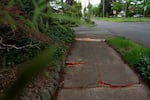
Orange paint warns pedestrian of uneven pavement on Southeast Schiller Street and Southeast 72nd Avenue in Portland, Ore. on April 23, 2026.
Saskia Hatvany / OPB
The proposal has the support of transportation and pedestrian advocacy groups, who have long lobbied the city to invest in safe, maintained streets.
“You all were dealt a very difficult hand of millions if not billions in maintenance backlog and no pathway to pay for it,” said Mike Dennis, executive director of pedestrian advocacy nonprofit Oregon Walks. “This is being fiscally responsible. We can pay now, or we can pay more later, and not just in terms of dollars, pay more later in tragic injuries and lives lost.”
The policy ensures that 25% of revenue generated by the new fee would be split between the city’s Vision Zero program, which focuses on street safety projects, and an unfunded council initiative adopted last year to invest in more sidewalks.
The proposal is reminiscent of a 2014 fee proposed by then-Commissioner Steve Novick and then-Mayor Charlie Hales. That plan initially promised to generate about $46 million annually through progressive income taxes for residents ranging between $60 and $900 annually, and a yearly fee on businesses ranging between $35 and $17,000.
Related: Portland poised to approve higher fees on road construction to fund street maintenance
But fierce opposition from business groups and fellow council members kept the proposal from advancing. That City Council ultimately settled on referring the 10-cent gas tax to voters.
City councilors are hearing some of the same arguments against the fee this time around. At a council hearing Wednesday, several people characterized the fee as a tax that should be approved by voters, not councilors.
“The city needs more revenue for the roads, the city needs to raise taxes, and part of the democratic norm in our system is to go to the voters when you need to raise taxes,” said John Starr, a member of the public who testified Wednesday.

An unpaved section of road on Southeast Knight Street in Portland, Ore. on April 23, 2026.
Saskia Hatvany / OPB
Jonathan Clay, a representative from Multifamily NW, a landlord coalition group, said the fees on apartment complexes will have an obvious result.
“Besides raising rents, how else would housing providers expect to recoup the losses of paying for other people’s transportation utility fees?” Clay asked the councilors.
Portland Metro Chamber, the region’s business lobby, organized much of the public opposition to the 2014 street fee. The advocacy group has stayed relatively quiet on this year’s proposal. But, in a statement emailed to OPB, CEO Andrew Hoan raised concerns about how this new fee could worsen the financial burden on Portland businesses, who already face some of the highest taxes in the country. Hoan wants to see the city pledge to not renew the “unsustainable” local gas tax, which is set to expire in 2028, before adding a new street fee.
“If the council approves this new fee without a commitment to sunsetting the gas tax, they will continue to add to Portland’s already crushing cost of living and running a business,” Hoan said.
Related: Can Portland eliminate traffic deaths? An East Coast city could be a model
At least two councilors – Dan Ryan and Eric Zimmerman – say these numerous concerns are why they plan on voting against the fee next week.
Councilor Olivia Clark spearheaded the new proposal and usually votes in lockstep with Ryan and Zimmerman. She has pledged to allow business groups a chance to give feedback on how the fee structure impacts them before and after it goes into effect in January 2027, and will consider incorporating those changes.
Most councilors have expressed strong support for the new fee. In fact, Mayor Keith Wilson’s proposed budget for the coming year seems to depend on its passage – he suggested using roughly $23 million of street fee revenue to prop up PBOT’s budget.

A cracked pavement on Southeast Mall Street in Portland, Ore. on April 23, 2026.
Saskia Hatvany / OPB
Unlike in the past, it appears the street fee will easily soar out of City Hall next week.
Novick, whose 2014 street funding effort may have contributed to his 2016 election defeat, credits Portland’s new form of government with the newfound support for a street fee. In 2014, councilors were elected citywide and represented bureaus. At the time, Novick oversaw PBOT, meaning he was really the only person on city council attuned to the city’s transportation funding crisis.
Now, Portland councilors no longer oversee bureaus and are elected to represent specific districts, where they all hear concerns about street issues from their constituents.
“People who weren’t the transportation commissioner didn’t feel a sense of responsibility for all of Portland, including the streets,” Novick said this week. “I think that in this council, we all recognize that we all have responsibility for all of the major functions of government, including the streets.”
Councilors will vote on whether to adopt the new fee Wednesday morning. If passed, it would go into effect in January.
It would be the second proposal to fund street maintenance adopted by council this month. Last week, councilors voted to increase a fee paid by utility companies who have to cut into city streets. That change will bring in roughly $22 million more to PBOT each year.
Correction: A previous version of this story misstated the proposed monthly fee for apartments. OPB regrets the error.