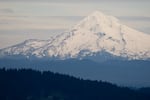
Poor snowpack covers Mt. Hood on a warmer than average day, reaching 56 degrees Fahrenheit, in Portland, Ore., on Feb. 3, 2026.
Eli Imadali / OPB
This past winter tied Oregon’s record for the warmest winter ever recorded. The warmer temperatures have led to record-low snowpack levels not only in Oregon but across many other western states. Climate change will likely make our winters not only warmer but also rainier, as more of the winter precipitation falls as rain instead of snow.
That rain and melting snow are also expected to move faster through our landscape into rivers and streams in the Pacific Northwest through the coming decades, according to a new study led by scientists at Oregon State University. Scientists developed a model that estimates current and future water transit times based on precipitation events in a tributary of the Yakima River. Faster water flows through the landscape could be a variable that water managers may need to consider when planning for the summer months when water demand is greatest.
Zach Butler is a postdoctoral researcher at OSU and the lead author of the study. He joins us for more details.
Note: The following transcript was transcribed digitally and validated for accuracy, readability and formatting by an OPB volunteer.
Dave Miller: This is Think Out Loud on OPB. I’m Dave Miller. This past winter tied the record for Oregon’s warmest ever and led to record low snowpack. It could be a taste of winters to come as climate change causes more precipitation to fall as rain, not snow. A new study led by scientists at Oregon State University could help water managers plan for this. It offers a new way to model the speed at which water makes its way from precipitation into rivers and streams. That transit time is getting faster, which could have major impacts on water quality and water availability later in the season. Zach Butler is a postdoctoral researcher at OSU and the lead author of this new study. He joins us now. It’s great to have you on Think Out Loud.
Zach Butler: It’s great to be here.
Miller: I mentioned transit time, or water transit, briefly just now. What exactly is it?
Butler: Water transit times are the time it takes water to move from once it arrives as precipitation to once it exits a watershed as stream flow.
Miller: What did you set out to study in this new research?
Butler: We wanted to use a newly advanced model to understand how climate change might affect water transit times in the hydrologic cycle, and the way we did that was we used this new model and measured and modeled a current historical climate. Then we used a new data set that can allow us to understand what climate change might do for temperatures and precipitation, and then we modeled what water transit times will do in the future.
Miller: For years, we’ve heard that less snowpack is a problem because there’s less of this aquatic battery storing water that can last as a solid form until spring and summer and slowly trickle out into surface water, that rain goes into a river faster than snow does. And it seems like your study corroborates that. It doesn’t overturn what scientists already thought. So what is new about what you learned?
Butler: What we’re showing is what scientists have said for a relatively long period of time, but what we’re doing is we have this newly advanced model that’s very computationally expensive. It’s very complicated. Our model essentially allows us to track precipitation events through our environment, and this has not really been done on such a large scale, and especially no one to our knowledge has done this in a future climate change scenario. We’re using this advanced model that can actually predict the future based on calculating water transit times as we mentioned.
Miller: Is it possible to track actual molecules of water? If there is some big snowstorm in the mountains, can you know that this particular snowflake eventually melted, and on June 5 some of those molecules are going to end up, I don’t know, in the Grand Ronde River?
Butler: Yeah, yeah, we can. It’s all done through isotopes. An isotope just means it has an extra neutron and atom and so when we do this – I’ve been talking about models – but what we currently do and what the current capabilities of most scientists and researchers are, is to use isotope observations within the water. That’s both within precipitation from once it arrives on a landscape, and then measuring the isotopes in the water at a stream or a river. And then understanding what that isotope value is from its arrival as precipitation.
And then understanding that isotope value as stream flow, you can use complex mathematical equations to have a pretty good accuracy of how long that isotope took from precipitation to stream flow. That was an important part of our research. We use this newly advanced model, but we used existing methods to validate our model during our current climate. So we went out into the field and collected isotope observations. Our model is able to simulate some of these processes as well and we could show how our model is able to predict our current climate accurately and based off the data we give it to simulate the future, we can then make these conclusions.
Miller: How much faster will water transit flows get in the coming years? What were your conclusions?
Butler: We showed on average across the year that water is going to move through our ecosystems nearly 20% faster or roughly one to two months. And in the Pacific Northwest this primarily means faster water in the winter. And again, that’s because, like we had a roughly normal precipitation across this winter, but as you mentioned we had much warmer temperatures and then that means a lot less snow.
And so once precipitation arrives more as rain, it’ll move through our watersheds faster and that’s what we observed, and this was on an average scope across the whole calendar year. The other thing we found was that water transit times will also have a noticeable seasonal shift from the winter wet season in the Pacific Northwest to the summer dry season out here.
Miller: Meaning what? What’s that shift you’re talking about?
Butler: That shift is, like I just said, we’ll have higher stream flows and younger water in our streams during the winter and spring, like right now. But we’re starting to see this shift as you get to summer and then fall, because we had most of that water coming out during the winter and spring, there’s actually less water available during the summer and fall, and that’s really where our findings get into the potential detrimental impacts related to what we’re showing. That, because we’re going to see less water in the summer and fall, that can have damaging impacts to our hydrologic cycle and to different agriculture.
Miller: Let’s turn to the problems that your study is predicting. You are getting to water availability there, which I want to come back to, but we’ve talked more about that over the years than about water quality, which you also talk about in your study. Why does faster water transit times potentially mean lower water quality?
Butler: That’s a key point. We’re showing faster water transit times on average, and what we’re showing is related to what other scientists and researchers have shown, that when you get water to move through faster, if you were to have a contaminant in an area, that contaminant will also move through faster through your watershed.
Normally, in our current climate, contaminants would perhaps move slowly through the environment with our current hydrologic cycle, but if we see this water that’s accelerating these processes, that means we could see higher levels of a contaminant if that were to happen, and that can be an issue for a variety of reasons.
Miller: OK, what kind of changes are you expecting in terms of water availability?
Butler: That’s the other key thing is the seasonal shift in the hydrologic cycle that our study is showing. Water availability is… we’re expected to see a decline in that in the summer and fall. In the Pacific Northwest that’s really important because most of our precipitation comes during the winter and spring, and we rely on that precipitation to melt slowly as snow through the summer.
But, like this year, we don’t have that snowpack to melt slowly and that means we’re going to have less water in the summer and fall, and we expect streams to be lower and reservoirs to be lower because of this, which means we’ll have less water to use for our agriculture.
Miller: How could your new model change the way water season projections are made, or decisions by water managers are made?
Butler: That’s a good question, and it really ties down to what we want our research to mean for people, and we want people who will manage water to be aware of what we’re showing. We’re using a model that’s used by many other scientists. Ours is just a different version of this model with adaptations that I mentioned. And what we’re saying is that we want this model to be used and for people to understand what these impacts might mean from climate change.
I’ve said this a couple of times, but this winter is just a really good example of what our study is saying is going to happen. I’m not totally sure if I answered that question fully, but yeah, just let me know.
Miller: Well, you did, but specifically, if there is a water master somewhere, how do you want them to be thinking about a water season differently going forward than they maybe have in the past?
Butler: I think the biggest thing is conserving your water more, and because we’re saying water is going to move through faster, it’s just finding additional ways to conserve your water more so you can make it last longer in the summer and fall, when we’ll have less water, like we’re saying. I think that’s the biggest thing that people could take away.
Miller: Do you think that the winter we just experienced is gonna be seen as the norm, say, 20 years from now? A historically bad year for snowpack. Is it just that terrible phrase, the “new normal,” going forward?
Butler: It’s hard for me to say it’ll be the new normal. I think I’d like to say it’s going to have a higher probability of happening more frequently. Whether that’s the normal, I’m not sure. Climate change is having all different effects across the world. It makes extreme conditions more likely. And so, yes, we’ll see a higher probability of what this winter was to happen more in the future, and that’s what our study is showing is that we’ll see a higher probability of that. Yes, we could still see snowy and cooler winters, but we’re more likely to see these warmer winters in the future.
Miller: In addition to your academic work, you are also a meteorologist for the website OpenSnow. What do you do for them?
Butler: Yeah, it’s a fun job. I do the weather report, essentially, for different ski resorts across Oregon. I put out a daily blog, we call a Daily Snow, where I look at the weather data and I digest it and I write about what that’ll mean for the ski and snow conditions across Oregon; and it’s really fun on a normal year to talk about all the snow that’s falling, where the best snow will be. We’re powder hunters as skiers or at OpenSnow, so we want to know where the best snow is. So I kind of digest the data and have fun and write a blog about what that means for who and where is going to see the most snow.
Miller: OK, but what you’ve just described almost seems theoretical or hopeful compared to the winter that you just reported on and did forecasts for. What was it like? It seems like you said you’re a powder hunter yourself, a skier yourself who got into this particular line, I assume because you love snow and love skiing. So what was it like to do those reports this dismal winter?
Butler: Yeah, it was hard. It was a little sad just to not have a lot of snow to talk about to cheer people up, and that was across the company of OpenSnow. We have forecasters that do these weather reports that I do for Oregon across most states across the West as well as the globe, and there was definitely a tone that we all set this year that was just a little sad.
But as a meteorologist and a writer, I tend to find optimism in most things. I think that’s just how I also live. I think it also makes you appreciate when it does snow, so there were some storms this year that did give good ski conditions, so I try to always see it on a positive note about, yeah, it was not a good year, but we still had some good days. I had some good days on the slopes in Oregon. That’s how I see it.
Miller: Zach, thanks very much.
Butler: Yeah, thanks. Great to be here.
Miller: Zach Butler is a postdoctoral researcher at Oregon State University. He was the lead author of a new study that provides a new way to see how climate change is speeding up the rate at which water makes its way from precipitation into streams and rivers.
“Think Out Loud®” broadcasts live at noon every day and rebroadcasts at 8 p.m.
If you’d like to comment on any of the topics in this show or suggest a topic of your own, please get in touch with us on Facebook, send an email to thinkoutloud@opb.org, or you can leave a voicemail for us at 503-293-1983.