Two lawsuits filed over the past week allege the drinking water systems that serve more than a quarter of a million Willamette Valley residents are being harmed by a federal agency that says it’s trying to help threatened fish.
Both lawsuits stem from the U.S. Army Corps of Engineers’ efforts to improve habitat for Endangered Species Act-listed Chinook salmon and steelhead fish – fish held back by the 13 large dams the agency operates on the Willamette River and its tributaries.
In Marion County, commissioners say they’re worried the Army Corps’ plan to draw down Detroit Lake to its lowest levels in history could affect drinking water systems in Salem and other communities nearby – and could affect wildfire response, agriculture and tourism in the Santiam Canyon area. The county sued the Army Corps on Wednesday, asking a judge to stop that drawdown until the federal agency finishes a report on how it could affect their water treatment systems.

FILE - Detroit Lake sits at a low water level during its typical winter drawdown, in Detroit, Ore., on Dec. 6, 2025. The U.S. Army Corps of Engineers is considering a plan to gradually lower Detroit Lake to its lowest levels ever starting in the fall of 2026 in an effort to help threatened Chinook salmon swim downstream.
Eli Imadali / OPB
Further south, the cities of Albany and Millersburg sued the Army Corps Friday over their own drinking water concerns.
Officials with the U.S. Army Corps of Engineers declined to comment on the litigation.
Reservoirs and drinking water
The Army Corps has been periodically lowering water levels at Green Peter Lake since 2023, and it plans to draw down water at Detroit Lake this fall. Those plans are the result of court and regulatory actions under the Endangered Species Act, said Greg Taylor, a supervisory fisheries biologist with the Army Corps.
But the agency’s initial efforts to comply with that law contributed to the deaths of thousands of Kokanee salmon. When the Army Corps flushed water from the Green Peter reservoir, those non-native fish were sucked through and killed by sudden pressure changes.
While Kokanee are not an at-risk species, the sight of masses of fish floating down the South Santiam River shocked observers and drew criticism from environmental groups.
In their lawsuit, the cities of Albany and Millersburg say the Army Corps’ decision to draw down the Green Peter Reservoir in late 2023 damaged their municipal water systems and threatened their ability to supply residents with safe water. Though that damage only cost the cities about $50,000, they say they need to make $31 million in upgrades so they can filter water that continues to be muddied when the Army Corps lowers reservoir levels.
Taylor acknowledged the turbidity created in 2023, but also said the agency has continued to draw down reservoir levels in subsequent years – with less damaging effects. There’s less debris and muck to disturb each time that water levels are significantly lowered there.
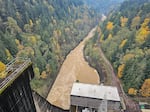
FILE - Water downstream of Green Peter Dam on the South Santiam River on Nov. 3, 2023. The river turned muddy after a deep drawdown of the dam’s reservoir that year.
Courtesy of Chase Berrier. / Courtesy of Chase Berrier
Marion County officials are concerned about turbid water coming from Detroit Lake. Located about an hour’s drive east of Salem, the lake provides drinking water for multiple Willamette Valley communities.
“The United States Army Corps of Engineers has proposed draining Detroit Lake to such a low level that it risks having insufficient water for municipal uses such as firefighting and drinking water, as well as insufficient water for agricultural, recreational and environmental uses,” Steve Elzinga, Marion County legal counsel, told commissioners Wednesday morning. “Such low water levels also mean that the Santiam River will have higher turbidity, which endangers water quality for everyone.”
Taylor said the Army Corps’ planned Detroit Lake drawdowns will happen in fall or winter, and will be enough water to meet spring and summer needs.
“I conceptually understand why people will focus on that and get concerned about it,” he said. “We’ve modeled the impacts to refill of the drawdown, and there’s little to no impact associated with this drawdown on refill.”
Marion County Commissioner Colm Willis said he’s not convinced by the information the Army Corps has released so far.
“Congress passed a law requiring the Army Corps of Engineers to do a turbidity report where they study the effects of this deep drawdown on drinking water and they have not done that,” Willis told OPB on Wednesday.
In its lawsuit, Marion County is suing to require the Army Corps to release a report on river turbidity and incorporate those findings into its assessment of the environmental impacts of its Detroit Lake plans.