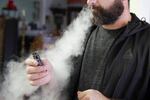
FILE - A person demonstrates use of a vape in this file photo from 2019.
Kristian Foden Vencil / OPB
The Oregon Supreme Court unanimously ruled last week that Washington County can ban the sale of flavored tobacco products, including vapes and hookah. County commissioners passed the ban in 2021, but it’s been tied up in court since retailers sued to stop it in 2022. The decision came just days after the U.S. Food and Drug Administration, for the first time, authorized the sale of some fruit-flavored vape pods.
Gwyn Ashcom is a senior program coordinator at Washington County Public Health. She joins us to share more about the county’s plans now that the ban can go forward.
Note: The following transcript was transcribed digitally and validated for accuracy, readability and formatting by an OPB volunteer.
Dave Miller: This is Think Out Loud on OPB. I’m Dave Miller. The Washington County Commission passed a ban on the sale of flavored tobacco products back in 2021, but retailers sued and the ban was eventually put on hold while the case made its way through Oregon’s legal system. Last week, the answer finally came. The state Supreme Court ruled unanimously that the ban can go forward. Meanwhile, that decision came just days after the federal Food and Drug Administration moved in the opposite direction. For the first time, it authorized the sale of some fruit-flavored vape pods.
Gwyn Ashcom is a senior program coordinator at Washington County Public Health. She joins us now. It’s great to have you on Think Out Loud.
Gwyn Ashcom: Thank you for having me.
Miller: I want to start with the reasons for this ban. How much is known about the effects of vaping on kids?
Ashcom: We know that vaping is very popular with kids. Just within our last 2024 Oregon student wellness survey with our population in Washington County, we know that 6% of our eighth graders and 13% of our 11th graders have used some form of a tobacco product. And of those kids that have tried it, 78% of them started with a vape product. And of regular users, 71% of those users that are youth are using flavored products.
So we know it very much appeals to them. We are concerned about them using it. We know there’s more research coming out regularly about the health effects of vape, and what it does to the body, and why we’re worried about youth using these products.
Miller: And so just to be clear, a 14-year-old can’t legally buy these products anyway, right? So what’s the idea behind the flavored ban, given that kids are not allowed to buy any of these products to begin with, flavored or not?
Ashcom: Right, they’re not allowed, but that doesn’t mean they can’t purchase still. So we know that some of our retailers were still selling; our last retail assessment, they’re doing better. But we did have 8% in 2025 of our retailers selling to people under the legal sales age.
Miller: Those are sort of stings to find out … When you say an assessment, it’s undercover folks saying, “can I buy this” and they’re not getting carded?
Ashcom: They’re getting carded possibly, but they are using their Real ID. So it is something that the state does as part of the annual inspection for all our retailers. They get an inspection for minimum legal sales age sales, and it’s youth that go in with their regular ID, nothing trying to look older in any way, and see if they can purchase a product. So, we’ve been gradually seeing improvements, now that we have a statewide tobacco retail license. It was over 20% of retailers at one point; we’re down to 8%. So we’re moving in the right direction.
But youth still have access to these products, either via friends or family, not just stores. So by limiting access, just them not being there, the products just aren’t there.
Miller: If there’s not strawberry-flavored, whatever, the thinking is that kids would be less likely to start vaping – that’s the basic idea here? If it tastes like tobacco, as opposed to cotton candy.
Ashcom: Right. I equate it [to]: if it’s not a vanilla sugary latte, and it’s straight black coffee and it’s the first time a kid is tasting it, which one would they go for? So we know that flavors appeal mostly to the young demographic than to an older demographic.
Miller: What falls into the category of flavored tobacco products? What cannot be sold in Washington County going forward?
Ashcom: Anything that is called a “flavor” such as what you’ve mentioned: cotton candy, strawberry, tropical fusion, tiramisu. We’re also prohibiting menthol, mint, even concept flavors that are “fire & ice” or “icy mist,” those kinds of things. They allude to probably having mint in their flavor.
Miller: Washington County didn’t just ban flavored tobacco products like the ones you mentioned with this ordinance, but also prohibits discounts and coupons. What’s the thinking behind that?
Ashcom: Yeah, we wanted to have a really robust policy. We know that youth are also price sensitive. So if we were going to come and say, OK, we don’t want these products on the market, the other thing we can do is also make them not so cheap and as affordable as we’ve seen in the past. So by prohibiting those price promotions, discounts and coupons, we know that youth will be less likely to purchase if the costs are too high. It could potentially stop initiation or at least stop prolonged continued use of the products.
Miller: OK, so the county commission, as I mentioned briefly in my intro, approved this ban, voted on this ban back in 2021, and then voters reaffirmed it the next year – but it wasn’t enacted. So, what happened legally?
Ashcom: Yeah, I can give you what I know. I’m not an attorney, but I can walk through what I understand it to be. We were sued in the fact that the belief was that we were preempted by the state and therefore not allowed to enact a stronger policy outside of the statewide tobacco retail licensing program.
Miller: Those are the allegations in the suit saying this ban should not be allowed.
Ashcom: Correct. So the court proceedings then went into detail with that. And as you know, litigation, it takes a long, long time to get through the court processes. So we’re very pleased that we have now come to this point with our Oregon Supreme Court agreeing that we do have the right to strengthen the current statewide tobacco retail license at the local level.
Miller: The state licensing law doesn’t preclude counties like Washington County from enacting stricter rules.
My understanding is now this has to go back to the lower court for the final adjudication. Do you have a sense for how long it’ll be before the ban is actually in effect?
Ashcom: We’ve heard it can take a couple weeks, a few weeks to get through that process. And in the meantime, we’re working with our public health leadership to determine all the things that need to get done and get in place, so that there’s lots of time to educate and work with our retailers ahead of time. So they’re not surprised. Nothing that would happen overnight. We’d be giving them lots of lead time to think about how they’re going to sell their product, finish selling out their products or work with their distributors to return product. So they’ll have time to get ready to comply.
Miller: And then what happens? I mean, what does enforcement look like? Let’s say, past the kind of grace period or education period, two years from now, if some convenience store in Hillsboro is selling cotton candy vapes, what happens?
Ashcom: We would be notified. It’s a complaint-driven law, so we’re going to have an online complaint system that the public, anyone in the public, could go to the website, report a location that they’re concerned with and what the situation is. It then triggers our response to go out and make a formal letter to the business that lets them know that we’ve received a complaint. This is what the complaint is about. Did you know? Make sure they have that little bit of education. There’s a little bit of a grace period for them to get things in order before a site visit would be required. Then we would show up on site to see, are those products in fact still on the shelves? And if they are, that’s when it moves to a citation.
Miller: You just said you are not a lawyer. You’re here from Washington County Public Health. But do you have any sense for what this ruling for Washington County’s ban could mean for Multnomah County’s ban? They followed you and they have also been on hold.
Ashcom: We’re hoping that we set the pace and that now it will help them move along. We’re the first county in the state of Oregon and in the Pacific Northwest to do something like this. So, we are really proud to be setting a precedent. We hope other counties will follow us and see that what we’ve been able to do, they can do as well. So with our verdict, we’re hoping that we’ll speed things along for Multnomah and they’ll be able to move through the litigation process a little quicker than we have.
Miller: So you’re the first in Oregon. Do you know if other localities in other states have done this, or are you relatively unique?
Ashcom: We’re unique for the Pacific Northwest, but there’s 420 other localities nationwide that have done this and six states have done this. So we aren’t the first, but we won’t be the last. We’re starting it in the Pacific Northwest, hoping that by us doing it, it’ll start spurring some of that work to happen over here.
Miller: That does bring us, though, to the nationwide question, because as I mentioned in the intro, all this is happening in Oregon at the same time that the FDA just approved fruit-flavored vape pods. It confused me a little bit when I saw this. If they had not been approved by the FDA until very recently, how are people still buying? How are adults able to buy them?
Ashcom: Yes, so they hit the market prior to any type of legislation being able to catch up to them. So it was a boom, right? When they landed, they landed big and fast, and we’re catching up. We’re still catching up. Obama’s administration was the administration that put in that FDA should approve these products before they go to market. And we’re just now seeing them actually implementing that. That shows how long these things can take.
Miller: So the Obama administration said, hey, let’s do an approval process to see whether or not they should be allowed. But in the meantime, they were legally – as far as the federal government was concerned – saleable and it took until two weeks ago for the FDA to then actually say yes or no. And they said yes.
Ashcom: They’ve been starting their market review. So there’s been some products like JUUL that have gotten the most notice in the community about that product. [They] can’t sell certain flavors because they were clearly selling to youth at that time. So, now we’re seeing that more of these products are coming up. They’re getting evaluated. FDA has to make decisions. Is this actually good for the public?
But youth are the primary users of these products for flavored vapes, flavored nicotine pouches – all of those things are youth. So having any flavor at all just sets it backwards, in our opinion.
Miller: And if you’re an adult who loves them, what do you say to that person? I mean, here you are as a public health person saying, “Too many kids are using these products.” And if an adult says, “Yeah, but I like them too. You’re gonna take them away from me, a 50-year-old, just so the 17-year-olds don’t have access. How is that fair?”
Ashcom: Most of the users that we have, at least research-wise, is young people using the products. Older people are not quite as driven to using these as young people are. And we’re still learning about all the health effects of the flavors themselves and what they’re doing to the body. We know you can digest Kool-Aid powder into the stomach, and we can mix it into water, we can drink it and our body can handle it. We don’t know what inhaling a Kool-Aid powder mix, let’s say, would do to the lungs. There’s still so much information that we need to learn.
The closest we have to it is of the factories that used to make buttered popcorn for microwaves and the particles that’d be floating in the air. Those workers were getting that absorbed into their bodies. [It] became a condition called popcorn lung, because it created a bunch of little Swiss cheese-like holes throughout the lungs. That is the first thing that we can correlate to what maybe breathing in a chemical flavoring might do.
So, we’re concerned about youth, but we’re concerned about everybody using these products because they’re not 100% safe. So, safer does not equate safe.
Miller: Gwyn Ashcom, thanks very much.
Ashcom: Thank you.
Miller: Gwyn Ashcom, senior program coordinator at Washington County Public Health.
“Think Out Loud®” broadcasts live at noon every day and rebroadcasts at 8 p.m.
If you’d like to comment on any of the topics in this show or suggest a topic of your own, please get in touch with us on Facebook, send an email to thinkoutloud@opb.org, or you can leave a voicemail for us at 503-293-1983.