Oregon voters this week soundly rejected a statewide measure that would have increased gas taxes and vehicle registration fees to fund transportation. On a local level, the opposite happened: Voters passed every measure funding roads closer to home.

The word “vote” is written in various languages on a Multnomah County ballot drop box in Pioneer Courthouse Square in downtown Portland, Ore., on May 15, 2026.
Eli Imadali / OPB
Support for local taxes didn’t stop there. Despite rising inflation and a souring economy, voters passed or renewed more than 40 taxes for libraries, local schools and in some cases fire and emergency services. The support was far from uniform locally, though, with a number of tax measures falling short, leaving school districts, as well as numerous agencies responsible for public safety, parks, pools and public works with significant funding gaps and a need to reevaluate budgets going forward.
Across the state, Oregon voters weighed 66 local tax measures in the May 19 primary election. Forty-two of them appear to be passing.
According to DHM public opinion researcher John Horvick, the results represent a slight dip in Oregonians’ overall support for funding measures compared to elections over the past five years. Still, Horvick said, Oregonians generally will fund the services they value. This election was no different.
“People say yes to taxes for various reasons. If they have confidence that the money is gonna be spent on the services they value are gonna be delivered well, they’re gonna be much more likely to say yes to something,” he said.
A mixed bag for school levies, bonds
Results were 50-50 for Oregon’s school districts in Tuesday’s election. Of the 10 K-12 school funding measures on the May ballot, five are passing and five are failing.
A Lane County levy to support the Oregon State University Extension Service was extremely close on Friday afternoon, but appears to be passing.
New levies to shore up district finances in Canby and Newberg appear to be failing.
“We put this on there because we wanted to see if we could do something locally, so we’re disappointed that it doesn’t look like it’s going to pass,” said Newberg superintendent Dave Parker.
Parker thanked parents and other volunteers who spent time messaging at meetings around town, but said rising costs as well as other statewide measures on the ballot may have soured voters on supporting Newberg schools.
“I think we had significant headwinds against this time around with the gas tax and some of the challenges going on in Washington D.C.,” he said.
Newberg is one of many Oregon school districts with funding challenges. For the 2026-27 school year, the district has a $5.7 million funding shortfall, and the levy would have helped stave off some of the cuts.
But now, a rejected levy means four furlough days, larger class sizes and school closure conversations.
“We need to reseat the [consolidation] committee and begin to have a conversation about what our options are,” Parker said. “If it were an easy solution, we would have already done it. The issue is none of these solutions fix all the problems.”
Parker said 17.5 teaching positions will be cut, along with 10 support staff positions. Staff have already been notified, but if the levy would have passed, some of these cost-saving measures would have been reduced.
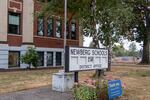
FILE - The district office of Newberg Public Schools on Sept. 13, 2022. Newberg is among five school districts in Oregon to see local funding measures rejected by voters on the May 2026 ballot.
Elizabeth Miller / OPB
East of Newberg, the Canby School District is also seeing voters reject a levy to help make up most of a $6.3 million shortfall. Like Newberg, district leaders are planning for four furlough days next school year.
“This will shorten the school year and impact both student learning and staff compensation,” Canby superintendent Jennifer Patterson said in an April message to families.
By adding furlough days to the school year, Newberg and Canby are temporarily sidestepping Gov. Tina Kotek’s April instructional time order. Under the order, all Oregon districts must restore any hours that were removed from the calendar through furlough days by the 2027-28 school year. The Oregon Department of Education is collecting information from school districts on instruction time.
Class sizes will also increase in Canby, up to “30 students in elementary classrooms and 35 to 40 in middle and high school,” Patterson said.
But one of the biggest blows to not only the school district but the community are the projected staff layoffs. The district is losing 60 staff members this year after cutting 74 staff members last year.
“Combined with last year’s $7 million reduction, this represents more than 25 percent of our workforce,” Patterson wrote in that April newsletter. “As one of the city’s largest employers, it also has important economic implications.”
The board will meet June 1 to talk about next steps, as well as continuing advocacy efforts for more state funding.
But not all the news was bad for Oregon school districts.
Voters renewed local option levies in the Ashland and Riverdale school districts.
Five Oregon school districts asked voters to support the repair and building of new facilities. All five have received state grants to match local bonds, if voters approved them.
But only three passed, in Sweet Home, Cascade, and the Athena-Weston school district.
School bonds on the Oregon Coast appear to be failing in the Siuslaw and Brookings-Harbor school districts.
As of Friday afternoon, one measure was still up in the air: a measure in Lane County that would have raised an estimated $12.8 million to support 4-H and youth programs. The 4-H measure is for youth programs on natural resources, emergency preparedness and other programs from the Oregon State University Extension Service in Lane County. It’s the only extension service operating on a 5-year local option levy.
That levy originally passed in 2021 with two-thirds of voters supporting it. After looking like it failed in early returns, the measure now appears to be passing, though at an extremely slim margin.
On its website, OSU Extension staff said Lane County’s reserves will help make up funding gaps as the organization considers next steps.
“Regardless of the outcome, OSU Extension programs in Lane County will continue in the near term. If the measure fails, Lane County has reserves that provide stability while we plan next steps.,” according to the OSU Extension Lane County website.
Yes and no for police funding
After 20 years of backing the current public safety levy, voters in Clackamas County rejected an increase by more than 20 percentage points. If the county does not find a solution before the end of the year, the levy’s failure will mean the county jail loses 84 of its 483 jail beds and the sheriff’s office loses dozens of employees, including 34 patrol deputies, five detectives and the agency’s internal affairs investigators. It will also cut funding for body-worn cameras.
Horvick said it’s a tough sell to ask voters to increase taxes to fund the same level of services they’ve received for decades — which was the case in Clackamas.
In Sutherlin, voters repealed a public safety fee. More than 60% of Tigard voters rejected the bond for a new police station.
But voters in the small coastal cities of North Bend and Port Orford approved raising taxes for local police.
Libraries, local roads get funding
All but one funding measure for public libraries appear to be passing. Voters in Eugene, Scappoose, Baker County and Veneta all passed levy measures to fund library services. The only library measure voters rejected was in Jefferson County.
While voters resoundingly rejected Measure 120, which would have increased gas taxes and vehicle registration fees statewide, Oregonians in rural areas voted to fund six different road improvement measures.
The measures that are passing are hyper-local: For instance, only 38 people cast ballots in the five-year local option tax for the Brownly-Marshall Road District. But it passed by more than 40 percentage points.
The Rogue Valley Transportation District five-year local option tax renewal was by far the largest of the road measures, decided by 45,000 Medford-area voters. It passed with 63% of the vote.
Horvick says local voters can connect such measures to a local need.
“It’s ‘I know the road. I’m very clear about what roads are gonna be fixed. I’m clear about who are the people that are getting the work done for me.’ It’s much more direct,” he said. “(Measure) 120 is much more politicized than these local road districts.”
Emergency services measures lean ‘yes’ — slightly
More than two dozen measures for fire and emergency services appeared on ballots across the state May 19. Fifteen of them passed and 12 failed.
In Columbia County, voters rejected levies for 911 services and the Vernonia Rural Fire Protection District. The 911 measure would have replaced a levy that helped fund emergency services starting in 1998 until its expiration in 2024. The Vernonia measure would have increased the existing fire district levy by about 60%.
A sweeping measure in the Columbia County city of St. Helens was soundly rejected by voters, impacting money for a range of municipal services.
But voters in Lake Oswego and Sublimity supported bonds for new and upgraded fire stations. Thirteen other fire and EMS funding measures passed.
Horvick noted that while most Oregonians don’t have a positive outlook on the economy right now, the urgency of funding public services can at times overcome that.
“The economy matters how people vote but it matters less than the services that they’re getting and the confidence that they’re gonna have that they’re gonna be delivered well,” he said.
Editor’s note: This story has been updated from its original version to reflect that the Lane County 4-H measure is passing, according to results available Friday.