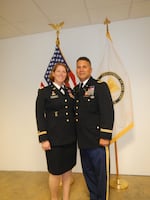
In this provided photo, Michelle Stewart and her husband, Bryan Stewart, pose for a photo during her retirement ceremony as Chief of Staff at the Arlington National Cemetery on July 25, 2014. Both Michelle and Bryan Stewart retired with the rank of colonel after a combined nearly 60 years of service in the U.S. Army. They currently live in Battle Ground, Wash.
Courtesy Col. Keith Joseph
In just a few weeks, millions of Americans will celebrate the Fourth of July with their families and friends at barbecues, parades and outdoor concerts under fireworks. This year’s celebrations will take on added significance as our nation commemorates the 250th anniversary of its independence.
As we approach this historic milestone, “Think Out Loud” hears from guests whose life experiences and personal histories illuminate different aspects of what it means to be an American.
We start by hearing from Bryan and Michelle Stewart, a married couple in Battle Ground, Wash. Bryan and Michelle retired as colonels in the U.S. Army after nearly 60 years of combined service at military bases in the U.S and abroad. They both served in Afghanistan and Iraq. Bryan was also deployed to the NATO headquarters in Belgium. Michelle worked in Bosnia, where she helped identify mass grave sites and assisted with the U.S.-led effort to end the war. She also served as the Chief of Staff at Arlington National Cemetery.
Michelle and Bryan Stewart join us to talk about how their military service has shaped their views on patriotism, sacrifice and our country’s founding ideals.
Note: The following transcript was transcribed digitally and validated for accuracy, readability and formatting by an OPB volunteer.
Geoff Norcross: From the Gert Boyle studio at OPB this is Think Out Loud. I’m Geoff Norcross. In just a few weeks, Americans will celebrate Independence Day. The observance takes on an extra significance this year with the 250th anniversary of the founding of our nation. As we approach this milestone, Think Out Loud is hearing from different folks about what it means to be an American.
Today we start with Bryan and Michelle Stewart. They are a military couple with a combined nearly 60 years of experience serving at bases all over the world. They’re both retired as colonels in the U.S. Army, and they now live in Battle Ground, Washington. Michelle, Bryan, welcome to Think Out Loud. It’s a pleasure to have you.
Bryan Stewart: Thank you. It’s great to be here.
Michelle Stewart: It’s great to be here, Geoff. Thank you.
Norcross: Bryan, let’s hear from you first. Tell us a little bit more about your military experience.
B. Stewart: Well, I went to ROTC in college in Tennessee and just thought – they paid my way through college – I thought I would do like my three-year mandatory obligation, but I enjoyed the army so much that I decided to stay a few more years and then you hit 10 years and you might say, you know, I’ll go for 20, then you’re still having fun at 20, so you stay at 30. So yeah, I just didn’t expect to do an army career, but I enjoyed it so much that I stayed a while. When I was a little boy, I was the kind of kid that played war all the time or played with little soldiers and all that stuff. So I’ve always wanted to be a soldier, and it happened and it kind of stuck.
Norcross: Did you come from a military family?
B. Stewart: No, my father was a Marine in World War II, but he did his time in the war and then went to college and seminary and that was about it. I had a few cousins in Vietnam that were older than me, but yeah, not a real big tradition like some families have.
Norcross: What was it about your experience in the military that made you think, I’m gonna stay with it?
B. Stewart: It can be a healthy lifestyle if you don’t get hurt. I mean, you have to stay physically and mentally in shape to do it. And I like the teamwork. I like the teamwork, being with your other soldiers and other good leaders and being able to lead good soldiers. Traveling, I love to travel, so you can be stationed in some not so nice places and some nice places if you’re lucky sometimes, so just the whole concept of being on a team and getting to do lots of interesting things was really appealing.
Norcross: What about you, Michelle? What’s your story?
M. Stewart: My story is very similar to Bryan’s in that I also was an ROTC grad, three-year scholarship kind of thing. So they paid for my college. Unlike Brian, I never wanted to be in the military. It was simply to pay for school, something I would do for a couple of years and get out as soon as I could. That plan changed because I had a really, really good time. It was wonderful to be given so much responsibility so early in life, running a platoon, then later a company. I like to be in charge, so I enjoyed it, so I stayed.
Norcross: Were you surprised by how much you enjoyed it and how much it was worth staying in?
Michelle: I was completely floored how much I enjoyed it. I really expected that I’d want to get into the corporate world, go off and make some money and do other things, but I really got a lot of satisfaction from being in service to our country.
Norcross: What was your most memorable experience or your most meaningful experience in the army?
Michelle: I think one of my most memorable experiences would have been a time that I spent with USAID. I was a military liaison to USAID in Afghanistan. This particular job required us to serve for a year in Afghanistan, and I was there under embassy auspices, which meant I was in civilian clothes, not wearing combat gear, and going all over the country with the ambassador and with the mission director for USAID.
In this one particular case, we’re in Badakhshan, which is in the northern part of Afghanistan, and we were visiting a woman’s clinic, and one of the things USAID had done was fund a training program for young ladies, really girls; they were just teens, teens from the villages who were given some medical training, initially just to deliver babies, but then we realized how successful the program was becoming and we trained those young ladies to do pretty much any sort of medical requirement that women of the village might need, because it was improper for a man, even a doctor, to touch a woman in their culture. So the young girls were doing great things.
And at this one particular clinic, I was approached by an older woman who spoke through a translator, and she said, “Thank you. Your program saved my daughter’s life and my daughter’s son’s life.” And she was just in tears and was very grateful, and it made me very, very proud to be from a country that would do such wonderful things in a part of the world that, frankly, no one else cared about.
Norcross: Given that background, I’ll ask you the central question of the moment, which is, what does it mean to you to be an American?
M. Stewart: I think being an American is remembering that freedom isn’t free. I know it sounds trite. Freedom is not free. Freedom comes with sacrifice. And in fact, I would say freedom and sacrifice are inherently linked. You can’t have freedom without sacrifice. Being an American isn’t simply waving a flag. It means putting something other than yourself first, believing in something that’s bigger than yourself.
In this case, our communities, our churches, our organizations, our agencies. I think people can serve in all kinds of ways, you don’t have to serve by joining the military. I particularly enjoyed it, so did Bryan, but there’s lots of ways to serve. And just wearing a red, white and blue T-shirt or waving a flag, that’s nice, but it’s not enough. Just thanking a soldier, it’s nice, but it’s not enough. Everybody has to do something in service to their community and their country.
Norcross: Same question to you, Bryan.
B. Stewart: Being an American on our 250th anniversary, I think America, since World War II, has had a leading, very important role in the world, and I think that’s been very important. And I think that’s something that’s eroding, possibly right now, but to be an example of democracy in a country that does more good than bad, hopefully, in the world.
Being a partner in the world is very important to me, I think. As I’ve traveled so much with the army, seeing so many different parts of the world and seeing the good things we can do, not just violent or bad things, you know. So I think I wish more Americans could travel more and see the world and get a bigger perspective on the world and how America partners with the world. But I’m proud of the good things we have done in the past and the good things we have done make me proud to be an American.
Norcross: But how do you think about the bad things, especially as a member of the U.S. military?
B. Stewart: Well, I don’t know what the definition of a bad thing is. Maybe some people will disagree about places we’ve gone to: Iraq, Afghanistan, maybe Iran too, currently. I think the services, we have civilian leadership of the services and we obey lawful orders, and we do our duty if it’s ethical and lawful. We do our best and hopefully try to do good things, mostly, not always. And I think that our Constitution sets up civilian leadership of the military, so that’s kind of the way we perform constitutionally.
Norcross: We asked for comments and voicemails about what it means to be an American today and what’s been top of mind for you as we approach the 250th anniversary of our nation’s independence. Here’s what Preston McKinley from Vancouver said:
“I’d like to see all Americans that aren’t currently living by a religion or faith to develop their own personal code of ethics by which to live each day. And this in part can be their contribution to America experiencing a better overall life together in our collective future together.”
Michelle, this kind of echoes what you were saying earlier, whereas you don’t have to join the military, you don’t have to go the path that you and Bryan did in order to live by a certain ethical code, because one was handed to you, certainly as a member of the military, but I wonder how that resonates with you.
M. Stewart: Oh, absolutely. Being in the military means, by definition, you’re giving up some of your personal freedoms in order to make the world a better place, assuming that the orders that you’re getting are designed to do just that. There’s lots of ways that one can serve. I think just picking up trash along the highway, volunteering at food banks, volunteering at your local church or community center, volunteering for older people or pet shelters. There’s a number of ways that anyone can help to make the world a better place.
Norcross: What does patriotism mean to you?
M. Stewart: Well, let me just start by saying I love our country. I think that patriotism in this age is really celebrating what makes America great. By that, I guess I mean our diversity, the honor and the dignity that is derived from just doing the right thing, even if it’s hard. And again, I’ll say it’s putting others before yourself, putting your country before your own personal benefit. It’s doing the things that lift others up, instead of always seeking to profit or putting yourself first.
Norcross: Bryan, I’m wondering if your ideas about what it means to be an American have changed over the years after you got out of military service. I mean, what has been the evolution of your thinking on this?
B. Stewart: That’s a tough question. I think I’ve expanded my thinking some, to not see things as all black and white. You know, we, Michelle and I, both went to the U.S. Army War College where they brought a lot of speakers who are very non-traditional. We had the president of the ACLU come speak to us and things like that. So it kind of expanded our thinking.
And ever since then, I’ve tried to maintain touch with the military. I have a lot of friends that are still serving as general officers or that stayed in longer than we did. And yeah, I try to stay in touch with geopolitics and all that and try to maintain a finger on the pulse, but I just try to keep learning and try to keep expanding options.
Norcross: Michelle, back to you. Are there values that you think all Americans should embody, regardless of their political affiliation?
M. Stewart: Absolutely. I think that the army has always been very value forward. We used to wear little dog tags that listed the army values, for example, loyalty, honor, integrity, honesty, those jump out at me. I think that all those values fall right in line with the theme that I keep referring to, which is sacrifice, putting others first and being active in volunteering to make the world a better place.
Norcross: How about you, Bryan?
B. Stewart: Yes, I think no matter your background, if you’re an American, no matter your background or political affiliation, I think there are values that do make us a good country or a better country. As Michelle said, sacrificing for the greater good, not being about the – I know Americans are very individualistic – the rugged individual is the cowboy of the West, and that’s great. But I think it’s important to think about the group and the greater good as a whole of our nation, not just about my backyard and my political party or what have you.
Norcross: We got a voicemail, from Kara Shane Cawley, and here I think she’s giving voice to a feeling that a lot of people have right now. Let’s hear what she had to say.
Kara Shane Cawley: I’m feeling like our country is kind of broken and you know, we’re so divided and I feel like we need to have a Constitutional Convention. Could we, as a country, come together and say, this is, you know, can we find any common ground? Do we see that there’s problems with our Constitution? Are there things we can change about it?
Norcross: So it sounds like she’s saying that we’re kind of stuck, and she may be referring to the fact that we haven’t substantially amended the U.S. Constitution in like, 55 years. I’m wondering, Michelle, if you feel that, too. That inertia, that inability to move forward together?
M. Stewart: Oh, absolutely. I think if you ask most Americans what is important to them, I think we would agree on about 80, 85% of the things, but our politics are becoming increasingly divisive and we’re being angered by the things that we listen to.
I think that our role as a bastion of democracy in the world is increasingly in question, and it makes me incredibly sad because I feel like for decades, centuries now, we’ve stood on the shoulders of those who’ve gone before us, and in this case, I think we need to fight the forces of tyranny. We need to use our voices and our votes to oppose corruption and greed and perhaps starting with a Constitutional relook is a really good idea.
Norcross: Thanks. “Constitutional relook,” I like the way you put that. Since you brought the Constitution into this, “to form a more perfect union,” the famous phrase from the preamble to the Constitution, what does a more perfect union look like to you, Michelle?
M. Stewart: I think a more perfect union would be where most Americans saw the similarities and the things that unite us as opposed to the things that divide us. A world where we could put our anger aside and question it, vociferously, constantly question our anger, because there are a lot of forces at work: internet and AI and even our politicians from time to time that want us to be angry, want us to… Hate may be a strong word, but be suspect of and dislike each other, and we really shouldn’t. There’s so much that we do agree on.
Norcross: Bryan, if our founding fathers, like Thomas Jefferson or Benjamin Franklin, were alive today, took a look around the country, what do you think they would think of what they saw?
Bryan: I think they would see, in their opinions, good and bad things. You know, I just finished watching Ken Burns’ documentary on the American Revolution and I thought there were some really interesting things even as a historian – I’m an amateur historian – and a lot of things I learned that I didn’t know before. I think they would say, “Well, we did a pretty good job in 1787, doing that Constitution and the Bill of Rights. It’s not perfect, we may need to,” as our listener just commented, “We might need to relook some things.”
Thinking about the military, I think they intended for Congress to have more of a role in military adventures around the world and declaring wars and all that. I think Congress has taken a backseat to that in the past 50 years or so, with a lot of our presidents, so I think they would say, “Well, you guys need to fix a few things here, but I think they tried to do their best.”
But that was 250 years ago, and of course they could not see the future. Some people call it the American experiment. I think they would say, “We did our part; now it’s your generation’s turn. You need to come together, build on what we started, and give future generations another 250 years.”
Norcross: Well then, the last question is for you, Michelle. How do we do that? How do we make sure our nation survives another 250 years?
M. Stewart: I’ll go right back to what I keep saying. I think it’s important to put the country first and let our anger and our divisiveness fade into the background. Celebrate and strive for unity.
Norcross: Thank you both very much. This was a great conversation. I appreciate it.
B. Stewart: Thank you.
M. Stewart: Thank you so much, Geoff.
Norcross: That’s Michelle Stewart and Bryan Stewart. They are married. They are former members of the U.S. military. They now live in Battle Ground, Washington.
“Think Out Loud®” broadcasts live at noon every day and rebroadcasts at 8 p.m.
If you’d like to comment on any of the topics in this show or suggest a topic of your own, please get in touch with us on Facebook, send an email to thinkoutloud@opb.org, or you can leave a voicemail for us at 503-293-1983.