Oregon before statehood
July 4, 2026, marks the 250th anniversary of the signing of the Declaration of Independence, but in 1776, Oregon’s statehood was still more than 80 years away.
So, what was happening in the Pacific Northwest 250 years ago? As Grand Ronde tribal member and historian David Lewis says, “It was all different tribes just living their lives.”
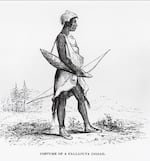
Sketch of a Kalapuya man drawn by Alfred Agate, a member of the Wilkes expedition of 1841.
Courtesy of Oregon Historical Society, 48789
He says, “The population of Oregon in the 1770s was mostly all Native American people.”
There were a few outliers. Spanish and British ships had explored the Pacific Northwest coast and occasionally even made landfall, trading and interacting with Native people. Indigenous oral histories include stories of shipwreck survivors living with tribes.
Still, European contact with Indigenous tribes remained rare.
Beyond today’s tribal boundaries
Today, Oregon has nine federally recognized tribes and several unrecognized tribes, but that doesn’t give the full picture of historical populations. During the mid-1800s, the United States government consolidated groups and moved them onto federal reservations, sometimes hundreds of miles away from their homelands.
“— Confederated Tribes of the Umatilla Reservation websiteElders remind us that there did not used to be Tribes as we know them today. Indian people were identified as so-and-so’s people, were recognized by their family, or by where they come from. ”
Disease and displacement
These populations represented just a fraction of their pre-contact numbers.
Lewis says that when Meriwether Lewis and William Clark traveled the lower Columbia River in 1805, they saw Indigenous people with the pockmarked scars left by smallpox. They also heard stories about a plague that had killed off large numbers of people in the 1770s.
“— William Clark journal, April 3, 1806My guide brought foward (sic) a woman who was badly marked with the Small Pox and made Signs that they all died with the disorder which marked her face. ...The Clatsops inform us that this disorder (sic) raged in their towns and distroyed their nation.”
Lewis says that by the 1830s, an even worse outbreak of malaria wiped out up to 97 percent of some populations.
“And so, we just don’t know how many different tribes were lost and then had to consolidate the remaining members with larger tribes.”
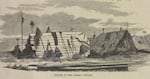
This image, titled "Graves of the Umpqua Indians," appeared in Frank Leslie's Illustrated Newspaper in April 1858.
Courtesy of the Library of Congress
He adds, “Some tribes likely just disappeared. We will likely never know the (entire) tribal picture before 1830.”
Where people lived: Cultural and geographic regions
Here’s what we do know: Oregon was home to dozens of Indigenous tribes, bands, family groups and clans, totaling tens of thousands of people, largely divided by cultural regions.
The largest populations concentrated along the Columbia River, the Willamette Valley, and coastal estuaries and inlets. These areas offered abundant water, wildlife and vegetation.
“Coos tribes of the coast, they had a giant estuary and they just never left. Everything they needed was there,” says Lewis.
People in the Great Basin and Columbia Plateau practiced a more nomadic lifestyle. Seasonal rounds took them hundreds of miles, moving between specific locations throughout the year to harvest, process and preserve plants and animals as the seasons changed.
Lewis says, “The Paiutes would travel literally across all of eastern Oregon. They would go from the Snake River all the way over to the Cascade Range, sometimes down to the Klamath, sometimes up to the Columbia. That’s a gigantic range.”
Many people, many languages
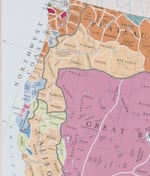
This Geological Survey map from 1991 shows some of the Pacific Northwest's historical Indigenous tribes and languages.
Courtesy of the Library of Congress
These different groups also spoke different languages.
According to linguist Dell Hymes, in the late 1700s, Indigenous people just along the Oregon coast spoke at least 18 distinct traditional languages. Hymes wrote in “The First Oregonians” that each village probably had its own dialect.
Hymes also documented 13 distinct language families.
Some of the well-traveled Northern Paiutes spoke Numu. That language is a member of the Uto-Aztecan language family, which comprises 60 related Indigenous languages spoken from the Great Basin to Central America and dating back roughly 4,000 years.
Despite the variety of languages spoken throughout the region, Indigenous people regularly interacted and even developed vast trade networks stretching thousands of miles.
“They did develop things like jargons or trade languages that they spoke between tribes,” Lewis says.
One of those, Chinook Jargon, also called Chinuk Wawa, became an important trade language with Native Americans and early Europeans. It’s thought to have originated in Oregon and spread all the way from southern Alaska to northern California.

Dictionary of Chinook Jargon, Portland, Oregon, 1887.
J.K. Gill & Co.
Today, the language is experiencing a revival. Lane Community College offers a Chinuk Wawa language program in collaboration with the Confederated Tribes of the Grand Ronde.

Related Content & Resources
- “Oregon Experience” documentary: "Broken Treaties"
- “Think Out Loud:” The US turns 250 years old this year. Oregon teachers share what the anniversary means for the classroom
- American250 Oregon Commission: OREGON 250
- Travel Oregon: Celebrate America250 in Oregon