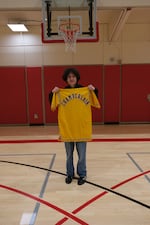
In this provided photo taken in January 2026 at the Multnomah Athletic Club in Portland, Quinn Brown poses with a warm-up jacket worn by basketball legend Wilt Chamberlain during the 1972 NBA Finals. The jacket, which Brown found and bought for $3 at the Goodwill store in Hillsboro, is expected to fetch as much as $250,000 at auction.
Courtesy Heath Silver
Several days a week, Quinn Brown will head to Goodwill stores in the Portland area to spend hours at a time sifting through blue bins to look for clothes to resell on the secondhand clothing site Depop. Brown launched his business reselling vintage clothes in 2023, when he was a junior at Lincoln High School. He says his items sell on average for $13 and the biggest sale he’s netted to date was $250 for a ‘90s-era t-shirt.
But all of that is about to change. Earlier this month, Sotheby’s listed for auction Brown’s thrift store find of a lifetime: a warm-up jacket worn by LA Lakers basketball legend Wilt Chamberlain during the 1972 NBA Finals. As first reported by Willamette Week, Brown spotted the warm-up jacket this past January during one of his weekly visits to the Goodwill store in Hillsboro. He paid $3 for the jacket, which Sotheby’s has authenticated and estimates to sell for as much as $250,000 when the auction closes on July 20.
Brown shares more about his amazing discovery, how he got involved in reselling vintage clothes and the growing popularity of thrifting among Gen Z youth.
Note: The following transcript was transcribed digitally and validated for accuracy, readability and formatting by an OPB volunteer.
Dave Miller: This is Think Out Loud on OPB. I’m Dave Miller. You never know what you’re gonna find in the Goodwill bins. That’s part of the thrill of the hunt. But even in your wildest dreams, it’s unlikely that you imagine a find quite like Quinn Brown’s. In January, paying by the pound, the recent Lincoln High School graduate spent about $3 on an old jacket. It has some loose threads on the stitching and some light stains, and according to Sotheby’s, it could fetch $250,000 at auction. Because it’s not just any jacket. It was worn by L.A. Lakers legend Wilt Chamberlain in the 1972 NBA Finals. Quinn Brown has been thrifting and reselling for three years now. He joins us now to talk about the find of a lifetime. Great to have you on the show.
Quinn Brown: Yeah, thank you.
Miller: Can you take us back to that moment in January when you found the jacket?
Brown: Yeah, I mean, it was just a regular Thursday morning. I woke up probably 7:00 a.m, I was in line at 7:30.
Miller: In line at the bins?
Brown: Yeah, in line at the bins, and I think I went in and I didn’t find too much right as they opened, but, the workers brought out new clothes and I was just walking around and I saw another guy, a few years older than me, holding a Wilt Chamberlain jacket, and I stood next to him and he ended up just tossing it right in front of me.
Miller: And you picked it up immediately.
Brown: Immediately, yeah, I was probably in the bin for half a second. I mean, I didn’t know at the time how good it was, but I have the knowledge to know that any ‘70s – or ‘80s is what I thought it was at the time – sports memorabilia is always going to be good.
Miller: Good meaning someone’s going to want to buy it.
Brown: Yes, for sure.
Miller: How did you go from buying a jacket at the bins to getting hooked up with Sotheby’s?
Brown: Yeah, so I ended up just posting it online and I had some Instagram accounts reach out to me wanting to post it because it’s something really cool that you don’t see often. And that post allowed Sotheby’s to just find me and they reached out and I did some calls with auction houses, but I ended up just choosing Sotheby’s.
Miller: You say you posted online, so you didn’t put it on Depop for sale?
Brown: No.
Miller: It was just like on Instagram.
Brown: No, I mean, I guess I was going to that day, but I got home and I kind of did my own research before posting or anything, I realized pretty quickly that I probably have Wilt Chamberlain’s jacket here.
Miller: Can you describe the authentication process that Sotheby’s then went through?
Brown: I don’t have a ton of information about it. I mean, I know what I did, like I was able to photo match it to one of the photos myself. Sotheby’s actually used it in the listing. And of course I’m not a professional authenticator, but I was correct in the fact that it was that same.
Miller: When you say photo match, like you found, and then their company that they use, looked very in depth at a closeup of Wilt Chamberlain wearing this jacket and then matched, oh, the letters on the back look very close in this place and these seven points all show us that this indeed is the jacket that he wore in 1972.
Brown: Yes, it is. I mean, we both had very similar, it was just a photo with circling small details that matched up perfectly, and so they really looked very similar. Lots of the ones that I used were the same used in the SIA photo match.
Miller: How did you get into this world in the first place of going through bins, and then eventually selling some of the stuff you find?
Brown: Yeah, I think it was my freshman year of high school, maybe in the summer going to my sophomore, so five years ago, my twin sister showed me the bins because she liked to go, and I kind of just picked it up from there. I started looking for clothing items for myself, and then at some point I found a pair of pants that I knew were cool, like somebody else would want them, but they weren’t my size. The waist was a little bit too small. So I posted them online. And they sold within a day for fifty dollars. And like, for me, that was a good amount of money at the time. I mean that’s a few hours of work at a regular job.
Miller: So were you hooked from that moment?
Brown: Pretty much. I mean, I just started doing it more and more and it kind of snowballed into what I do today, of posting 30 items per day.
Miller: Can you describe a typical day now in your work life?
Brown: If I am to go to the bins, which is probably three or four times a week, I get up at 7, or a little bit before that, and I’m in line by 7:30, 7:45. And I go in, normally I stay for three to four hours, can be longer, could be shorter, depending on the day, but I will go home, I’ll take pictures of thirty items. I have a certain amount I do every day, so I take the photos and I package them up and catalog them, and then I will either ship out items or post them. It really just depends. I don’t have an exact schedule, but each day it looks pretty similar.
Miller: How competitive is it when you’re in the bins and there are other people who are not just like looking casually for something to wear, but they’re, like you, they’re in the business?
Brown: Yeah, I mean, I don’t really look at it as competitively as I feel like some other people do because I just see it as you’re going to find what you do and you’re just going to put in the work. I think that in some ways it can be less competitive with friends. I made some of my best friends who are super great to hang out with, and we don’t see it as competitive, especially towards each other.
Miller: So at this point you’ve developed a community of resellers at the bins?
Brown: Yeah, definitely. I mean, I feel like in the terms of the people who go consistently, called regulars, I see them pretty much all the time, and I don’t really feel competition when looking at other people. It’s more just we’re all doing the same thing and I respect them, and it’s just sort of the way it is.
Miller: Do any of those regulars treat you differently now? I mean, I imagine that none of them found a jacket that is going to be worth close to 100,000 times more, so Sotheby’s says, than what they paid for it?
Brown: Yeah, it’s definitely hard sometimes. I do very much notice people treating me differently, and it’s unfortunate, but that’s just how it’s going to be with envy and jealousy.
Miller: With all the attention your story has gotten, I assume that the guy who you said is a couple of years older than you, who picked up the jacket and then put it down, and then you immediately snapped it up. I imagine he realizes what he let slip away?
Brown: He does.
Miller: Oh, you know that for a fact? You’ve talked to him?
Brown: Yes.
Miller: What do you know about what he’s going through?
Brown: I have kind of chosen to stay away from that. I mean, I feel very guilty about it, but that’s how it is, the bins. I’ve made the same mistake with different items, not to that scale, but I’ll throw back something that I realize is worth a few hundred dollars, after. And that’s just how it is. Everybody makes mistakes like that.
Miller: Young people have been thrifting for decades, but it does seem more mainstream now than I remember it in the ‘80s or ‘90s, and it seemed more like, I don’t know, a subset of culture when I was growing up as opposed to mainstream culture now. Why do you think it’s so popular among people in their teens and early twenties now?
Brown: I think a big part of it is social media, and I also think that some of it is a sort of like a trend among young people. I mean, I know at least at my high school, a lot of people would just go to thrift stores and find clothes and like that’s kind of where people found cool clothes to wear and so it just became popular by being a trend that people liked and I just picked up on that.
Miller: In order to be good at this, how important is it to see where specific style desires, where trends are going?
Brown: You really need to be able to see that, and just kind of attempt to predict the future, which is pretty hard to do, but as I’ve done it, it gets easier for me to see the trends incoming and like as soon as something changes, I feel like I’m able to see it.
Miller: How quickly do tastes change as far as your awareness of them?
Brown: I think that they change very quickly. Something that’s been very popular just a year or two ago can lose 60%, 70% of its value, just based on what people want to wear, and that goes as far as saying like, baggy clothes versus skinny jeans, but also just like specific styles of T-shirts and like, Disney, for example, was super popular, over COVID and a little bit after, and then it’s lost a lot of its value. It seems like people just lose their desire to have those items and then, yeah.
Miller: What are you looking for now for the next, say, six months? What do you think is going to be valuable?
Brown: I think that polo T-shirts are pretty in right now, some rugby stuff, that’s just one of the things, maybe boot cut jeans, Abercrombie & Fitch, just a lot of brands.
Miller: As this has become your job, has some of the joy that you used to have or that I guess I imagined you’d have of going to the bins, looking for clothing for yourself, do you still feel that or is it more like clocking in, clocking out, and just just spending a lot of time taking pictures of jeans?
Brown: You know, I think that actually being at the bins, it’s still really fun for me. It sometimes it just feels like hanging out with friends, because we’re just working together. And then another thing I will add is that when I find something for myself that I know I’m gonna like, that feeling is still totally there. Like it’s much rarer to do that, but if I find a really cool hoodie that fits me and I like it, I still get the same feeling as I used to.
Miller: And so there’s still times when you say, this one is for me?
Brown: Yes, of course.
Miller: The Nike sweatshirt you’re wearing right now, is that from the bins?
Brown: Actually it’s not. This is one from high school. Somebody I used to know sold it to me.
Miller: Oh, OK, so you still bought it, but yeah, ok, it’s yours, from the bins, but you didn’t find it in the bins?
Brown: I don’t know if he got it the bins. I think that it was just his hoodie and I liked it, and I messaged him and I was like, hey, would you sell that? Like I’ve been looking for this one, so I ended up buying it.
Miller: So as I noted, Sotheby’s says that it expects the jacket to sell for between $150,000 and $250,000. There are still about two weeks to go for the auction. Not that many bids yet, it’s only at $14,000 with a lot of time to go. What percentage of the final sale goes to the person who found it, goes to you?
Brown: Well, I get 100% of the final sale and then there’s a percentage added on after the buyer pays.
Miller: Oh, OK, so this money, whatever it is, it’ll be
yours.
Brown: Yeah, whatever it says at the auction, when it ends, I get that money.
Miller: What are your plans for what to do with it?
Brown: I’m just going to invest it, probably in an index fund. I’ve been able to save a lot of money doing this for the last three years, so I’m not in a place where I need to pay for college or any debts or anything.
Miller: Quinn, thanks very much. Congratulations.
Brown: Thank you.
Miller: That’s Quinn Brown. He is a vintage clothing reseller in Portland.
“Think Out Loud®” broadcasts live at noon every day and rebroadcasts at 8 p.m.
If you’d like to comment on any of the topics in this show or suggest a topic of your own, please get in touch with us on Facebook, send an email to thinkoutloud@opb.org, or you can leave a voicemail for us at 503-293-1983.