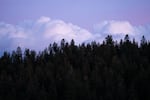
Dusk falls over a forested ridge in the Blue Mountains, north of Enterprise, Ore., on May 20, 2026.
Eli Imadali / OPB
Nearly 5 million acres of forest and grasslands in Oregon could see drastic changes under the federal government’s new draft plan for the Blue Mountain Forests. The draft, which was recently released to the public, proposes tripling the logging happening across three national forests in the state’s Blue Mountain region. While some are hopeful this could boost timber jobs that have declined in the region, others worry about the wider implications it could have on recreation and hunting.
April Ehrlich covers lands and environment for OPB. She joins us to share more about the plan.
Note: The following transcript was transcribed digitally and validated for accuracy, readability and formatting by an OPB volunteer.
Dave Miller: This is Think Out Loud on OPB. I’m Dave Miller. We start today with a proposal to completely overhaul the way a third of Oregon’s national forest land is managed. The Malheur, Umatilla and Wallowa-Whitman National Forests are collectively known as the Blue Mountains. They’re being managed under a plan that was developed in 1990, even though these plans are supposed to be revised at least every 15 years. That’s because twice now, efforts to revise the Blue Mountains plan have failed. Last week, the Trump administration unveiled its proposal for a new revision. It would more than triple goals for timber sales and eliminate regulations that protect large trees and sensitive habitat.
April Ehrlich covers land and environmental policies for OPB, and she joins us now. It’s great to have you on the show.
April Ehrlich: Thanks for having me.
Miller: Can you first just give us a sense for the scale of the land managed under this plan?
Ehrlich: Like you mentioned earlier, this covers three national forests. So there’s actually three separate forest plans, but we just call them the Blue Mountains Forest plans. Some people might know the Blue Mountains as a specific mountain range, but this is an entire ecoregion, covering all of those national forests. That equates to about 5 million acres, which is a lot to comprehend.
I did some of the math. It’s about the size of New Jersey, which I imagine probably doesn’t mean a lot to people here on the West Coast. So I looked at how many Portlands would fit in – about 54 Portlands. So if you think about how far it takes for you to get from Southeast Portland and Northeast Portland, imagine 54 of those. It’s pretty massive.
Miller: OK, a vast area. For people who haven’t been there, can you describe some of the landscapes?
Ehrlich: Again, it’s really big so it’s really diverse. So anybody who’s driven from Portland to Idaho has maybe seen a lot of the sagebrush and the agricultural areas and may think, “oh, this is very dry.” But you veer off of that freeway and you go down some of the forest roads and you just encounter this incredible landscape. It just feels like a hidden secret because a lot of people don’t really drive five hours from Portland to seek out these sorts of mountains.
But you see these huge peaks and these really big, rolling grasslands. There’s actually the largest intact grassland in the Pacific Northwest here, and I drove through it recently and it just kind of felt like it went on forever. We have wet forests where there are ferns, and then there are some dry areas where there’s sagebrush, and tons of rivers and lakes. It’s just huge and very, very gorgeous.
Miller: I mentioned in my intro briefly that these plans were created in 1990. They should have been updated twice since then. They haven’t been updated at all. Why not?
Ehrlich: It’s just been really contentious. The last time a plan was rescinded was in 2019. They were actually really close to finalizing it, but so many organizations came forward – something like 300 of them – and objected to the plans, and said we are not happy with this. The Forest Service was like, OK, we’re not gonna do it this time, we’re gonna rescind it and start all over again.
So yeah, we’ve been working on new plans since 1990. I think the crux of the issue is that there are some really contentious issues at play here and a lot of very passionate people, especially in an area where this region means a lot to people, in Eastern Oregon and people all around the state. [As] I mentioned earlier, there’s all these beautiful areas where people can get away from the city, just seek some solace or maybe hunt elk, which is also a really big part of the economy there.
Of course, there’s a lot of logging that used to fuel a lot of the economies there as well. People are just really passionate about it. They really need the Forest Service, an agency, to come and help piece apart those issues and find some sort of common ground. So far, it just hasn’t been able to do that.
Miller: So let’s turn to the proposal that was officially unveiled last week. There had been inklings of it in the weeks leading up to it. But what are the biggest changes under this revision proposal?
Ehrlich: Under the current proposal, it’s interesting because I think what stands out to a lot of people is the tripling of logging – that’s a huge increase. There are some speculations as to whether the Forest Service can even reach its goals. But that aside, I think another thing that has stood out to people I’ve been talking to is that it just doesn’t really touch on road densities or motorized access. Motorized access is like being able to drive through a forest in an ATV, in a snowmobile, in a car, truck, anything like that. That’s really important to some people because they want to be able to drive into those far reaching areas and collect wood or seek solace. If you’re a logging company, you want to be able to have roads and motorized access so you can do a timber sale.
But at the same time, that sort of motorized access can really inhibit elk and deer that migrate through the area, and it can also cause a lot of environmental issues like spreading invasives. So yeah, that’s kind of the big issue. It kind of feels like, from what I’m hearing, the Forest Service just didn’t even touch on it this time because it didn’t want to get involved with that conflict. And it’s maybe even trying to avoid what happened before where it just became so contentious that it had to rescind the plan.
Miller: What did you hear about this proposal from conservation groups?
Ehrlich: Like I mentioned earlier, the tripling of logging is something that environmental groups are especially concerned about. There are some questions as to whether the Forest Service can meet those timber targets. The milling infrastructure just isn’t really there in the local area. A lot of mills have closed. I don’t think there’s a single mill in Grant County. With diesel prices being what they are, timber companies are not likely to want to transfer that wood to a faraway mill.
Then, of course, there’s the issue of staffing at the Forest Service. They’ve lost a lot of staff, so can they even have the ability to be able to do all that logging? That aside, the thing is that these logging targets are gonna set the bar for the next 15 years, and environmental groups are especially concerned about that.
Miller: You mentioned elk hunting. What about hunters? What have you heard from hunters?
Ehrlich: Hunters share some similar concerns with conservation groups in terms of road density and motorized access. They’re concerned about motorized vehicles scaring away elk into other areas, particularly private lands. That causes a lot of issues for private landowners. Elk damage crops and cause a lot of havoc. But also, it turns elk hunting into an exclusive activity. You can only really hunt on private land if you know the landowner and they happen to have a tag for hunting elk.
So elk hunters appreciate some of the logging increases because that would create meadows where elk can forage. But in addition to that foraging area, [elk] also need a sense of security. They are not going to get that if there are a lot of cars driving through the area.
Miller: What would have to happen before this proposal is finalized?
Ehrlich: Right now, it is a draft environmental impact statement. That’s a fancy way of just saying it’s a draft plan. The Forest Service is going to accept public comments for the next 90 days. September 30 is people’s deadline to weigh in and provide their thoughts on what the plans say. Then after that, the Forest Service will issue a final draft environmental impact statement. It might have a month of accepting some final objections. Then a leader at the Forest Service will have to sign off on it. Then it’ll be finalized.
Miller: After decades of failed attempts though, is there reason to believe that this revision will be finalized?
Ehrlich: A lot of people are really unhappy with the current draft. There’s the hunters who don’t like the road densities or motorized access. There are motorized access groups who want to be able to access these lands, and they are unhappy with the fact that it doesn’t solidify motorized access in these forests. Then of course, the environmental groups are upset with the logging.
I think the only group who seem to be really happy with this is the logging industry and some local county officials. But I think even the people who are unhappy with the draft, as it stands now, really just wanna get it done. They’re tired of this process. We’ve been working on it for 20 years. I think they just really wanna close this chapter of their lives and move on.
Miller: April, thanks very much.
Ehrlich: Thank you.
Miller: April Ehrlich reports on land and environmental policies for OPB.
“Think Out Loud®” broadcasts live at noon every day and rebroadcasts at 8 p.m.
If you’d like to comment on any of the topics in this show or suggest a topic of your own, please get in touch with us on Facebook, send an email to thinkoutloud@opb.org, or you can leave a voicemail for us at 503-293-1983.