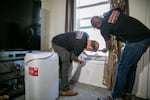
(Left to right) Rele Martinez and Eduardo Diaz with Cooling Portland install a new portable air conditioning unit in the home of a low-income resident of Portland, Ore, July 1, 2025. The Cooling Portland program, funded by PCEF money, is one aimed at providing portable cooling equipment to low-income Portland residents, prioritizing those who need it most.
Morgan Barnaby / OPB
It’s been five years since the Portland Clean Energy Fund, or PCEF, gave out its first grants. The fund has grown much more than expected, and various interests have proposed using some of it for non-climate goals. The Community Energy Project is among the local groups that helped create PCEF after voters passed the ballot measure in 2018. The Fund was designed to reduce carbon emissions to help get Portland to net-zero emissions by 2050, develop a diverse workforce and focus on populations most affected by climate change. Jim Plantico is one of the Community Energy Project’s program directors. He joins us to share more about the program, what the money is being spent on more broadly and the specific projects that CEP has implemented with PCEF grants.
Note: The following transcript was transcribed using AI and validated for accuracy, readability and formatting by an OPB volunteer.
Dave Miller: From the Gert Boyle Studio at OPB, this is Think Out Loud. I’m Dave Miller. It’s now been five years since the Portland Clean Energy Fund, or PCEF, started giving out its first grants. The fund was designed to reduce carbon emissions and develop a diverse workforce with a focus on the populations most affected by climate change. But the fund has grown much more than initially expected, and various interests want to use some of the retail taxes proceeds on non-climate goals. Community Energy Project is one of the local groups that helped create PCEF and has distributed some of the money that’s been collected. Jim Plantico is the in-homes program director at the nonprofit. He joins us to talk about what PCEF grants are actually being used for. It’s great to have you on the show.
Jim Plantico: Thank you, Dave. Yeah, so we at Community Energy Project have a grant through PCEF. Currently we’re just about to finish it, which was a $10 million grant to retrofit over 200 low-income Portland houses. And basically what that means is to do sort of energy efficiency upgrades in those houses from insulation to air ceiling to installing heat pumps, which are greatly necessary for seniors and folks with disabilities and other marginalized communities.
Miller: I want to hear a lot more about that, but can you just first remind us what the promise of PCEF was when voters approved it back in 2018?
Plantico: Back in 2018, this was a program that is a 1% tax on large scale corporations making over a billion dollars a year. So this is not a tax that is from local communities. This is a corporate tax on business licenses and those funds go into energy efficiency programs that support marginalized communities and low income groups.
Miller: My understanding is that you had been a general contractor before you joined this nonprofit, CEP, the Community Energy Project. Why did you want to join the nonprofit?
Plantico: So I was working as a contractor for over 10 years. I actually sold my business and was looking for other opportunities, hired a business coach. I was going to think about starting another business and that coach was like, well, maybe you’re really passionate in this type of work. Maybe you should do it in the nonprofit space in sort of a different perspective, and it was great.
Miller: When you say “this kind of work,” so as a contractor, you had some kind of a focus on resilience or climate adaptation or installing heat pumps or, I mean, were you doing similar work to what PCEF money is now going towards?
Plantico: For our program, similar work, the concept’s the same, we’re looking at houses and coming up with solutions to make that house more energy efficient. And I could do that as a for-profit business to folks that could afford it. And this work can be expensive. And so I was providing energy efficiency upgrades to houses that would make people pay a lot less in their utility bills, make their house a lot more comfortable, but you had to pay for that. And so by switching to the low-income groups, I was able to do similar type of work for folks that are really struggling to have a large energy burden in helping those individuals.
Miller: People in general who never would have been able to afford your services when you were working at a for-profit company?
Plantico: Correct, and I thought at the time that I kind of knew where sort of the low-income floor was as far as like the need out there, and it is much greater than I imagined. Seniors who are living on a fixed income and they’re paying high property taxes maybe and they just are struggling to live and if a piece of equipment, let’s say their furnace breaks down, they can’t come up with the $400 repair to maybe fix that furnace. And so oftentimes they live without heat for a long time until we come in to come up with solutions for them.
Miller: And in that case, say a gas-burning furnace as opposed to a heat pump, which the installation for which would be way more than $400, I mean we’re talking about thousands of dollars there.
Plantico: It is a lot more expensive, but I keep thinking that our seniors want to live in place. So by making these types of upgrades, we’re enabling our seniors to live in place for the rest of their lives. We’re providing cooling that they might not have had otherwise. And so they can live in a warmer climate more comfortably. Also, there’s just huge health benefits, because part of a heat pump filters air that just generally makes the living environment of a house much more comfortable for older people and people with disabilities.
Miller: What has Community Energy Project focused on with PCEF money over the last five years?
Plantico: So PCEF was designed to really focus on marginalized communities and sort of reaching out and I think that that’s really important with community-based organizations because when you look at the exterior of a house, you really don’t know the energy efficiency of that home. You don’t know the occupants of that house. And so it really takes an organization like ours to get into that home and have a relationship with the client and really advocate for that client to make these types of energy efficiency upgrades. Oftentimes our clients have never really had an experience with a contractor before and and for our clients it’s sometimes, people are very proud of their house and it can be kind of uncomfortable to let strangers into your most personal spaces.
Miller: How would people find you in the first place?
Plantico: So we have partnerships with other community organizations all over the city. A lot of our work is through word of mouth and so often our clients that we serve are the first on the block to receive these types of services. So they might be the first in their neighborhood to receive a heat pump or solar panels or something. And when those things happen, they tend to tell their neighbors, they tend to tell folks that are in their community and so we get a lot of traffic through just word of mouth and families telling other family members.
Miller: If you’re just tuning in, I’m talking now with Jim Plantico. He is the in-homes program director at Community Energy Project. It’s one of the nonprofits that’s gotten grant money from Portland’s Clean Energy Fund. We’re talking now partly because of the various kinds of pushes to use PCEF money for other initiatives or projects. What does it actually take for a homeowner, somebody to qualify for the work that you’re providing through this PCEF money?
Plantico: So with our grant specifically, it is for low-income individuals and so you have to fall below 80% of the median family income in the area. We also have a focus on working with marginalized communities, people of color, folks that have really been left out of sort of the other climate change initiatives and really are at the front lines of climate change.
Miller: So far we’ve been talking about the homeowners or people who are actually the beneficiaries of this work, but I mentioned at the beginning briefly, and we haven’t really dug into this yet, the people who are doing this work. What has this meant for the workforce?
Plantico: That is another massive change from what I’ve experienced. I got in this industry in 2009. I got a grant that subsidized my business and back in the day I was in a room with a bunch of white males.
Miller: I should say for people who don’t know, I can see you. You are a white male yourself.
Plantico: And just the amount of diversity that is brought into the industry and it is pretty special. 60% of the labor that’s doing this work come from marginalized groups. Seven out of nine of the contractors that are doing this work for us are coming from a diverse workforce. This is the first in my life that I’ve worked with such a diverse group of folks and it’s really nice because then it enables the clients that we serve to see faces that are familiar in the work that we’re doing. And so that is a just a real benefit of PCEF.
Miller: How do you think about the various current efforts to use PCEF money in different ways? I’m thinking in particular about the Moda Center renovation push and the Portland Police Bureau push.
Plantico: Certainly. I mean, I work for a grantee, I think that as part of PCEF’s initiative, it is workforce development. It’s bringing marginalized groups into the workforce. There is a clear energy efficiency component to the work that PCEF is doing with tree canopies and multi-family construction and that sort of thing. I don’t know so much about the diverting funding through a ballot measure for the police force. If the Moda Center has some sort of energy efficiency component that is going to bring diverse labor into the space, there may be an argument for that. I don’t know.
Miller: Jim, thanks very much.
Plantico: Thank you.
Miller: Jim Plantico is the in-homes program director at Community Energy Project.
“Think Out Loud®” broadcasts live at noon every day and rebroadcasts at 8 p.m.
If you’d like to comment on any of the topics in this show or suggest a topic of your own, please get in touch with us on Facebook, send an email to thinkoutloud@opb.org, or you can leave a voicemail for us at 503-293-1983.